$IONQ Niccolo de Masi just took the stage at Cantor Convergence
The CEO of IonQ sat down in Miami Beach with Jeff John Roberts, Finance & Crypto Editor at Fortune. Roberts asked him to explain how the quantum tech works.
Jennifer Rosenthal Maimon, comms chief at the DeFi Education Fund, was in the room and posted it live. In her account:
→ He said the quantum revolution is upon us, drawing a parallel with how fast ChatGPT and AI moved.
→ Roberts pressed him on what comes next.
→ His answer, which he called a bold prediction: cryptographic and cybersecurity risks will not go down from here.
On a stage built for finance and crypto, Niccolo de Masi made the case that the quantum revolution has arrived, and that protecting data is part of it starting now.
Reminder: IonQ has been building that protection layer by layer, with ID Quantique for quantum-safe networks and Elisity for zero trust access control across a company's network.
#IonQ #Quantum #CantorConvergence
Watch a single SAR collection transition from traditional imagery to Colorized Subaperture Imagery (CSI), highlighting man-made structures across this agricultural landscape.
Explore Capella's SAR capabilities: https://t.co/2jI7E4GDwW
$IONQ security chief Leslie Kershaw in Forbes
Leslie Kershaw, Chief Information Security Officer at @IonQ_Inc, is featured in Forbes. In a piece published on November 9, Heather Wishart-Smith brings her in on what leaders need to do before a quantum computer can break today's encryption (Q-Day).
Before IonQ, Kershaw was Chief Information Security Officer at Capella Space, now an IonQ company. Earlier, she held cyber leadership roles in the U.S. Space Force and at the National Security Agency.
Her first step, as Forbes reports it: make a list of every lock (the cryptography) a company uses and where. Only that list shows which locks to change first. She worries that AI is taking much of the attention and budget away from that work.
IonQ applies it to itself. Through Kershaw, Forbes reports that IonQ is implementing quantum key distribution (QKD) internally, keys sent on particles of light so any interception shows up, across a company that has acquired 11 businesses in the past three years. On October 26, IonQ had already shown a live quantum-safe network protecting its own data between Geneva and Seoul.
Her view reaches beyond security: "I look forward to the ability to cure diseases. I think quantum will allow us to unlock things with medicine that we haven't been able to do before," she said.
She spoke on October 8 in Tysons, Virginia, at Uniting Women in Cyber, the one-day conference of The Cyber Guild, a nonprofit, on a panel alongside Verisign's CTO Burt Kaliski.
That list is exactly where IonQ's offer starts, as laid out at Investor Day and with Elisity:
→ Map where a customer is exposed to a quantum attack
→ Add the cryptography each device runs and the risk it carries to Elisity's IdentityGraph (planned), to rank upgrades by business risk
→ Move to post-quantum encryption (PQC) or quantum keys (QKD)
→ Wall off older machines that can't be upgraded, like factory controllers or medical devices, until they are replaced
https://t.co/iFtUd1L8jw
#IonQ #QuantumSecurity #PostQuantum
$IONQ CEO on the quantum security race: “We’re here to help”
At Cantor Convergence, an audience member asked @NiccoloDeMasi which policies the US should put in place and which agencies should take on the challenge.
He predicts panics. Election cycles, distractions and gridlock slow governments down. Meanwhile China is already 10 years ahead of the US in investing in QKD (quantum key distribution, encryption keys that expose any eavesdropper), on the ground and in space. Europe is leaning in too, and the countries further east are leaning in harder. IonQ already runs quantum networks in a lot of Eastern Europe, where cybersecurity is seen as a cold war turning into a hot one.
Niccolo wants far bigger budgets for this, at the Department of War and across other agencies. He applauds the White House for the June 22 executive order (the first of its kind he has seen in the Western world), which mandates post-quantum cryptography (PQC). More is needed: on top of that software, the US will have to deploy QKD hardware. The only open question is when and where.
The scenario he wants to avoid comes around 2030. The West celebrates winning quantum computing, its Manhattan Project, and China answers: “Doesn’t matter, because I’ve QKD’d the whole country.”
IonQ is “spiky at both” (strong in computing and in defense). His offer to the room is direct: “We’re here to help.” He calls this the space race of the decade, and warns that bodies could start piling up in the streets once hospitals lose power and water treatment plants go off, even if today looks calm.
IonQ already covers both layers: it supplies the PQC software the executive order calls for, and deploys QKD hardware in Europe through ID Quantique’s national networks. When IonQ agreed in October to acquire Elisity, a network segmentation company, Niccolo said the deal would leave IonQ “well positioned to help customers protect critical infrastructure and enterprise networks throughout the transition to the quantum era.” At Cantor, he asked the room to spread the word and come see the team.
#IonQ #Quantum #CantorConvergence
This #VeteransDay, we honor the courage, dedication, and sacrifice of all who have served. 🇺🇸 To all veterans, including those across Capella and @IonQ_Inc, thank you for your service!
Congratulations to Oliver O’Brien at Cambridge's @DeptofPhysics!
Using @IonQ_Inc's Forte quantum computer, his research shows how measurement choices can improve quantum algorithm performance, demonstrating an advantage over classical methods under specific conditions.
https://t.co/TEcsmEeW5U
$IONQ Forte puts a 2007 quantum theory to the test
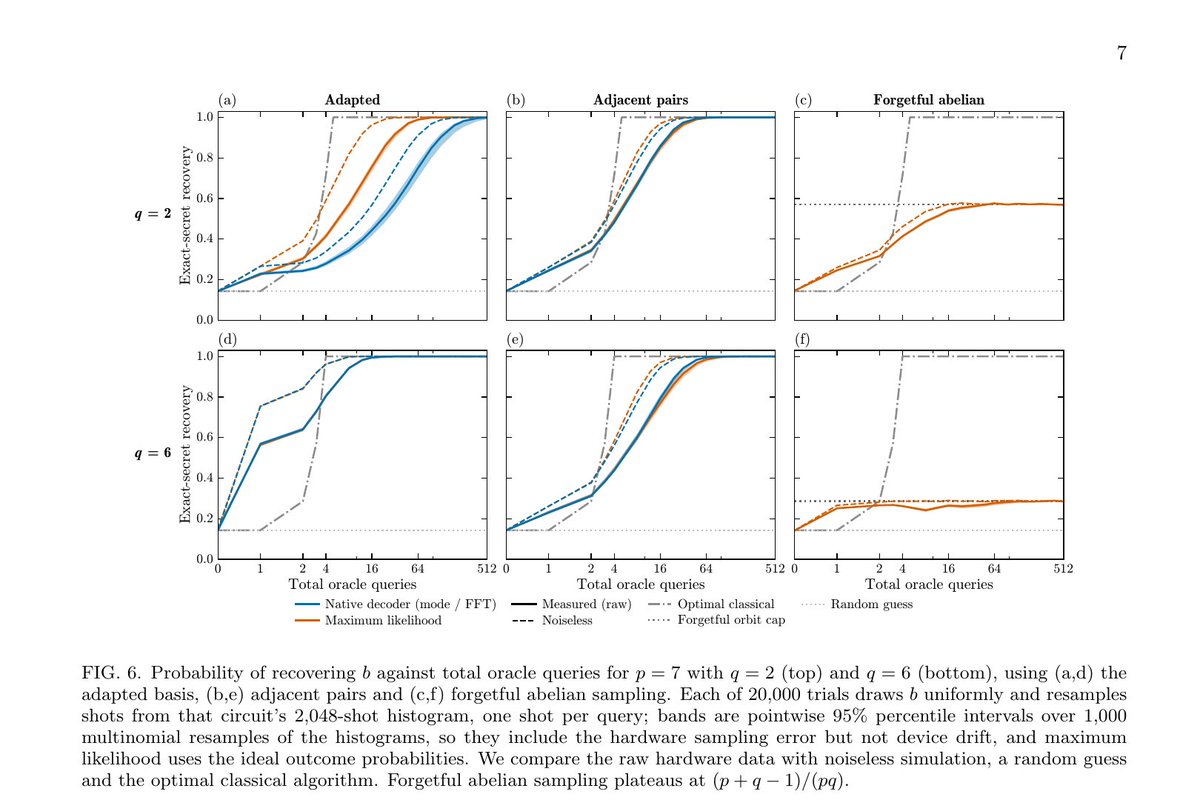
Oliver O'Brien, a researcher at the University of Cambridge (DAMTP), ran it on IonQ's Forte in October. @NadaHosking, Founder and CEO of @FormationQ_, presents it as the first research paper from the Quantum Technologies Accelerated Alignment Initiative, run by FormationQ with Cambridge's Cavendish Laboratory.
Picture a sealed box that hides a secret pattern (a hidden subgroup). You can feed it inputs and look at what comes out (queries), and you have to work out the pattern from that.
In its simple version, this puzzle sits under Shor's algorithm, the famous quantum method for breaking today's encryption. This study takes on a harder version, where the order of the steps changes the result (non-abelian). Some problems behind graph matching and behind post-quantum encryption built on lattices come back to this harder family.
In the harder version, a quantum computer can hold the answer and still give nothing away. Everything depends on how you read its qubits at the end (the measurement basis). In 2007, four researchers worked out on paper which ways of reading work and which fail.
O'Brien tested four ways of reading on Forte, end to end: 75 jobs and 153,600 runs over four days. The machine behaved as the theory said. One way of reading told nothing about the secret. The right way found it, at a success rate that tracks the 2007 formula, on real hardware with real noise.
What it brings: a theory that lived on paper for almost twenty years now has data from a real quantum computer behind it, and it shows the choice of reading decides whether you learn anything at all. To the author's knowledge, this is the first experiment to run this harder family of puzzles end to end.
The sizes are tiny, with numbers up to 7, and no encryption is at risk from it. The paper is a preprint, shared before peer review. The code and data are public.
We have followed this initiative since February, when FormationQ's £1,675,000 gift to the Cavendish included computing time on IonQ systems. In his thanks, O'Brien credits FormationQ and IonQ for his access to Forte. Nine months in, that link between IonQ, FormationQ and Cambridge has produced its first test of the 2007 theory on real hardware.
Congratulations to Oliver O'Brien and the Cambridge team.
New study
🔗 https://t.co/u0qzFIheI1
#IonQ #QuantumComputing #FormationQ
$IONQ researchers cut a quantum decoder's mistakes 610x
That is against the classic method it starts from (belief propagation, BP), in a computer simulation. Against two newer methods, including IonQ's own (beam search), it lets through 1.7 to 4.3 times fewer mistakes.
The work comes from Min Ye, Senior Staff Researcher at IonQ, and Nicolas Delfosse, who leads IonQ's quantum error correction team. They call it PriorTilt.
Qubits make little mistakes, all the time (errors). A quantum computer keeps checking its qubits in small groups, and when a check finds something odd, an alarm rings (syndrome). The alarm shows where to look. Someone still has to work out which mistake caused it.
That someone is a detective: a regular computer sitting next to the quantum one (the decoder). It finds which mistake set off the alarms, and the mistake gets fixed (correction), while the program keeps running. Each time the detective picks the wrong suspect, a mistake slips through and spoils the answer (a logical error).
The classic detective starts with a first guess about every suspect: how likely it is to be the culprit (its prior). Suspects and alarms swap clues again and again, and each guess goes up or down until one story explains every alarm. Sometimes the clues go round in circles, and the case gets stuck.
PriorTilt lets the detective work as usual for a while. If the case is still stuck, the detective changes its first guess about only the few suspects still unclear, and keeps all the clues gathered so far. Fewer than 1 suspect in 200 gets this second look each time, on average. The detective repeats this until the story fits or time is up.
Fewer missed mistakes means a quantum computer can run longer calculations before one slips through. The paper explains that this family of error fixing codes (qLDPC) can protect information with fewer qubits, and that it needs a detective both accurate and quick.
The detective runs on an ordinary computer chip. On a single core of a laptop chip (Apple M3 Pro), PriorTilt was faster on average than the two newer methods. In September, IonQ already showed its real-time decoder running on a single laptop processor.
Two of the three codes tested use circuits from Walking Cat, IonQ's plan for a trapped-ion quantum computer that fixes its own mistakes as it runs (fault tolerance). The authors add that staying this close to the classic detective may make PriorTilt easier to build into hardware.
These results come from a computer simulation, and the paper is a preprint, shared before peer review. The code is public.
Congratulations to Min Ye and Nicolas Delfosse.
New study: PriorTilt
https://t.co/iMkoAPTGhA
Code
https://t.co/9gQ2HEBGLk
#IonQ #QuantumComputing #QEC
■ IONQ, 니콜로 CEO가 양자컴퓨팅 경쟁을 1942년 맨해튼 프로젝트에 비유했다.
당시 각국에 “원자폭탄까지 얼마나 남았나?”라고 물었다면 답은 제각각이었다.
중국 15년
소련 7~10년
독일 5~10년
로스앨러모스 2년.
결국 중요한 건 ‘가능한가’가 아니라 누가 얼마나 빨리 현실에 도달하느냐였다.
양자컴퓨팅도 지금 비슷한 상황이라는 니콜로CEO의 주장이다.
어떤 팀은 10년이 필요하다고 하고, 어떤 팀은 2년을 이야기한다.
그리고 IonQ는 이렇게 말한다.
“우리는 30년 동안 해왔다.”
① 1994년 첫 양자 논리 게이트
② 2020년 최초의 상장 양자컴퓨팅 기업
③ 내결함성 양자컴퓨팅 로드맵
④ 20,000큐비트 규모의 암호해독 연구
⑤ 특허·IP·인력·현금·매출을 갖춘 현재의 규모
특히 중요한 건 시간표가 구체화되고 있다는 것이다.
올해 공개된 연구에서는 내결함성 양자컴퓨터의 다음 세대 로드맵이 제시됐고,
20,000큐비트 수준에서 타원곡선암호(ECC)를 해독할 수 있다는 게이트 수준 연구도 등장했다.
ECC는 일부 국가·블록체인 등을 보호하고 있고, RSA-2048은 금융·통신·정부 등 광범위한 인프라의 핵심 암호체계다.
과거 수백만 큐비트가 필요하다고 여겨졌던 암호해독에 필요한 하드웨어 규모가 5자리 수 수준까지 내려왔다는 점도 중요하다.
더군다나, 알고리즘과 소프트웨어가 계속 발전한다면 현재 예상되는 암호해독 시점이 다시 앞당겨질 가능성도 있다.
결국 양자전쟁의 핵심은
“누가 가장 많은 큐비트를 가지고 있느냐”가 아니라,
“누가 먼저 오류를 수정할 수 있는 실용적 양자컴퓨터를 만들고, 실제 문제를 해결하느냐”다.
------
물가가 오르니, 금리도 오르고, AI혁명의 일등 공신인 사람은 불륜사건으로 물러나게 생겼다.
이런 매크로와 소음을 다 꺼보자.
양자의 가장 빠르고 큰 쓰임새는 보안에 있다는 생각만 남는다.
그럼 누가 가장 잘하는가?
1942년 맨해튼 프로젝트에서도
모든 팀이 같은 속도로 달리고 있었던 게 아니다.
시간의 격차가 승자를 만들었다.
IonQ의 가장 큰 무기는 바로 그 "시간의 격차"이다.
#IONQ #Quantum #QuantumComputing
More solid progress on error correction from @nic_delfosse and Min Ye at $IONQ.
Their new PriorTilt decoder is a simple software tweak that makes quantum error correction far more accurate. It only adjusts a tiny fraction of the guesses inside a standard decoding method, yet it cuts remaining errors by hundreds of times on efficient quantum codes—while still running faster than more complicated approaches. The advance is notable because it shows how a minimal change to a standard decoder can deliver order-of-magnitude gains in error suppression, making efficient quantum codes far more practical for large-scale, fault-tolerant computation.
$IonQ Fireside Chat
Cantor 2026 Convergence Conference
Replay of IonQ CEO Niccolo de Masi’s conversation with Fortune’s Jeff John Roberts.
https://t.co/J7DcP4cmA2
$IONQ - Quote of the day from Niccolo: “Just because bodies are not piling up in the street yet, doesn’t mean they won’t be.”😂
This is a must watch. There’s a lot of meat on the bone here.
$IONQ CEO: the quantum race looks like the 1942 atomic race
At Cantor Convergence, Fortune’s Jeff John Roberts asked @NiccoloDeMasi to break down the Manhattan Project analogy he had made backstage.
Niccolo took the room back to 1942. Ask the atomic bomb teams how far along they were, and you would have heard “15 years out” in China, 7 to 10 years in the Soviet Union, “subject to stealing IP,” 5 to 10 years for the German team, “subject to resources.” One team, at Los Alamos, “was two years out.”
He sees “the same wide spread in quantum computing right now”: some will tell you a decade, others two. “But in the case of IonQ, we’ve been at it for 30 years.” Those of us who have followed IonQ from the start know the milestones: the first quantum logic gate in 1994, the first public company in the sector in 2020, and today “the largest quantum company in history” by revenue, balance sheet, market cap, patents, IP and people.
Then come the two papers we have followed this year. In April, the blueprint for fault-tolerant quantum computing (machines that correct their own errors), with the next three generations of IonQ machines spelled out. Two months ago, the gate-level paper on cracking elliptic encryption with 20,000 qubits, “roughly 2028 in the lab,” probably 2029 in the real world.
Elliptic encryption protects some nation states and the blockchain. RSA 2048, used by banks, telcos and most nation states, comes “probably a year after” on the roadmap, and “civilization as we know it relies on RSA 2048.” The hardware needed has fallen from “a million qubits” to “five figures,” and he expects progress on algorithms and software could bring the date forward again within the next two years.
In 1942, the gap between teams decided the race. Today, IonQ is the one that has already put its timeline on its public roadmap.
#IonQ #Quantum #CantorConvergence
$IONQ CEO: code breakers lead for the first time since Enigma
At Cantor Convergence, Fortune’s Jeff John Roberts put it to @NiccoloDeMasi directly: “You’re saying some pretty bleak stuff backstage. How bad is it going to be?”
Niccolo’s answer: in the last few months, the momentum from code making to code breaking “has shifted for the first time in probably 50, 60 years.” The only comparable moment he can name is Bletchley Park and Enigma in the 1940s.
The attackers want quantum computers too, and they will try to copy, steal and catch up. “They are behind us, fortunately, but they’re not decades behind us.” “They’re years, hopefully. Quarters, worst case.”
His conclusion for everyone in the room, “whether or not you run a company or a country”: “You’re at the trough of cybersecurity risk you’re going to experience for the rest of your life right now.” IonQ’s lead is the time to build the defense, and the company can help on both sides of this race today (code breaking and defense).
#IonQ #Quantum #CantorConvergence
I joined @jeffjohnroberts of @FortuneMagazine for a great conversation today @cantorfitzgerld Convergence in Miami.
IonQ builds both leading quantum computers and the quantum security needed to defend against them, and we manufacture it all on U.S. soil. Jeff and I talked about what that means right now, including how AI and quantum are changing the cyber threat, and what quantum readiness means for blockchain and digital assets.
I shared how we think about a layered approach to security, from post-quantum cryptography to quantum key distribution, and why the White House’s recent executive order matters. And we discussed why owning our foundry and a domestic supply chain is so important for scale and national security.
Thanks to Jeff and Cantor for the conversation:
https://t.co/fptG0ngTeK
#IonQ #QuantumComputing #QuantumSecurity #CantorConvergence
$IONQ CEO: built to scale, locked against copying
At Cantor Convergence, right after the Manhattan Project analogy, Fortune’s Jeff John Roberts pushed further. The bomb was figured out almost a century ago, yet people still can’t build one because the uranium has to be processed. Once quantum is cracked, could everyone replicate it within the same year?
@NiccoloDeMasi split it in two. Can IonQ build a thousand machines once it has built the first? “There’s no one else like us.” IonQ makes its own chips and its own machines, and with SkyWater, the foundry it acquired, it can make millions of them. The parts for one machine still cost eight figures, not ten.
He adds that NVIDIA picked IonQ because its machines can sit in a data center without getting vibrated out of alignment.
Can people copy it? “That one’s definitely no.” IonQ spends heavily on physical and digital security, runs maybe two or three top secret facilities, and a couple hundred of its people hold security clearances, Niccolo included. That makes IonQ a partner for the United States and the Five Eyes (the intelligence alliance of the US, UK, Canada, Australia and New Zealand).
A machine you can build by the million also has to stay impossible to copy. Niccolo has “no intention of letting people steal our IP at any point in the future, because we’ve seen this coming for quite some time.”
#IonQ #Quantum #CantorConvergence
$IONQ : cyber risk will never be lower than it is today
"You're at the trough of cybersecurity risk you're going to experience for the rest of your life right now."
@NiccoloDeMasi said it in Miami Beach at Cantor Convergence, in front of a room full of finance and crypto leaders. Across from him, Jeff John Roberts, Finance & Crypto Editor at Fortune, had warned the audience the panel would be "a little bit scary."
Niccolo took them back to 1942. Ask the teams racing to build the bomb how far along they were, and the answers ran from 15 years to two. Quantum has the same spread today, and IonQ sits at the short end: 30 years of work since the first quantum logic gate in 1994, about $6 billion invested, a place among the very few in DARPA's Stage C, and the first partner NVIDIA chose for its Boston data center, because its machines can sit in a data center "and not get vibrated out of alignment."
Roberts asked whether anyone could simply copy it. IonQ makes its own chips in its own foundry, with a supply chain entirely in the US, and can build "millions of machines." His words: "There's no one else like us." Copying the know-how? "Definitely no."
The track record backs it up. Revenue went from $40 million in 2024 to $130 million in 2025 and over $500 million this year, with the goal of becoming "a multi-billion dollar revenue company" within three years. IonQ has hit "not just financial guidance the last 5 or 6 years, but our technical guidance as well." "Quantum is now, it's inflecting now."
That head start is why IonQ can describe the threat so precisely. In April it published how it will build a machine that corrects its own errors. Two months ago came a paper showing that 20,000 qubits could break elliptic curve encryption in 26 or 27 days, roughly 2028 in the lab, written in consultation with the NSA with the final details withheld. RSA 2048, the lock banks and telecoms rely on, follows about a year later.
The attacks have started without quantum. In the last month alone, nations from Italy to France to Japan to Malaysia were hit, along with the FBI and DHS websites and Binance, and French and Italian supermarkets lost cooling power. AI models are only getting started, and once they work with powerful quantum computers they will do "even more dastardly things." He expects a "historically large uptick in investments in cybersecurity defenses."
Then Roberts asked: "You're saying some pretty bleak stuff backstage. How bad is it going to be?"
Niccolo answered straight. For the first time since Bletchley Park and Enigma, code breakers have the momentum over code makers. The bad guys are "years, hopefully. Quarters, worst case" behind. Data stolen today will be decrypted later, and the world will truly focus "when you start losing power to hospitals and water treatment plants go off."
The race is global. China invests 10 years ahead in quantum key distribution, on the ground and in space, and could one day say: "I might be behind you in… cryptography, but I'm ahead of you in defense." In Europe, the countries further east lean in harder, because they see an "increasingly hot war that's happening in cybersecurity," and IonQ already does quantum networking across a lot of Eastern Europe. "We're spiky at both," computing and defense.
His answer comes in three layers: lock down the network, move to the post-quantum cryptography the White House mandated on June 22, and put quantum key distribution at the core of data centers, "because it's unhackable." In his words, IonQ is "the largest QKD company in the Western world," and its customers with "a strong security posture" never make the news. To the crypto crowd in the room: "Come and find me."
Cyber risk will never be lower than today. Niccolo's message: act now instead of waiting for the panic, and be "the hardest target." IonQ is in a position to help every company and every country get there, from the chips to the networks. "We're here to help. Please, genuine offer, please do spread the word."
#IonQ #Quantum #CantorConvergence