1/ I just read @MattSheehan88’s new piece in Carnegie and it's a great takedown of the one argument that kills every attempt to regulate AI: "do that and we hand the lead to China." The record says otherwise. 🧵https://t.co/i0u2sB96SF
The thing that blows my mind about Palantir is they've chosen the name of a wondrous seeing stone that was secretly debased by Sauron and ended up corrupting and destroying all who used it.
This argument keeps misdescribing what China’s actual sources of competitiveness are, then treating those bad descriptions as explanatory.
Rather than rebut every bad conclusion, it's more useful to identify and refute the false premises causing most of the damage. Let's go:🧵
Here's an excerpt from a talk I gave a few years ago on the complexity:
___
A second precept or maxim I think we should all take up is that we should strive to understand the optical properties of the lens – the lens through which so very much of the information we get about China ultimately filters. What I mean, mainly, is the media – though this is true to some degree in the academic research and the analysis we read as well. Let’s focus for now, though, on the media, because it serves as the nearly exclusive source of knowledge for anyone who isn’t a specialist in China, either studying the language, or the politics, or the history, or the economics or what have you currently at a college or university, or working in a field related to China. Even specialists depend on the media for a huge amount of their intake concerning China.
I believe there is much to be admired in most of the journalists who’ve shaped the American understanding of contemporary China. On balance, they are idealistic and principled individuals. They didn’t go into journalism to get rich. They are, by and large, dedicated to bringing truth to light and to fact-based reporting. They are, if I may generalize, more skeptical than average people. They even lean toward cynicism, despite their idealism. As idealists, many of them have a streak of activism, too: Their instinctive sympathies are with the oppressed, the downtrodden, the marginalized. They root for the underdog. They’ve “followed the money” and pulled off tremendous feats of forensic accounting. They’re resourceful and persistent. They’re admirably brave: they work in the face of surveillance, harassment, the threat of detention or expulsion.,
I love that journalists have this adversarial approach when they’re reporting on things here in the U.S. You’ll hear variations on a quote, often attributed if incorrectly to George Orwell: “Journalism is printing what someone else does not want printed; everything else is public relations.” Journalists in the Anglophone West at least have an idea of themselves as speaking truth to power, of ferreting out misdeeds by the mighty, whether in government or in business. I’ve certainly cheered on our journalists in the last couple of years as they’ve bravely faced an administration that’s always screaming “fake news” and calling them the “enemy of the people.” Watching journalists boldly go after the uncountable instances of malfeasance and skullduggery in the present U.S. administration it’s hard, for someone like me at least, not to be genuinely impressed and even inspired.
But even now when I open the paper and read a dozen, sometimes more, articles that by themselves would make me believe that the end is nigh and that America is basically in flames – about the shooting of innocent motorists, about suicides, about gun violence, about corruption and overdose deaths and hate speech – I still have the rest of the paper, about the more mundane things, even about some happy things. And more importantly, I have my own lived experience of the United States. I know that I’m going to come home and my wife will be pruning roses and my son will be playing Fortnite and my daughter will be enthusing about the latest release from the K-Pop band BTS. I know we’re going to go to Costco, and to grill, and watch Netflix.
But when I as an average American who has never lived in China or studied it seriously in an academic setting sit down with my paper and read six or seven stories that touch on China, and most of them are negative, I simply don’t have that same context. There aren’t numerous other stories, less sensational and less stridently critical, to dilute down my impression; and of course I don’t have the lived experience of China. My impression, then, is going to be formed without that counterbalance. And the China that emerges is one formed of all these negative impressions. China becomes a place defined by political repression, a toxic environment, venal officials and a crass nouveau riche.
Should the mission of foreign correspondence be changed, then? It’s a question others have asked, too – writers like Peter Hessler, who has had the luxury of writing in a space that allows him to unpack tons of context and introduce a living, organic picture. This is urgent, especially when writing about a country as different as China, a country where the historical context matters so very much, where the potential consequences of misunderstanding are so dire, I think that it must be. In an ideal world, foreign correspondence on China would be like Peter Hessler’s: it would be able to provide more context, fill in more relevant history, offer a broader perspective and remind readers of how far things have come. It would avoid imposing American ideological frames on issues and strive to convey, to the American reader, a better sense of what Chinese priorities are, and what the Chinese lived experience has been.
Reporting by reputable Western media outlets may very well be accurate. But often it doesn’t quite add up to realistic. The stories don’t, in other words, convey a sense for what China is really like.
I’m reminded of something that Jiayang Fan, a staff writer for The New Yorker once said. Speaking on a panel at the New Yorker Festival with other China correspondents for the magazine, she was asked what it’s like for her, as someone who was born in China and spent her childhood there, to read the reporting on China in western publications. She said that it reminds her of looking at an x-ray of a familiar body part – of her hand, say. The x-ray image of her hand is literally penetrating, and very accurate: all the bones, in their exact relation to one another, invisible to her naked eye. But for all its anatomical precision, the image just isn’t her hand. It doesn’t have the flesh, the muscle, the sinews and tendons and blood vessels that make it her own organic, living hand.
Unfortunately, it’s unrealistic to expect that this will change. The constraints are too many. Keeping a reporter in the field is expensive, and in a time of tight budgets and struggling media outlets, growing bureaus – and having them in more cities around China – is not going to happen. Reporters aren’t going to suddenly start doubling or tripling their output. They will still, by the inexorable force of many structural factors, select stories that are not quotidian. They will keep writing about the bridge that collapsed, and not the thousands that didn’t. They’ll avoid the dog bites man story, choosing instead the man bites dog. They will go to one of the precisely three types of China stories, as categorized by Jamil Anderlini, the bureau chief of the Financial Times: Big China, Bad China, and Weird China.
Alas, most of us decide what outlets we like and what reporters we trust based not on the assiduousness with which they report, or their ability to succinctly provide relevant context, but rather it’s based for most of us on whether their reporting confirms our preexisting biases and beliefs. This is very hard to get over. And as those pre-existing biases become part of our mental furniture, as these narratives harden, it becomes even harder to change them.
So let’s understand that there will be bias in the reporting you read on China. That doesn’t mean that there’s some coordinated campaign to smear China. We’re talking about a relatively small number of individuals with an outsize ability to shape our views on this massive nation of 1.4 billion people. Together they form a kind of lens through which we view China, and we simply have to take some time to think about the way that this lens tends to distort and diffract the light passing through it.
Sometimes it’s not structural, and the bias is more straight-up: Using words that have become unquestionably pejorative, like regime used to describe a government (we only use it for governments we don’t like, thus one never hears about the Trudeau regime, the Macron regime, the Abe regime) – but the Maduro regime, the Putin regime, the Xi Jinping regime.
Watch out also for this tendency to treat China as some kind of monolith, but keep in mind – even when you find glaring instances of this – that Beijing also deliberately projects an image of China as monolithic, and be forgiving. Still, let’s hold our own media to a higher standard: When a local government enacts some bad law, let’s call it out when the report says “China” enacted that law. Imagine, as you often should, what it would look like in reverse: What would it look like if a school district in Arkansas bans the teaching of evolution in public schools, say, and you read a headline that said, “U.S. bans teaching of evolution.”
Debris from our recent hotfire anomaly may wash ashore in the coming days/weeks. If you encounter any debris, do not touch or approach it for your safety.
Please report the location immediately:
Call: 1-321-222-4355
Email: [email protected]
In the 21st century, uncertainty—unknown possibilities—is not a bug, but a feature.
Designing industrial policy under such conditions requires more than pivoting away from neoliberalism.
It means not simply picking winners but discovering them. And once they are discovered, it is essential to tailor support beyond the usual toolkit of tariffs and subsidies.
https://t.co/p2ebmGydh4
The Von Braun Wheel - Building Humanity’s First Rotating Space Station
https://t.co/kRzs8XPnR8
Before NASA, we had a plan for a rotating space station. The Von Braun Wheel could be humanity’s first step toward artificial gravity, orbital habitats, and permanent life beyond Earth.
I planned this one as a region-by-region tour: how is the Global South reacting to Trump and Putin summits?
@eolander's answer, in the first ten minutes: mostly, it isn't. What looked like the absence of a story turned out to be the story. New episode 👇
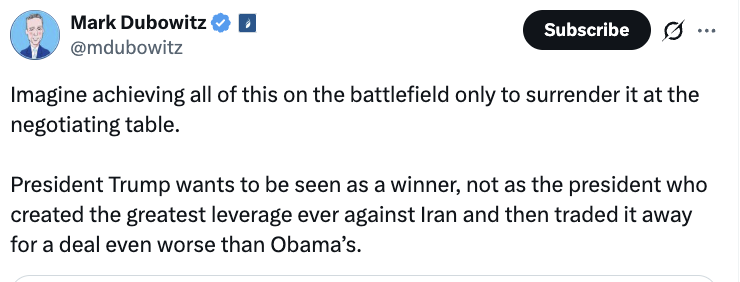
The warmongers and the pro-Israel crowd have been freaking out for the past 36h publicly. With Trump announcing a deal just now, the freakout will crescendo.
Netanyahu will likely be more muted publicly. He cannot afford to confront Trump publicly, particularly not as he is gearing up for elections.
But the voices in Washington that often act as his proxy will be loud, desperate, and reeking of despair.
The issue here is that guys like Mark pushed to start this disastrous war and now Trump is left with only bad options to end it. But the neocons never pause to think…hmm maybe the stupid regime change wars are the real problem?
My mate Bouncer died yesterday. He’d lived with us for 13 years as a furry, purring, permanently migrating ornament.
I didn’t know I could feel such grief for a witless bag of bones who destroyed my favourite sofa and crapped in the shower tray.
Below is a picture taken on the day he selected me at the animal shelter.
One of the key challenges in tracking low-speed, low-altitude targets such as drones is the radar's minimum detectable radial velocity (or minimum radial speed for tracking).
1/4
Don’t Panic: A Guide to Artificial Intelligence
https://t.co/Gq5bvOc62V
Artificial intelligence is changing the world, but not quite the way headlines suggest. Here’s a calmer look at AI’s risks, limits, and real potential.
After reading it, I'm trying to understand the point of emphasis. If it is that drones provide a cheap alternative to air forces or indirect fires, he's absolutely correct. However, the technology behind them is hardly new. Want a small man portable system capable of killing a tank which is controlled by a 15km fiber optic cable with a camera in the nose? Welcome to the 1980s FOG-M and 1990s EFOGM. Nations like the US do not need the use of drones to kill the enemy, they are pretty good at it without drones. What they do need to do is to prevent drones from other nations from killing them, which reduces the problem set and associated cost. That's not to say that the US cannot use drones offensively and indeed it plans on doing so when suitable, they're cheaper than Tomahawks after all, but war doesn't stop in bad weather conditions which limit drone activity and cold weather does do a number on battery life.
The Ukraine conflict is both understating and overstating the effect of drones. Currently Ukraine runs four people per drone and the typical reaction time for a "call for fire" is about 20-30 minutes. That's not going to stop an armored brigade. On the other hand, we can also assume that drones will become more responsive and less manpower intensive and thus more dangerous.
On the other other hand, counter drone defenses are a major source of effort. He mentions lasers, but not microwaves. It's possible to harden a drone, but it makes it more expensive with a smaller payload. It's possible to put a computer into a drone for autonomous operation or even swarm operation (Remember the BAT munitions being kicked around a while ago?), but again that makes things heavier and more expensive. In effect, the drone will turn into just another guided missile. (And is it really that much cheaper than firing off a couple of 155mm BONUS rounds, which will get to the vicinity of the target 20km away in 2 minutes?). And of course you have the RWS modifications which are installed on an sorts of vehicles. 7.62mm is plenty good enough to kill a drone, systems like the Bullfrog are showing great promise on such mini-CIWS concepts. Indeed, the difficult bit isn't keeping a modern armored formation alive, it's in keeping an unarmoured formations (and the sustainment elements) alive. The M1 tank already has an RWS mounted on its top, kindof hard to fit one to a rifleman's helmet. Currently the only place on the front line of Ukraine more dangerous than being in a tank is being not in a tank. Overall the US Army's position is that the overall threat of drones can be mitigated to a level akin to that of the ATGM or artillery. Something you need to respect and take measures against, something which will cause losses even if those measures are implemented, but not something which will stop you.
From the purely economic perspective, indeed, the drone era has made even small militaries far more effective, but that can be mitigated. More importantly, one must avoid falling into the Jeune Ecole trap of thinking drones make other assets obsolete instead of complementing them. To a large extent, you get what you pay for, and drones, even by the score, do not provide the same "right here, right now, no matter the conditions" capability that more expensive assets can provide.
For a pretty in depth discussion on the problems and limitations, look up the Army Futures Command youtube channel and the 6 hours of public panels for the problems of the Ground Air Littoral.
As an aside, his assessment that drones were decisive on the Nagorno Karabach war is disputed by analysts. They were more, in gamer terms, a win-harder card, but what won was proper application of combined arms of which the drones were a part combined with determination. Example https://t.co/UmNaNg21fI