Eight-year-olds are told in one classroom video prepared by HMRC:
“You can think of tax as one shared bank account that everyone in the country pays into. The government is then in charge of looking after this bank account and sharing all the money to help everyone in the country. This money is also used to pay for the things that your town or city needs. When you’re older and you get a job, or maybe even start your own business, the taxes you’ll pay will all be added into this shared bank account."
Slavery was an evil in which people from every continent and region participated. We should be honest about the whole history, not select the parts that are politically convenient today, especially given Britain's leading role in ending the transatlantic slave trade.
If Caribbean countries are asking Britain for a formal apology for Britain’s role in the transatlantic slave trade, will they also be asking the same of the descendants of African kingdoms, rulers and merchants who captured, sold and profited from the trade?
On demands for reparations, whether through cash or debt relief, we have been down this track before. Twenty-five years ago, Jubilee 2000, Drop the Debt and Make Poverty History argued that cancelling the debts of poorer countries would give them a fresh start. More than $100 billion of debt was eventually written off, but many of those countries have since built up even bigger debts. Labour are already spending too much on Britain's welfare state, now is not the time for Andy Burnham to be providing global welfare.
There is no reason British taxpayers today should be held financially responsible for things that happened generations before any of us were born. And I have even less patience for political elites in commonwealth countries who don’t know how to make their own citizens prosperous now looking for another opportunity to blame Britain.
As Prime Minister, Andy Burnham should be Britain’s greatest defender. Instead, he is writing articles saying we need to confront our history (as if we haven't done enough of that) and considering another formal historical apology. Tony Blair already expressed Britain’s deep sorrow and regret for our role in the slave trade nearly twenty years ago. There is no need to do so again.
This is all another navel-gazing distraction. The Commonwealth should be looking forward, not endlessly backwards. That means economic partnerships to make us all richer and deeper military and security cooperation against common threats. If every Commonwealth summit becomes an exercise in presenting Britain with demands for cash then we need to start asking if it is worth the effort.
How did I miss this jaw-dropping anecdote from Lucie Kon @imluciekon last week.
Apparently a BBC diversity officer told a Jewish staff member, who’d been trying to set up a Jewish BBC support group a few years ago, that it wasn’t needed “because Jews run the media”.
A ‘Diversity, Equity and Inclusion’ officer.
This is just dystopian now.
(@DailyTPodcast int here: https://t.co/MuMQT3Gdlb)
@bt_uk We’ve had no broadband (fibre-optic) since Sunday at CA5 7HW. What is odd is that some of our neighbours are still connected. No visible signs of damage. I’ve asked our MP @MCSavours to help as BT is utterly unresponsive and communicates only via bots.
@turnersophiegrn UK has 40 GWh of long term storage.
Royal Society estimates a weather dependent electrified grid will require around 60,000 to 100,000 GWh.
Can you give us an estimate of the additional cost of the storage investment that you believe can't wait, Sophie?
https://t.co/j7IAmzxXza
UNBELIEVABLE 😵💫
Man Arrested in England for Shouting “Come On, England!” Near Pro-Palestinian Protest
In England, a man walking near a pro-Palestinian demonstration was arrested by police after simply shouting, “Come on, England! Come on, England!”
Financial regulation like Basel 1-2-3 and modern central banking as applied by Greenspan , Bernanke , Yellen & Powell created an even greater risk than they sought to mitigate : it deindustrialised the US ( and the entire west ) to the point where it can no longer reliably produce the goods required to defend itself.
The idea that a functional, sovereign state can sustain itself by reducing its productive capacity to a services economy, reliant on asset-inflated wealth and debt-fuelled consumption, was the great economic delusion of the 1990s.
The inevitable result is a financial economy increasingly disconnected from the material economy that underpins it, where asset prices rise, private debt expands and paper wealth accumulates while the industrial capacity required to manufacture the physical goods on which national prosperity and security depend , steadily erodes toward existential doubt .
Eventually, your geopolitical rival is not merely producing more cheaply ; it is manufacturing the machinery, electronics, materials, components and defence systems that you can no longer produce yourself.
You become financially wealthy but materially dependent, capable of financing your own defence in theory but incapable of manufacturing it in practice. A nation that cannot manufacture the material foundations of its own security is not truly sovereign; it is dependent on the continued willingness of others to supply the means of its survival.
So called central banking independence was used to channel workers wages into a fully financialized bankers economy that literally can’t produce the goods it needs to defend itself or remain independent .
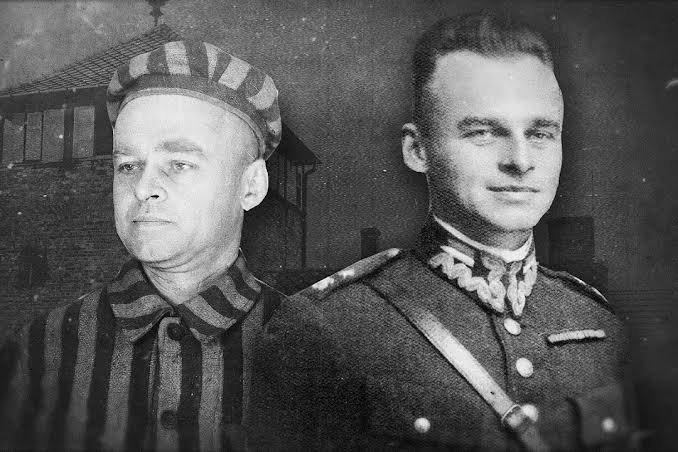
Witold Pilecki was a Polish cavalry officer and resistance leader who voluntarily let himself be captured by the Gestapo in September 1940 to infiltrate Auschwitz and expose Nazi atrocities...
Inside the camp, he formed the Union of Military Organizations (ZOW), building a secret network that shared food, boosted morale, used the camp hospital to save inmates, and planned for a potential uprising. Pilecki compiled some of the first comprehensive intelligence reports detailing the camp's mass executions, selections, and gas chambers, smuggling them out to the Polish underground and Western Allies. After nearly three years in the camp, Pilecki escaped in April 1943 alongside two fellow prisoners.
. . .
A Polish resistance officer deliberately allowed the Nazis to send him to Auschwitz. On September 19, 1940, Witold Pilecki entered a German roundup in occupied Warsaw, accepting capture as part of a secret mission. His task was to discover what was happening inside the concentration camp, organize resistance and transmit information to the Polish underground. He survived more than two and a half years in Auschwitz and escaped in April 1943. Yet after the defeat of Nazi Germany, Poland's new communist authorities arrested him, subjected him to a political trial and executed him on May 25, 1948.
Pilecki's mission began while the German occupation was expanding its system of terror against Polish society. Auschwitz had been established in 1940, initially imprisoning large numbers of Polish political detainees before developing into a major centre of mass murder. Reports of brutal treatment and deaths were already reaching underground organizations, but reliable information remained difficult to obtain. Polish resistance leaders wanted someone inside the camp who could establish clandestine contacts, gather evidence and prepare prisoners for possible coordinated action. Pilecki accepted the assignment and entered the roundup using the false identity Tomasz Serafiński.
He arrived at Auschwitz on September 22, 1940, and was registered as prisoner number 4859. Inside the camp, Pilecki began forming an underground organization known as the Union of Military Organizations. Its members attempted to assist vulnerable prisoners, exchange information, strengthen morale and maintain contact with resistance networks beyond the barbed wire. The work was extraordinarily dangerous. Discovery could result in torture, execution or punishment of fellow inmates. Pilecki and his associates nevertheless collected intelligence about conditions in the camp and the crimes being committed there. Information was sent out through released prisoners, escapees and clandestine contacts.
His reports became part of the Polish underground's efforts to inform Allied authorities about Nazi persecution and mass murder. The Auschwitz-Birkenau Memorial confirms that information associated with Pilecki reached the resistance outside the camp before his escape. His testimony was important, but it would be inaccurate to claim that he alone revealed the Holocaust to the world. Many prisoners, escapees, Polish underground members and Jewish organizations contributed to the flow of information about German crimes. Pilecki's distinction was the deliberate nature of his infiltration, the organization he helped build and the exceptional risks he sustained over an extended period.
On the night of April 26–27, 1943, Pilecki escaped with two other prisoners. Once outside, he continued documenting what he had witnessed and sought support for possible action to liberate the camp. Such an operation was beyond the practical capabilities of the Polish underground without major outside assistance. Pilecki remained active in the resistance and later fought in Warsaw Uprising of 1944. After the war, he served in Polish military structures associated with government-in-exile, which rejected the political domination of Poland by Soviet-backed communist authorities.
#archaeohistories
NESO seem to be making the same mistake the banks made before 2008.
They have solid models of gas supply, interconnector flows, frequency control, winter demand and weather variability. But each one treats the other factors as independent of the one it’s modelling.
When things break, they aren’t independent. A cold, still high-pressure system over northwest Europe ramps up gas demand for heating and power, cuts the imports we rely on (because Europe has the same weather), drains storage over several days, and raises the risk of plant failures, all at once.
Before 2008, banks assumed mortgage defaults were independent and packaged them accordingly. But rising rates and falling house prices hit everyone together. The correlations had been measured in benign years, when defaults really were close to independent, and assumed to hold in a crisis. They didn’t.
NESO’s correlations are similarly drawn from ordinary days. To their credit, their own methodology acknowledges that LOLE can’t show whether risk is concentrated in a few severe weather years, or how deep and long shortfalls might be.
The fix is a coupled Winter Stress Test: run one severe, plausible scenario through all the models together, as the Bank of England now does for the banking system. Energy policy should be set against a correlated assessment of winter reliability, not a collection of independent ones.
One of the most underreported stories of Covid corruption is how, at the outset of the pandemic, as Fauci was launching his origins cover up, the Chinese used the now bankrupt Evergrande Group as a vehicle to establish a secret backchannel to Fauci through a donation to Harvard. To this day, we still don't know what the Chinese wanted from Fauci, what he told them, or why nobody seems interested in finding out. It's a totally bizarre story.
Das rote Gebet
Die jüngsten Nachrichten aus Frankreich haben in mir eine längst vergangene Epoche wachgerufen und die Erinnerung an ein Ereignis zurückgebracht, das ich damals gebannt in den Medien verfolgt hatte.
Es war im Herbst 1977, etwa ein Jahr bevor Ruhollah Chomeini sein Exil vom Irak nach Frankreich verlegte. Damals sah ich Bilder, die mich tief bewegten: In der Pariser Kirche Saint-Merri war eine ungewöhnliche Allianz aus islamistischen und marxistischen Revolutionären zusammengekommen. Eine Woche lang hielten sie ein Sit-in ab und traten in den Hungerstreik, um ihren Protest gegen den Schah, für „Demokratie, Freiheit und Gerechtigkeit“, in die Welt zu tragen. Auch Palästina war damals ein ebenso wichtiges Thema wie der Iran. Den Berichten zufolge hatte Mohammad Montazeri die Aktion organisiert, der Sohn von Ayatollah Montazeri und ein enger Vertrauter Chomeinis. Ihm gelang es, die iranisch-marxistischen Studentengruppen in Europa zu mobilisieren und die beiden Oppositionskräfte, die den Sturz des Schahs betrieben, zu einer geschlossenen Front zu vereinen.
Besonders ein Bild brannte sich mir ein: Um ihre Identität zu schützen, trugen die Protestierenden rote Masken. Dieses eindringliche Schauspiel gab der Aktion ihren bleibenden Namen: „Das rote Gebet“ (نماز سرخ). Für mich bleibt sie bis heute ein beklemmendes Sinnbild einer unheilvollen Allianz zwischen radikaler Linker und islamistischem Klerus. Es war eine opportunistische Zweckgemeinschaft, gerichtet gegen den Westen und seine Errungenschaften, nicht zuletzt gegen das selbstbestimmte Leben der Frauen, und sie ebnete schließlich den Weg für die Islamische Revolution von 1979.
Obwohl beide Lager im Schah ihren gemeinsamen Feind sahen, erwies sich das Bündnis, wie von vielen befürchtet, als tragisch kurzlebig. Nach dem Umsturz erlebten wir im Iran, wie sich das Regime Chomeinis mit beispielloser Brutalität gegen seine einstigen marxistischen Verbündeten wandte. Islamisten nutzen stets die Plattformen und Netzwerke anderer gesellschaftlicher Bewegungen, um ihre Ziele zu erreichen, und vernichten diese Bewegungen dann als Erste. Die Meldungen über Verhaftungen, die erzwungene Emigration Tausender und vor allem die systematischen Massenhinrichtungen im Sommer 1988 machten mich fassungslos.
* * * * * *
Wenn ich heute auf diese Schlagzeilen zurückblicke, drängt sich mir dieselbe quälende Frage auf, die mich mein Leben lang begleitet: Warum vermag der Mensch nicht aus der Geschichte zu lernen? Warum müssen wir immer wieder die bitteren Erfahrungen am eigenen Leib machen, die andere Völker längst schmerzvoll durchlitten haben?
Reminder: just yesterday we learned that:
A) a former ISIS guard for a beheading squad came to yookay illegally on a boat, obviously because of the ECHR/HRA he can't be jailed or deported, living freely;
B) SAS guys sent on missions to deal with ISIS beheaders were then arrested for MURDER for dealing with them; they were lied to by the military police; they have been told they can never be clear of the charges (because the ECHR/HRA means any time some lawyer like Jolyon or Hermer wants to team up with nutters on a ECHR case, the government will be forced to investigate again and remember Hermer's friend *invented* war crimes to bring cases against British soldiers, but obviously wasn't jailed, triples all round in the Inner Temple).
So we're importing the jihadis at scale while prosecuting for murder SAS we rely on to defend us from the jihadis - and if you don't like this you're fascist and it's a reason to ban X in yookay.
No you will not see Kemi-kasi campaign on these issues because the Tories agreed with Labour for 25 years that this combination is 'defending civilisation'. The Tories imported many of the jihadis now in the news, and the Tories approved all the worst officials and lawyers in SW1 bringing the lawfare cases, including against those who were given medals by the Queen for stopping IRA terrorist attacks - they now have to beg for cash for lawyers in their 70s/80s.
And because Reform is a bin fire which can't maintain focus on anything for 2 minutes -- like Kemi-kasi -- you probably won't see anything sustained from them either.
Was just watching France24 and apparently online auction sites like eBay and Vinted were being flooded with stolen goods from the French riots.
https://t.co/OfiDE0Qoca