It’s no secret that several large rates pods/funds have blown up over the past couple of weeks. We’re all trying to rationalize the price action... On the obliteration of the 5y, I think this is much more about negative-convexity hedging (mortgages) than a genuine growth rerating
@ConvexityDredge@RudyHavenstein That’s super interesting, I have likened it to 1995-2000 also but more aligned to currently being 1996-97.
Thank you for this
The proportion of “experts” on X is inversely proportional to a peak in the narrative. Epidemiology, Ukraine, Hormuz/underwater mining, supply chains and memory stocks - all have had their moment here.
Welcome to all of the fixed income experts!
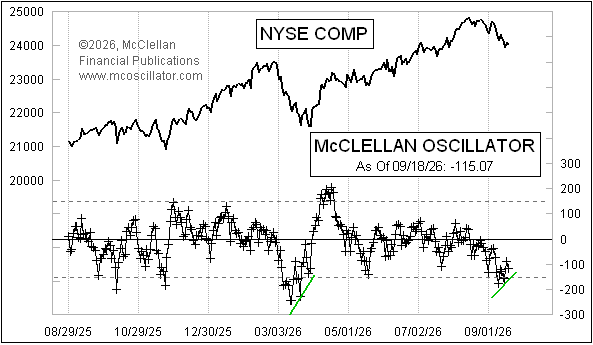
Positive breadth at the close on Monday will bring a 3rd McClellan Oscillator bottom, higher than the last two, which is a powerful bullish signal. We last saw one of those at the March 30, 2026 low.
Money still moves the market.
The M2 Stock Market Model just flipped to +2, its most favorable reading, with both components positive as of August. Since 1960, a dollar held in the S&P 500 only during +2 months grew to $21.65, versus $6.59 at +1.
This week's TradingEdge Weekly video covers the M2 signal, a market environment reading entering the danger zone, a gold model turning favorable, and what history says about stocks after a first rate hike.
The full SentimenTrader market view: https://t.co/0DjVvGV1Tq
Jamestown nearly starved itself to death through a spreadsheet decision made in London. The Virginia Company established the colony in 1607 as a joint-stock venture, but crucially mandated that all food, land, and production flow into a common store, distributed equally regardless of individual contribution.
Then, the predictable result: by the winter of 1609-1610, roughly 500 colonists shrank to 60 survivors eating rats, leather, and each other.
Collectivized production destroys the price signal that tells producers what to make and how hard to work. Every bushel of corn John Smith grew belonged equally to the man who slept through harvest. This structured incentive to produce nothing masquerades as generosity.
Governor Thomas Dale fixed this in 1614. He allocated private plots. Output increased dramatically, immediately. Colonists who owned their yield guarded it, cultivated it, and traded it. Property rights attached effort to reward. The famine ended.
The Virginia Company's London directors could not know local conditions, soil quality, individual skill, or daily weather. No central administrator ever can. That knowledge lives dispersed across thousands of actors, readable only through prices and ownership. Strip those mechanisms and you get Jamestown's "starving time," every time, without exception, across every continent and every century that has tried the experiment since.
SPX has opened at the highest point of the day for 3 straight sessions.
What does it mean?
Fuck if I know, but here are some forward returns and worst draw downs over the next 5 days.
Inigo Fraser Jenkins (@AB_insights) on why the US track record isn't the whole story:
Rank markets by market cap in 1899: the US and UK compounded beautifully.
Japan, Russia, Germany, Austria-Hungary, France? Effectively wiped out.
"There is this inherent survivorship bias in the way people think about long-run returns."
Listen: https://t.co/mfnaUo1DNT
Watch: https://t.co/RnIrcDOgFb