This is exploitation!
Can't be justified!
Why stop competition because you want to fleece people?
Elsewhere the entire management that schemed this daylight robbery will be sacked!!!
And yes, an airport bus at 10k is rather too expensive.
An airport bus should be affordable to workers at the airport who commute daily too.
That's the case elsewhere too.
A bus is a mass transit vehicle and makes money by the number of passengers it conveys at low/affordable fares.
It makes no sense to charge 10k and ferry 5 passengers to earn 50k and go with 20 empty seats.
Charge 2k and fill the 30 seats and earn 60k.
You make more money...
And ferry more people...
I have never seen a public transportation bus that charges 14% of minimum wage per trip in my entire life and I have been to a few places!
We can do better!
Mr President without revisiting the 2013 power sector privatisation, unbundling transmission to private sector capital and unbundling the distribution licences to 1 state per DISCO, all your efforts in the power sector will be in vain! My humble advise from a Nigerian passionate about electricity!
*Subsidies Are Not the Problem: Building an Economy That Works Is*
There is nothing inherently wrong with *subsidies*. The real policy questions are:
1. *How will the subsidy be financed?*
2. *How will leakages, abuse and criminality be prevented?*
3. *Will the subsidy deliver measurable social and economic benefits?*
If credible answers to these 3 questions above are provided, a subsidy can be a legitimate and effective public policy tool.
The United Kingdom, despite being a high-income economy with low unemployment, low inflation, low interest rates with relatively strong infrastructure and social institutions, operates an extensive system of public support and subsidies, including:
* publicly funded education up to age 18;
* healthcare through the NHS;
* social and council housing;
* child and family benefits;
* disability and long-term illness support;
* heating and energy support; and
* subsidised or free public transport for certain categories of residents, including children and older people.
* And many more
The point is simple: subsidies are not inherently bad policy. Poorly designed, poorly targeted and poorly financed subsidies are the problem.
For Nigeria, where energy costs have a direct impact on transportation, food, production and household welfare, government should consider targeted interventions to cushion the effect on vulnerable citizens. Any such programme, however, must satisfy the three tests of sustainable financing, effective control of leakages and measurable economic or social benefit.
Subsidies also do not have to come exclusively from the FG. State and local governments can design interventions that address the specific needs of their populations. In the UK, for example, different levels of government provide different forms of support. When I turned 60, I received a Freedom Pass that allows me to travel free on London's public transport system, a benefit provided through London's local and regional government arrangements rather than as a direct cash subsidy from central government.
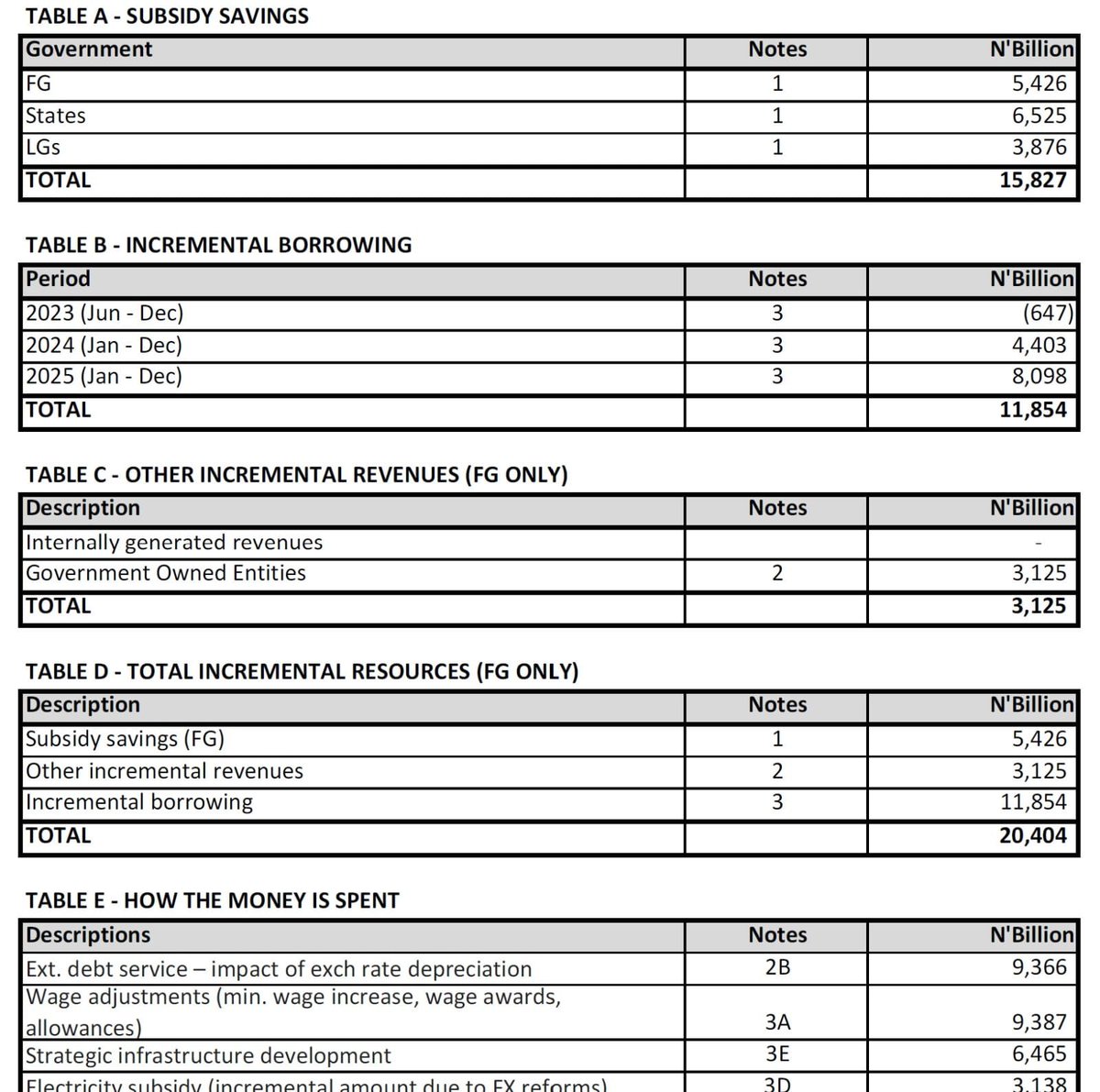
This is particularly relevant to Nigeria. According to the FG's recent reform scorecard, of the reported *₦15.8 trillion in savings, approximately ₦5.4 trillion, or 34%, accrued to the Federal Government, while about 66% accrued to state and local governments*. If that is the distribution of the fiscal gains, citizens should reasonably expect to see corresponding improvements in public services, infrastructure and, where appropriate, targeted state and local-level support programmes.
Subsidies are also not new to Nigeria. Growing up in Gboko, we benefited from heavily subsidised education, including books and writing materials, as well as comprehensive public healthcare and medicines. The issue, therefore, is not whether Nigeria should subsidise its citizens, but *which subsidies deliver the greatest value and how they should be financed and administered*.
Ultimately, however, the *greatest subsidy Nigerian governments can provide is an economy that works*.
That means policies that:
* expand production and create jobs;
* raise household incomes;
* improve security;
* mechanise agriculture and increase food supply;
* expand electricity generation and reduce energy costs;
* build efficient rail and public transport systems;
* deepen the housing and mortgage market;
* close infrastructure gaps; and
* mobilise private and public capital for productive investment.
Nigeria's long-term solution cannot be a permanent system of compensating citizens for an economy that does not produce enough. The priority must be to expand productive capacity and reduce the underlying cost of living and doing business.
This also has implications for monetary policy. The challenge for the CBN is to support growth and investment without generating excessive demand or reigniting inflation. But an economy of approximately 240 million people, producing half of the output of the 12 million people in the UAE and the same output as the 3 million people in Qatar has an undeniable growth and productivity challenge.
In conclusion, the policy objective should therefore be clear:
Subsidise where necessary and where it delivers measurable public value but, above all, build an economy in which Nigerians need fewer subsidies because productive investment, infrastructure, jobs and rising incomes make life more affordable.
_Nick Agule ([email protected]) is a public affairs analyst_
Potential measures include:
• reforms to strengthen institutions and blocking revenue leakages;
• substantially reducing crude oil theft;
• expanding the effective tax base, particularly among high-income individuals and profitable economic activities;
• accelerating the conversion of eligible Joint Ventures into Incorporated Joint Ventures to reduce dependence on government cash calls and mobilise private development capital;
• reviewing the architecture of the 2013 power-sector privatisation to attract better-capitalised operators and reduce the persistent accumulation of sector-wide liabilities.
• Unlock greater economic and fiscal value from mining activities
• Block customs and import-duty leakage
• Inventorise and commercialise or privatise government-owned commercial assets
• Expand VAT and other consumption-tax on luxury goods.
The objective should be to improve government finances without imposing unnecessarily high adjustment costs on households and productive businesses.
*5. The costs borne by Nigerians must also be quantified*
The government's scorecard largely focuses on the fiscal costs and benefits to the state.
However, the reforms have also imposed significant costs on individuals, households and businesses through higher transportation costs, energy costs, food prices, imported input costs and the wider inflationary effects of currency depreciation.
These costs have not yet been comprehensively quantified.
A proper national reform scorecard should therefore contain two sides:
The fiscal benefit to government; and the economic cost borne by citizens and businesses.
Without the second calculation, Nigerians cannot have a complete picture of the true cost-benefit outcome of the reforms.
*6. The next phase must focus on the supply side*
Ultimately, Nigeria cannot rely indefinitely on reforms that primarily increase prices, exchange-rate values, taxes or the cost of economic adjustment. The next phase of reform must focus aggressively on output growth and reducing the underlying cost of living and doing business.
This should include:
• transferring or restructuring the refineries to enable efficient private-sector investment and reduce the cost of petroleum products;
• mobilising large-scale private capital to expand electricity generation, transmission and distribution;
• improving security and injecting mechanisation to restore agricultural production and increase food supply;
• restructuring and commercialising the railway system to reduce logistics and transportation costs;
• developing long-term, affordable mortgage finance to reduce housing costs; and
• addressing infrastructure and regulatory bottlenecks that constrain private investment and productive capacity.
• Attracting private capital in the steel sector
*Conclusion*
The reforms may have prevented even greater fiscal and economic deterioration, and the government deserves credit for taking politically difficult and courageous decisions. However, a reform cannot be judged only by what it saves the government; it must also be judged by what it costs the economy and its citizens.
Nigeria's next reform phase should therefore move decisively from price adjustment to productivity, from demand compression to supply expansion, and from simply redistributing economic pain to creating the productive capacity that reduces costs and raises incomes.
*The ultimate test of reform is not how much revenue government generates from citizens, but whether reforms enable Nigerians and Nigerian businesses to produce more, earn more and live better.*
_Nick Agule ([email protected]) is a public affairs analyst_
*NIGERIA’S REFORM SCORECARD: WHAT HAVE WE GAINED, AND WHAT HAS IT COST US?*
_Nick Agule_
_Email: [email protected]_
_X: @NickAgule_
_LinkedIn: Nick Agule, FCA_
_Facebook: Nick Agule, FCA_
21.08.2026
I have reviewed the numbers presented, and a number of issues arise.
First, it is commendable that the FG considers itself accountable to Nigerians and has taken the step of presenting an account of the benefits and costs associated with its reform programme. Given the far-reaching impact of these reforms, such transparency is both welcome and necessary.
However, the numbers also raise important questions.
*1. Sources of the expected reform gains*
The reforms were expected to generate fiscal benefits principally from:
a. *Higher naira revenues* arising from translating dollar-denominated government receipts at a significantly higher exchange rate;
b. *Savings from the effective elimination of the official foreign exchange subsidy* and the unification of exchange rates;
c. *Savings from the removal of the petrol subsidy;* and
d. *Savings from the reduction or removal of certain electricity subsidies.*
The Minister's presentation appears to have addressed the benefits arising from higher exchange-rate translation and foreign-exchange reforms. However, it is less clear how the savings from petrol and electricity subsidy reforms were treated in the overall calculation.
*2. The subsidy savings require further clarification*
Petrol subsidy expenditure alone was estimated at over *₦4 trillion in 2022.* On that basis, the elimination of the subsidy over approximately two and a half years should, all things being equal, have generated substantial cumulative fiscal savings of not less than *₦10 trillion*.
This raises an important question: if the reported reform gains include the savings from petrol subsidy removal, how much of the incremental benefit is attributable to the other reforms, including the higher naira value of dollar receipts and the elimination of the foreign-exchange subsidy?
A clearer reconciliation of the individual components would help Nigerians understand precisely where the gains have come from.
*3. The downstream fiscal costs must also be assessed*
The more fundamental issue is whether the reforms should be assessed solely by the revenues or savings they generated, without fully accounting for the costs they created elsewhere in the economy.
Based on the figures presented, approximately *₦5.4 trillion* in reform-related gains appears to be accompanied by substantial additional fiscal pressures as a fallout from the reforms, including approximately:
• *₦9 trillion* associated with wage adjustments; and
• *₦9 trillion* in increased external debt-service obligations.
That represents approximately *₦18 trillion* in identified downstream fiscal pressures, compared with roughly *₦5.4 trillion* in reported gains. To address this deficit from the reforms impact, we borrowed *₦11 trillion* more.
If these costs are causally linked, directly or indirectly, to the reform programme, then the appropriate question is not simply:
How much did the reforms save or generate?
It should also be:
*What did Nigeria have to spend, borrow or absorb elsewhere as a consequence of implementing the reforms?*
A reform that generates ₦5.4 trillion in direct fiscal benefits but contributes to substantially larger downstream costs requires a more comprehensive cost-benefit assessment.
*4. There may be cheaper ways to improve public finances*
Nigeria should also pursue structural reforms capable of generating significant fiscal gains at a lower economic and social cost.
@ShehuSani By your own assessment, is the country working for the ordinary Nigerian?
In the midst of poverty we are hearing officials owning 48 houses, women no visible business having millions of dollars in bank accounts and jewellery running into billions. Fake federal agency.
So, @ARISEtv brought this energy expert, NICK AGULE, just to rubbish President Tinubu’s administration efforts on electricity. Man didn’t just lecture them from the scratch, he also ensured they saw reasons why they should agree with all the President’s power sector reforms. He applauded the democracy day speech where Tinubu spoke extensively on the power sector
The armed group was reportedly in full retreat, yet our forces did not pursue and destroy the fleeing enemy? Fleeing to where exactly? Were there no military units along their escape routes? Why were blocking forces and ambush positions not established ahead of them? Why was there no coordinated operation to cut off their withdrawal and finish the job?
This is what frustrates Nigerians. Our troops fight hard to push the enemy out of an area, only for the surviving fighters to disappear, regroup, rearm, and return to kill again. It is like a football team that battles its way into the opponent's penalty box and then suddenly turns around and walks back to its own half without taking the shot.
Most importantly, why did this level of offensive action not occur while the General was still in captivity? Why was there no overwhelming operation to locate, isolate, and crush the terrorists before they murdered him?
The purpose of military operations is not merely to make contact with the enemy; it is to deny them freedom of movement, destroy their capability to fight, and ensure they can never return to terrorise innocent citizens.
Nigerians deserve answers.
Haba na Dr Abati!
A HOSPITAL cares for people to live...cure is the approach
A HOSPICE cares for people who are dying... palliative is the approach.
Hospices are not common in Nigeria but Dr Abati is widely travelled nah!
@GbeleePaul@aonanuga1956 Power Minister Joseph Tegbe Has a Unique Opportunity to Succeed Where His Predecessors Since 2013 Failed: Energy Expert Nick Agule Sets Out Key Priorities for Power Sector Reform
https://t.co/eMEqfgNDD4
@LegendaryJoe@aonanuga1956 Power Minister Joseph Tegbe Has a Unique Opportunity to Succeed Where His Predecessors Since 2013 Failed: Energy Expert Nick Agule Sets Out Key Priorities for Power Sector Reform
https://t.co/eMEqfgNDD4