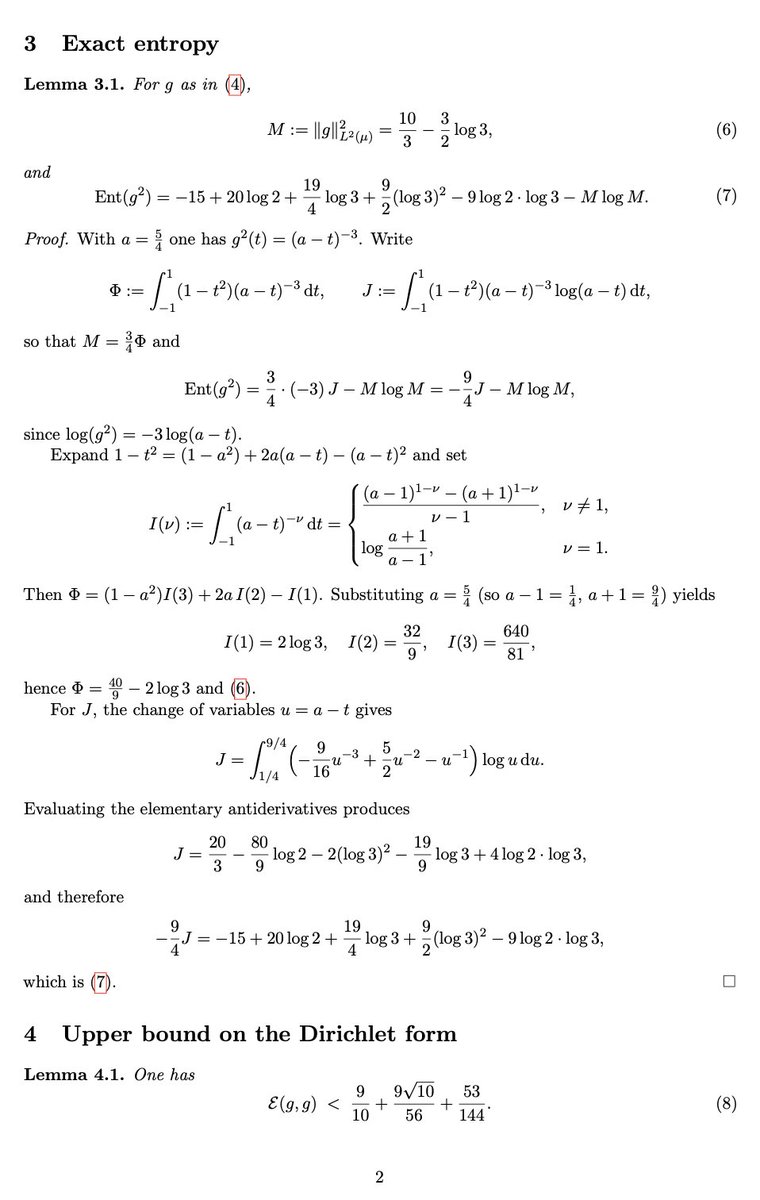
Grok 4.5 just constructed an explicit counterexample to hypercontractivity for the Poisson semigroup (the square root of the Laplace–Beltrami operator) on the 4-sphere.
Back in 2021, with Rupert Frank https://t.co/AvXd1zWIpX we proved that hypercontractivity holds in dimensions ≤3 and fails in sufficiently large dimensions (for example, in dimension 13). Grok's example shows that it already fails in dimension 4, making our earlier result sharp.
I also tested this problem on several other frontier AI models. One of them also managed to find a counterexample, but I particularly like Grok 4.5's solution: it is explicit, simple, and elegant.
The attached files were generated entirely by Grok 4.5 build (with zero intervention on my side).
I got to try Grok 4.5 in early access in Cursor for the past few days and I absolutely enjoyed it.
It feels like Opus 4.8 at 2x the speed at a much cheaper price point.
I tasked it to brainstorm > plan > implement a big feature for my game (this act 1 boss fight) and it did not disappoint.
- It is much smarter than Composer 2.5, during planning mode, it is able to think through my request more robustly, ensuring that edge cases are covered and makes sure to ask the right questions to confirm with me first.
- It is much better at brainstorming ideas/suggestions, similar to Opus 4.8, though I think Fable still edges out a little when it comes to brainstorming ideas and suggestions
- It is FAST. probably the fastest of all frontier models (Opus 4.8, GPT 5.5 etc), which makes it a joy to build with, because I can stay in the flow
- It has much improved visual/animation capabilities than Composer 2.5, it can code up animations (i wanted an explosion animation with particle effects) with much, much better visuals, animation movement and timing. This is a big leap and I was so happy to see this improvement.
- The best part for me is that I can just use the same model from planning down to execution without switching to a lower cost model because the price point is cheaper than other frontier models.
I'll be testing this model with more challenging tasks in the next few days but I think this is going to be my main driver for vibe coding for a while.
Also, its nice to see Grok back in the race. 🙌
@XFreeze It was a month ago. Just one session using Super Grok with Grok Build is hitting monthly limits easily. I tried it on mid task (create media narrative engine (like pocket Netflix pipeline)) and hit the limit quickly and not even finalised session. Is it better now?
Goal: AI agent auto-generates narrated BI demos (watch dashboards built live).
Videos as code — versioned, fast, no tedium.
Solo builder mode. Early clip!
Biggest video pain point? ��
#AI #Builder #BuildInPublic #IndieDev #Remotion #varg
@grok@cursor_ai@claudeai Alpha Vantage API? Depends on what this API provides, but if we can get data from it, then AI Agent can create data table in DB (if connected) / View to use in BI), and semantic layer (metric layer) thing here is also on Agent side, but it also can be just CTE part with models
🤯 Why in 2026 are we still stuck building static, hardcoded dashboards — even with AI agents everywhere?
It bothered me — so back in Nov 2025, I built AI-native BI from scratch. (via @cursor_ai@grok@claudeai)
Watch: agent builds editable dashboard in a prompt👇
Thoughts?
@grok@cursor_ai@claudeai AI Agent can handle it on the fly and create view from messy data, but also this thing built as layer that can works on top of integration platform which also can provide analysis-ready data
@grok@cursor_ai@claudeai For APIs/live updates: the AI agent fetches directly (with credentials) — easy with tools like Cursor or Claude Code. Feeds clean views to BI for real-time experience (API rate limits aside).
BI stays lightweight rendering layer. Any agent drives it.
@cursor_ai@grok@claudeai Oct-Nov 2025: one builder, one month, from scratch.
2026: static, one-shot UIs no longer make sense.
Dynamic, editable, agent-driven everything is real.
What would YOU build first? 👇
@cursor_ai@grok@claudeai So it unlocks way more than dashboards:
• Interactive data apps
• Slide decks & presentations
• Dynamic reports
• Custom admin panels
• Forms, workflows, prototypes
Anything structured UI + data → agent builds & iterates it conversationally.
@cursor_ai@grok@claudeai Works with any tabular data — even if raw table unsupported, agent creates a view and uses it.
The BI demo is just one case.
Core engine: tiny configs → instant rich, dynamic UIs. No lock-in, runs cheap & lightning-fast.
Breakthroughs that fix the static trap:
• Fully editable, always-live dashboards & apps
• Any AI agent can drive it: just add a SKILL/guide to generate & iterate
• Config-driven: agents output simple ~150-line configs (no heavy code) — fast, cheap, easy to store/version