Uno de los tipos más oscuros de toda la política argentina. Un tipo que solamente está ahí por ir oculto lista tras lista con una única ambición: el poder y parasitar el país.
Increíble la película que se hacen, en los comentarios.
Pasa lo mismo en la bolsa, para algunos siempre va a estar todo manejado, quien sabe por quien.
La bicicletta è la morte lenta del pianeta.
Un professore di una prestigiosa università ha fatto riflettere i suoi studenti e poi ha detto:
"Un ciclista è un disastro per l'economia del Paese: non compra auto e non chiede prestiti per comprarle. Non paga l'assicurazione. Non compra carburante e non paga la manutenzione e le riparazioni. Non usa parcheggi a pagamento Non causa incidenti gravi Non ha bisogno di autostrade a più corsie... e non ingrassa.
Le persone sane non sono né necessarie né utili all'economia. Non comprano farmaci. Non vanno in ospedale o dal medico. Non aggiungono nulla al PIL (prodotto interno lordo) del Paese.
Al contrario, ogni nuovo fast food crea almeno 30 posti di lavoro: 10 cardiologi, 10 dentisti, 10 dietologi e nutrizionisti, e naturalmente + le persone che lavorano nel ristorante stesso".
Scegliere con saggezza: ciclista o fast food? Vale la pena di riflettere.
Per concludere ha anche aggiunto: i pedoni fanno peggio perché non comprano nemmeno una bicicletta. Quindi, se potete scegliere, optate per un'auto o un camion.
ASWATH DAMODARAN: PRIVATE CREDIT IS THE NEXT CRISIS.
His framing starts with a question that nobody in the boom is asking. Who exactly are the lenders writing the checks to fund all these AI data centers? Shale oil companies borrowed heavily when oil was at $120 a barrel and got crushed when prices fell to $60. The same pattern is forming today in compute infrastructure, and the people putting up the capital are getting almost no scrutiny.
Damodaran does not see private credit as the sophisticated, intelligent alternative the marketing has positioned it as. He sees it as sheep. Every fund is chasing the same deals, the same sectors, and the same yield premiums that allegedly justify the structure. Intelligence in his view has been confused with confidence, and confidence in this corner of finance has compounded into something far more dangerous than the participants realize.
His broader point is that hedge funds, private equity, and private credit have all followed the same destructive arc. Each one began as a genuinely good niche business solving a real problem. Hedge funds 30 years ago produced positive alpha, beating passive investing by 3 to 5 percent annually. Today they look like expensive mutual funds, underperforming passive by roughly 1.5 percent. Private equity started as a focused, disciplined strategy for a small set of operators and has grown into a sprawling category that now struggles to deliver the returns that justified its emergence. Private credit had a legitimate original purpose, which was lending to borrowers that banks structurally could not serve.
What killed each of these businesses was the same disease. Overreach. A $200 billion niche business gets sold as a $20 trillion opportunity. When that scaling happens, sloppiness follows, bad actors enter the space, and the average quality of every participant deteriorates. The original alpha disappears not because the strategy stopped working, but because too much money chased too few good deals.
The danger with private credit is far more severe than the parallel problems in private equity and hedge funds. Equity investors take their losses and move on. Lending businesses, when they overreach, take others down with them. Banks. Pensions. Insurance companies. Sovereign wealth funds. The systemic linkages run far deeper than most participants understand, and the social costs of a real default cycle in private credit would extend well beyond the funds themselves.
Damodaran's warning is essentially that the industry is repeating the exact mistake that produced every previous credit crisis. Take a good idea, scale it past its natural capacity, attract bad actors with the promise of easy returns, and wait for the inevitable cycle that exposes how much of the underwriting was never serious in the first place.
@AswathDamodaran@FixedFloating
apprendre le mandarin c'est sans doute la meilleure décision que j'ai prise de ma vie, ça m'a ouvert des portes que j'aurais même pas osé imaginer
vous avez plein de gens qui débarquent en chine persuadés qu'ils vont parler anglais et signer des deals, sauf que les chinois s'en battent les couilles de l'anglais, ils s'en foutent de l'occident, ils ont rien à faire de nous des américains et encore moins des européens, ils avancent à une vitesse qu'on mesure même pas et ils le font sans demander l'avis de personne
sachez que le rapport de force a basculé, aujourd'hui c'est le reste du monde qui a besoin de la chine, de ses usines, de ses ingénieurs & de son capital
et c'est là que le mandarin change tout, apprendre leur langue ça prouve que vous faites l'effort d'entrer dans leur monde au lieu d'attendre qu'ils viennent dans le vôtre, ça envoie un signal de respect profond envers leur culture et dans un pays où une relation de confiance pèse plus lourd que n'importe quel contrat signé c'est exactement ce respect là qui vous ouvrira des portes que vous décrocherez nulle part ailleurs
le futur il se construit là-bas, soit vous apprenez leur langue soit vous regardez le train passer en parlant anglais à un mur
@XDecretoOK Muchachos Dante Gebel , tiene años y años de oratoria. Es un tipo hábil y muy preparado. Raro que con tanto poder establecido en EEUU , quiera empezar en ARG.
El mercado argentino no crece como el americano.
Funciona en megaciclos.
Largos períodos de destrucción de valor, seguidos de subas explosivas de 500%, 700% e incluso 900%.
La clave no es tanto elegir buenas empresas. Es identificar en qué momento del ciclo estás parado.
Hoy ese momento parece estar más cerca de los máximos que de los mínimos… por eso, a nivel bursátil, diversificar a nivel global no es una mala idea.
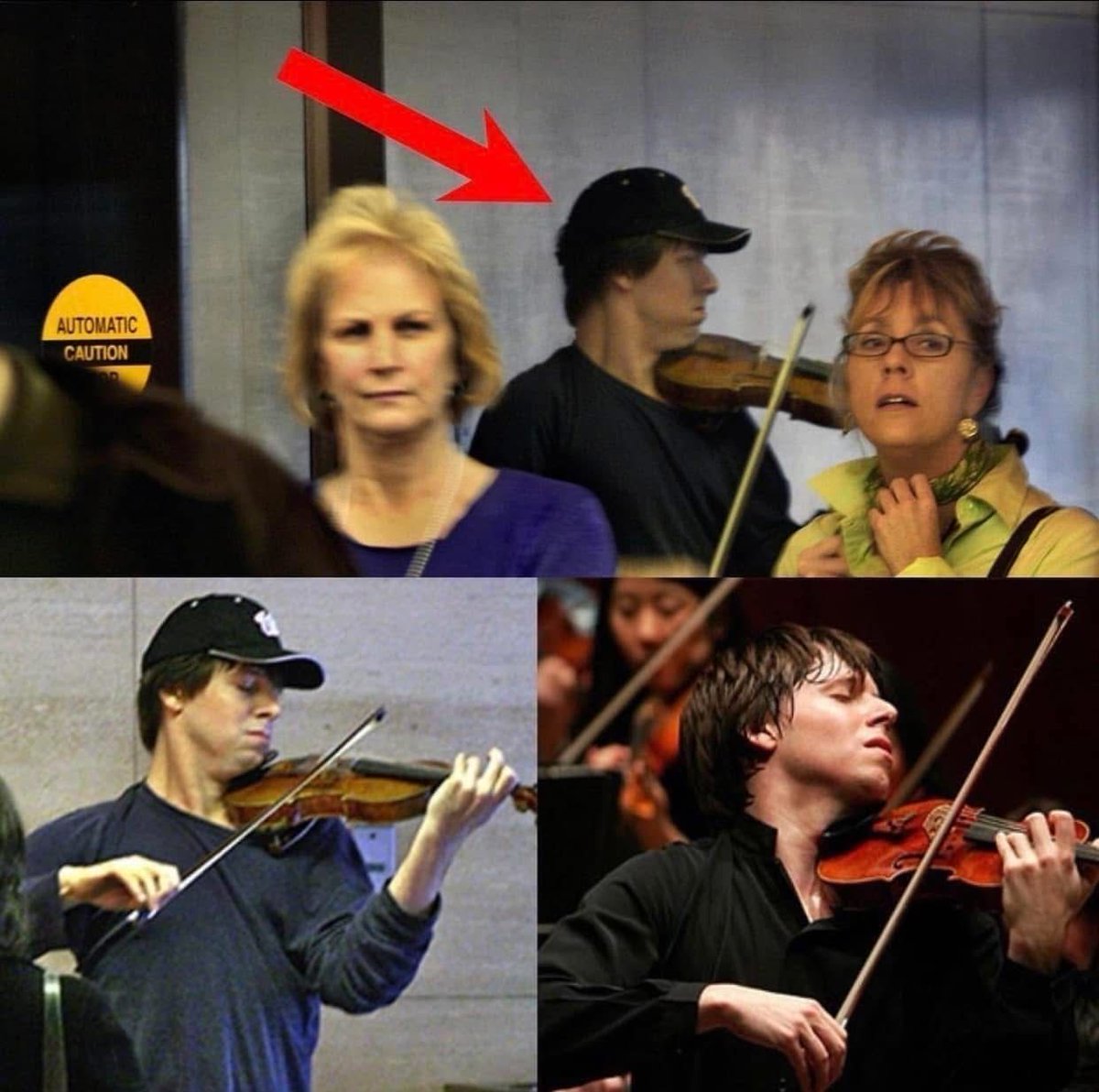
A violinist played for 45 minutes in the Washington D.C. subway.
Of the 1,097 people who passed by, seven stopped to listen to him, and one recognized him.
He collected $32.17 in tips from 27 passersby (excluding $20 from the one who recognized him).
Only one person knew this, but the violinist was Joshua Bell, one of the best musicians in the world. In that subway, Joshua played one of the most intricate pieces ever written with a violin worth 3.5 million dollars.
Two days before he played in the subway, Joshua Bell sold out a Boston theatre, and the seats averaged about $100.
The experiment proved that the extraordinary in an ordinary environment does not shine and is so often overlooked and undervalued.
There are brilliantly talented people everywhere who aren’t receiving the recognition and reward they deserve. But once they arm themselves with value and confidence and remove themselves from an environment that isn’t serving them, they thrive and grow.
Your gut is telling you something. Listen to it if it’s telling you where you are isn’t enough!
Go where you are appreciated and valued.
Know Your Worth.
Credit : @foundconsciousness via IG
La rotación de portafolio que se viene con la IA será feroz!
No lleganos a identificar ganadores y perdedores.
Muchos apuestan a índices para estar cubiertos!
Pero la IA, si es correcto lo que se habla, destruirá modelos enteros de negocios de empresas que se ven súper sólidas!