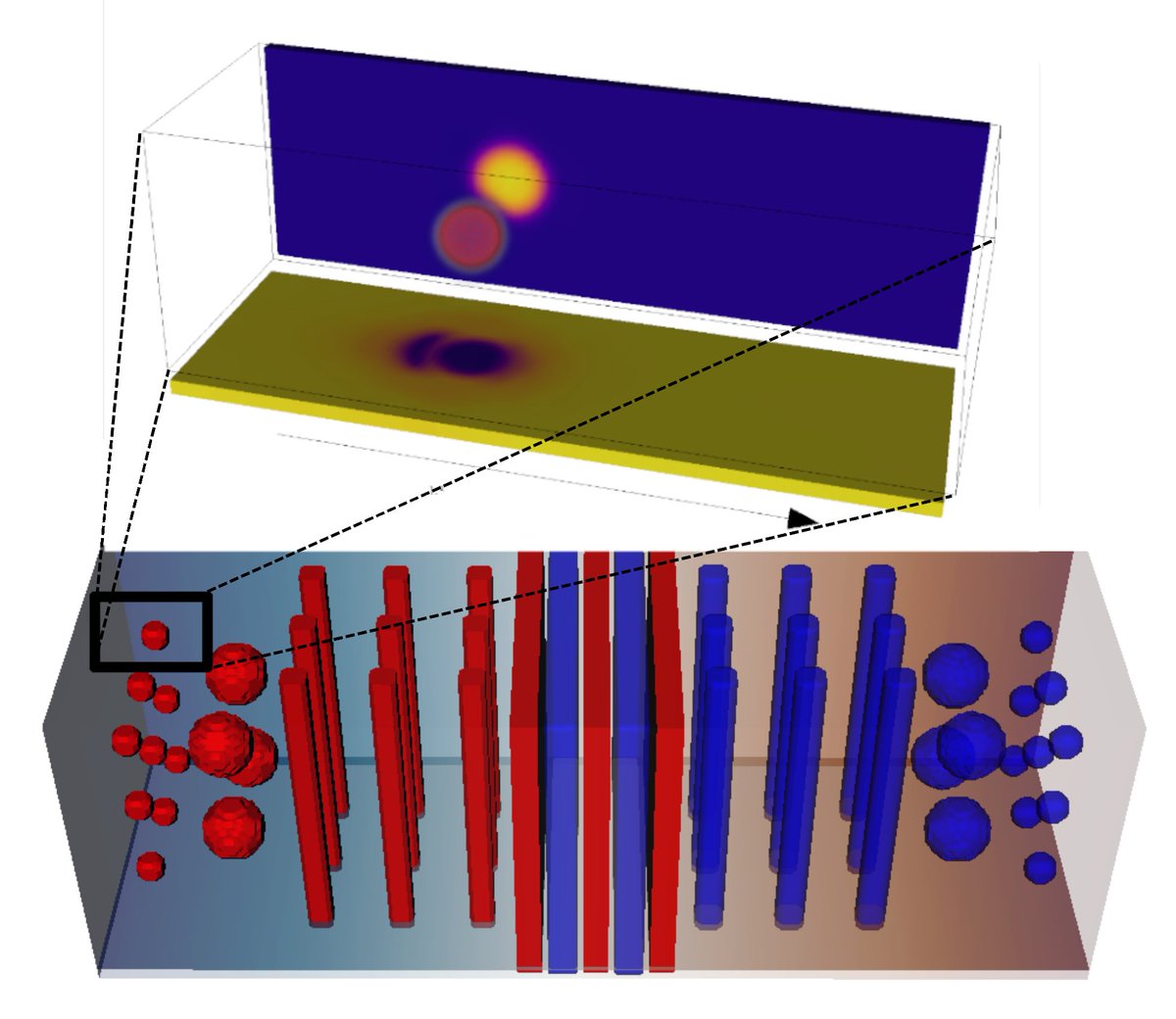
I will be presenting two e-posters at the upcoming EAS annual meeting, one about shallow heating in magnetar crusts and the other about gapless superfluidity in accreting neutron stars
Researchers developed a model that describes the microscopic dynamics of a nucleus accelerating through the #superfluid medium of a #NeutronStar’s inner crust. The #OpenSource tool could be used to shed light on superfluidity in other #nuclear systems.
🔗 https://t.co/0S1ZTMQTdR
Uncovering an exotic phase of matter called a supersolid came down to the perfect spin cycle. Researchers used a magnetic field to stir atoms about 50 times a second —fast enough to trigger vortices but gentle enough to preserve the quantum phase.
https://t.co/bDHdF82A4U
Back from the 45th International School of Nuclear Physics in Erice, Sicily, Italy, where I gave a lecture on nuclear clustering and pasta in neutron stars. The PDF file can be downloaded here: https://t.co/3KwmkLexrz
Yesterday our @PhysicsColumbia colleague Mal Ruderman passed at 97. He was a great scientist - a legend in the field of neutron star physics - and among the kindest and humblest people I've met. He was active in our department well into his 90s and will be missed.
Le premier magnetar extragalactique découvert par @ESA_Integral dans la galaxie M82 ! Un événement transitoire unique : ces étoiles à neutrons au champ magnétique hyper puissant n’étaient connues que dans notre galaxie.
▶️ https://t.co/NimdAnP4pv
@TNGTelescope @ESA_XMM
@martinmbauer Some nuclear clocks are already at our disposal through the extremely stable radio signals coming from neutron stars:
https://t.co/PBaaShd5Zd
We have found that this peculiar state never considered before can naturally explain the observed late time cooling of neutron stars in low-mass X ray binaries after the end of an accretion episode.
Novel superfluid state of matter discovered in dead stars!
Research from my PhD student supported by @frsFNRS published in Physical Review Letters:
https://t.co/uaseq9FjhU
#neutronstar#cooling#superfluidity
Neutron stars can be spun up to very high frequencies by the accretion of matter from a stellar companion. Under such circumstances, we have shown that the neutron superfluid could enter a novel state driven by the pinning of vortices.
We're excited to announce our detection of #GW230529, the first exceptional #GravitationalWaves event from our fourth observing run #O4. Check out @astronerdika’s cool infographic https://t.co/sxd50MyQjU or visit our #GW230529 detection page https://t.co/oGH4baLlss
📢 My Polish colleagues have just released a free software package to probe neutron-star crusts within full 3D time dependent density functional simulations
https://t.co/7rspzeIl40
🆕ESA’s Integral sees, for the first time, how nuclear explosions 💥 on a neutron star feed its jets. Will this help us figure out jets in all sorts of astronomical objects? 🤔
Find out here 👉https://t.co/D9KJad85GZ