Seems I am in good company with my last tweet, even though I probably was a little less serious about replacing Biden with Romney than Aaron Sorkin is.
My wonderful colleague Jaime Millán is organizing the following event:
II Spanish Workshop in Development Economics
Pamplona, Oct 24-25 @ncid_unav@ICS_unav@unav
Keynote speakers: @SeiraEnrique (Michigan State) & @DaveEvansPhD (@the_IDB)
Submission deadline: June 16
RT plz!
38 days until the first day of the EU Parliament election.
Today, the lead candidates (EU Commission Presidency candidates) will face off in their 1st debate at 7 PM CEST. It is organized by Studio Europa Maastricht + POLITICO. #ep2024#MaastrichtDebate
https://t.co/vEzcQ8NCcy
Enrique García-Viñuela, @NicolasMotz and I offer some new empirical evidence on the determinats of the vote for protectionist parties in an article recently published in @EUP_TheJournal
From @ICAE_UCM & @I4Replication we invite colleagues and master/doctoral students in Madrid and beyond to participate in MADrid replication games on Friday 17th May 2024 at 10. If you are interested, fill out the form in https://t.co/okj86zy3Vy and SAVE THE DATE! 🧵 1/7
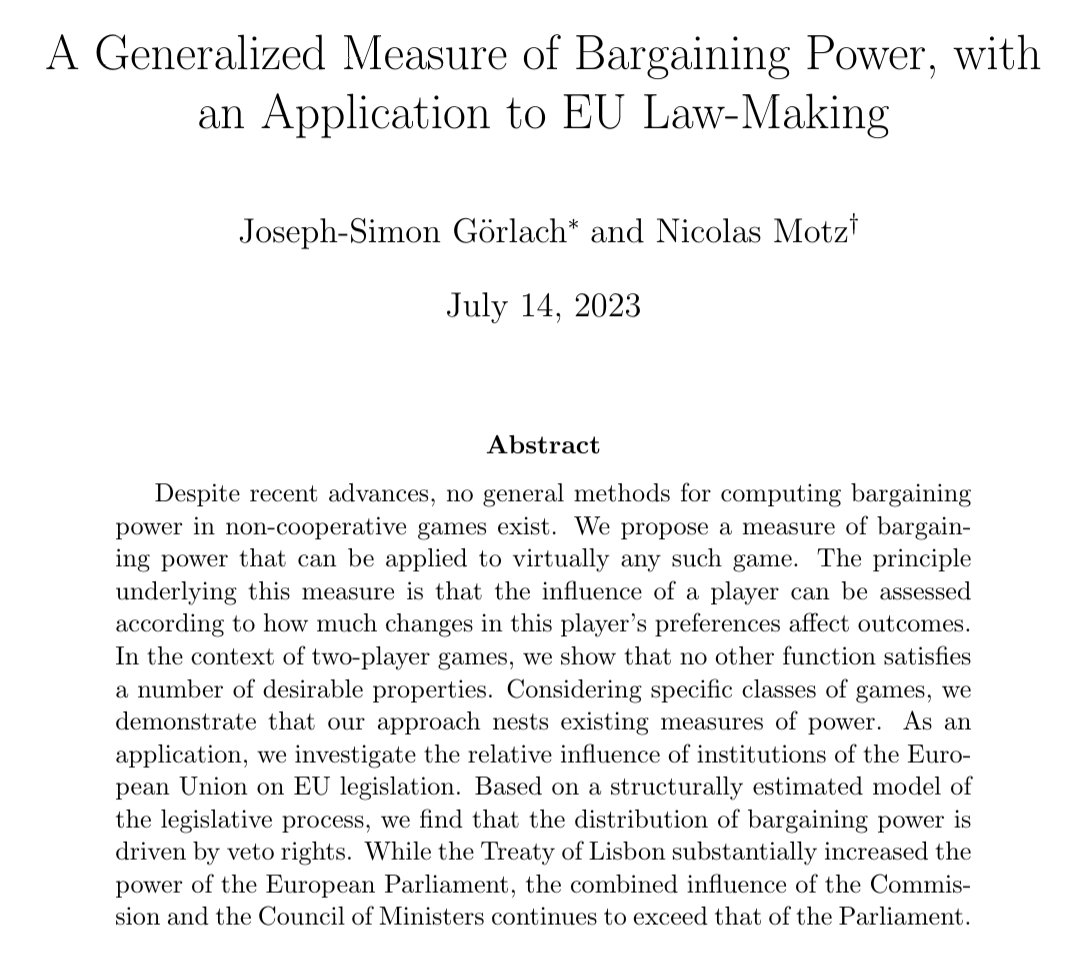
New version of our wp on measuring bargaining power!
https://t.co/3Nw0co2fec
New improved measure and, for the first time, an axiomatisation for general N-player games. We also have cool applications to cartel formation, intra-household bargaining, and legislative bargaining.🥳
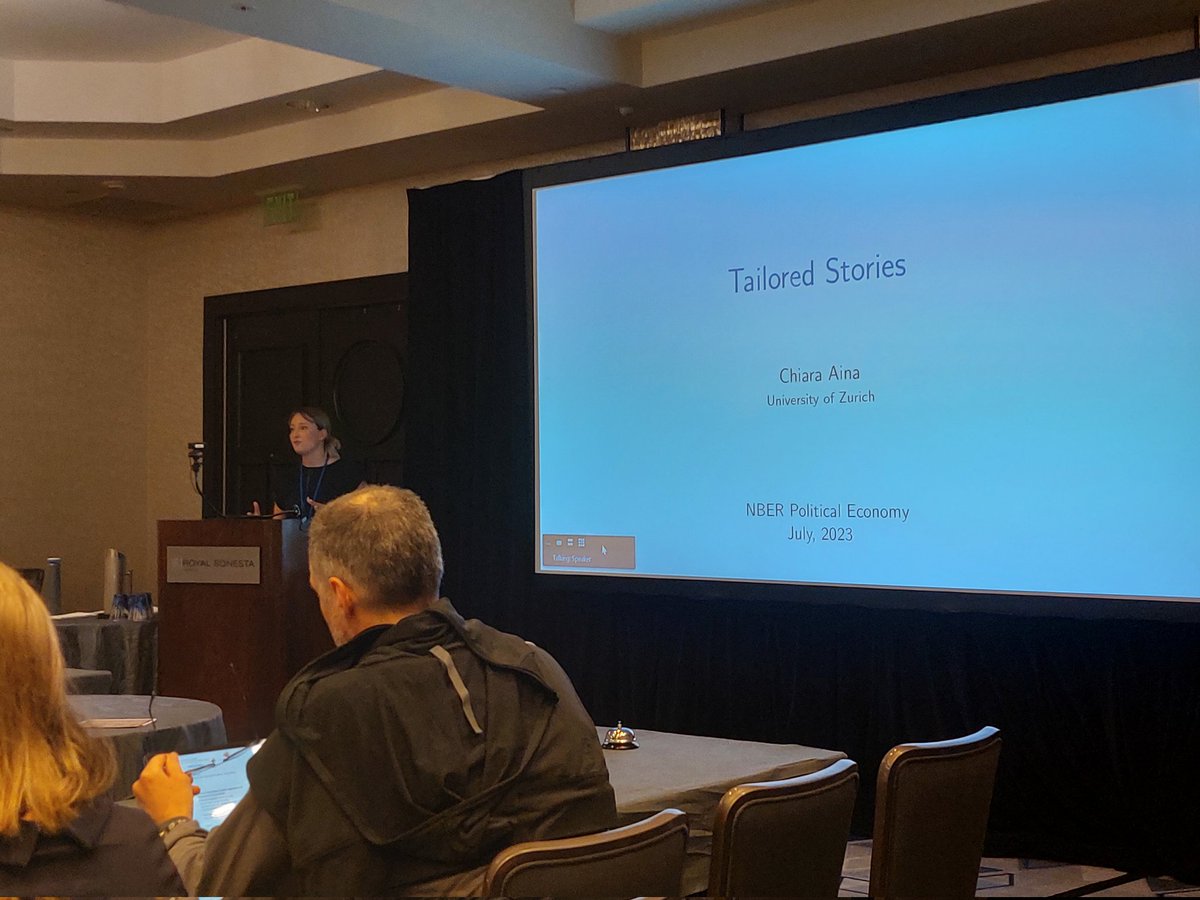
@chiaraina opens @nberpubs Summer Institute Political Economy with a great talk.
Simon will present our work on bargaining power tomorrow morning at 9am eastern time. You can tune in on the youtube channel of the NBER.
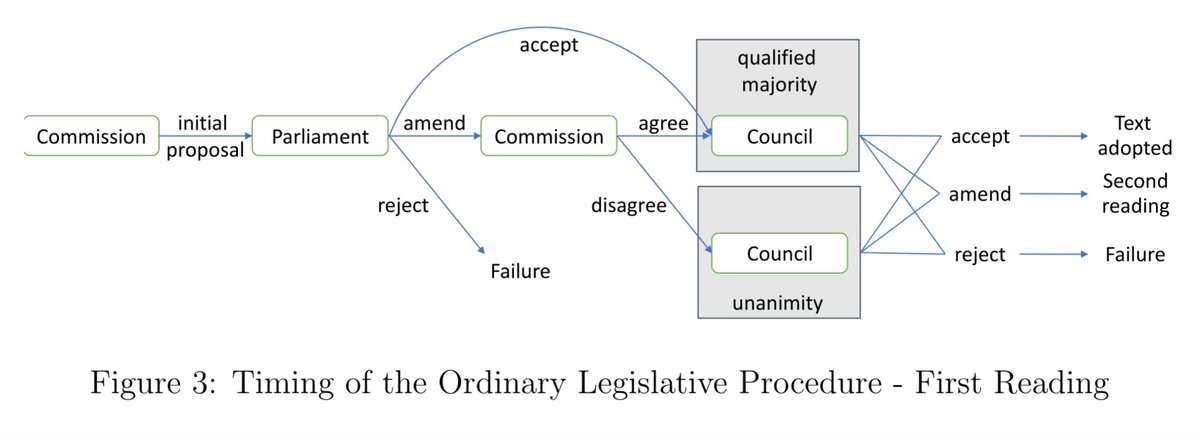
Before the Treaty of Lisbon, a substantial literature used voting power indices to analyse possible voting rules in EU's Council of Ministers. But voting in the Council is only one step in passing a law. Our method can be applied to the process as a whole, as we do in the paper.
🚨 New working paper 🚨
https://t.co/3Nw0co2fec
A tremendous amount of effort has gone into this one!
We introduce the first general measure of bargaining power for non-cooperative games.
Why is this important?👇
Non-cooperative games are explicit about the process of bargaining. Our measure helps us understand what features of this process give some players more influence and others less. Such knowledge is useful for designing better institutions.
Example:
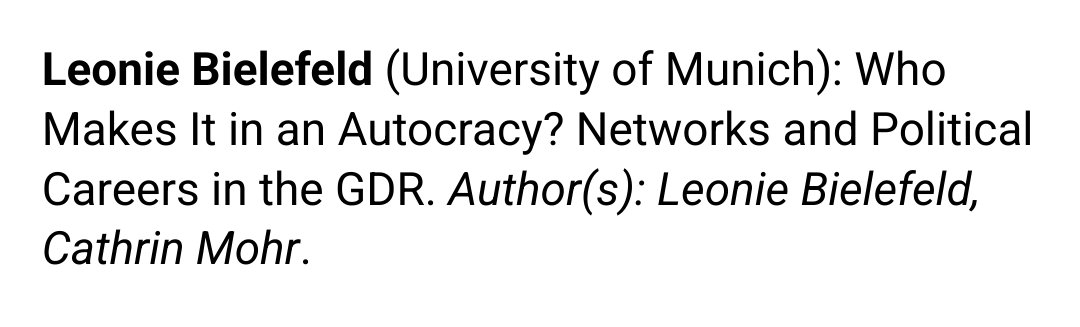
...a very nice presentation by Leonie Bielfeld showing that in order to get ahead in your political career in the former GDR, it helped to be less rather than more connected. Why? The top brass wanted to prevent the formation of factions that could become too powerful.
...a super interesting keynote by Paola Conconi with new data showing that, when it comes to free trade agreements, firms lobby overwhelmingly in favour. Nice contrast to the traditional "protection for sale" view. Also really enjoyed...
@LCCorchon My students of intro to econ (in Spanish) will soon have a test with multiple choice questions that they can do at home. I gave chatGPT some questions from last year and it got essentially everything wrong. So at least for now I don't have to worry 🤞
6 new post-doc @Unibocconi within the Age-It project coordinated by @vingalasso. One of them will work with Jerome Adda. Simon Goerlach and myself: info here https://t.co/jvkGwQscsc Apply!!!!!
When your project started with data from the 7th term of the European Parliament...eventually you were able to add data from the 8th term...and then one day you realize that the end of the 9th term is only two years away, and that doesn't seem long at all. 😂 #slowlylosingit