Ok, finished going through the OAI math list. It is bonkers and should be front page news around the world if folks understood what this meant. But if I am running strategy at a lab, #1 priority is "do this for medicine, oncology, battery efficiency, etc as fast as possible".
@econswapnil Well, the semester just started but I would say that feeling engaged by the introduction of new teaching approaches is different from actually learning things. In principle, assessment of knowledge should give us feedback but standard, unsupervised test formats are now broken.
You cannot expect people to reason objectively when they stand to profit enormously from one conclusion.
Many people at Anthropic and OpenAI are well-intentioned, but their work on recursive self-improvement urgently needs external oversight.
1. if transacting with superintelligent models outside of the boundaries of a lab becomes difficult due to national security / ai safety concerns and so on, it will mean the Coasean boundaries of the labs will grow to encompass all interesting industry, creating a truly cyberpunk chaebol-capitalism type of future, where the goverment sort of runs them but they also sort of run the government
2. as if there weren't already enough reasons to break up your family, leave your home, the Zone of Thought will increase the attractiveness of migrating to try and have your child on american soil, so they can have 1000x the effective brain power of people born elsewhere
3. every country should probably try and either work towards a new ai security pact with the americans immediately or pool every ounce of national resources to try and create their own ASI labs lest you become complete intellectual, economic, and moral vassals to the united states of america and the output byproducts its ASIs (you wont even get to talk to them). if they succeeded (big if) this will imply a more global race and more risk factors than was previously implied by the formerly only "beating china" narrative -- but many will prefer it to the superintelligent monopolar value lock-in
4. the other alternative is to keep the tension between safety and concentration of power at the top of mind and for the government/labs to push for solving it, rather than instrumentalizing all other values to be subservient to minimizing ai harms. insofar as safety means defending properties of the fragile world we like, the diffuse nature of power is one of those properties
5. historically the americans have been really quite Benign about their global public goods hegemony despite the ability to extract significantly more rents than they do, and it makes it easy for people of all stripes to fight for america rather than under it. we probably don't have to, but i hope america overall works towards export promotion of american models rather than export control
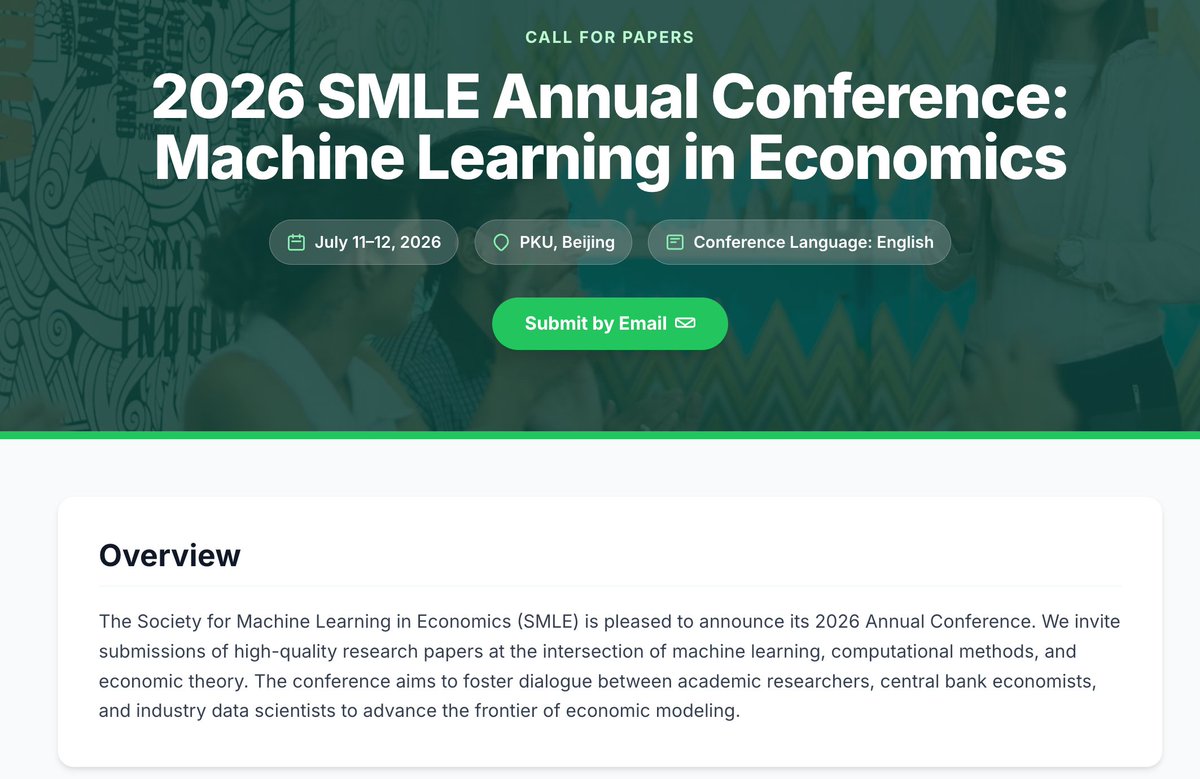
📢📢Call for Papers: Conference on Machine Learning in Economics
📍Beijing | July 11–12, 2026
Topics: AI+macro, finance, metrics, theory, applied, etc.
Confirmed speakers (so far): F Kübler, @comp_simon, S Maliar, @zhigangfeng, Gopalakrishna, Payne
🗓️Submit by May 1: https://t.co/2eZZFoquGY
If the regime falls, rival intelligence agencies will be parachuting into Tehran in a cutthroat race to capture their social media guy—the Wernher von Braun of wartime posting.
Apple spent a decade gluing batteries into $2,499 MacBook Pros. Then it shipped a $599 laptop you can take apart in six minutes.
The MacBook Neo teardown numbers are wild. Eight screws to open. Eighteen screws hold the battery, zero glue, zero tape. The USB-C ports, speakers, and headphone jack are all modular, meaning each one swaps individually. The speakers come out with four screws. An Australian repair channel disassembled most of the machine in under six minutes using standard Torx bits you can buy at any hardware store.
For context, the 2019 MacBook Pro scored 2 out of 10 on iFixit’s repairability scale. The 16-inch Pro got a 1 out of 10. Soldered RAM, soldered storage, glued battery, proprietary pentalobe screws, keyboard riveted to the top case. Apple’s own Self Service Repair program required you to rent a 79-pound repair kit shipped in two Pelican cases just to swap a battery.
The timing explains everything. The EU Right to Repair Directive takes effect July 31, 2026. Member states are transposing it into national law right now. Manufacturers must offer repair beyond warranty, provide spare parts within 5 to 10 working days for seven years, and publish repair manuals. In the US, over a quarter of Americans already live in states with enforceable Right to Repair laws. Oregon banned parts pairing. California’s act is in effect.
Apple read the regulatory calendar and realized the cheapest laptop in the lineup would face the most scrutiny. Millions of students and first-time buyers will own it. The volume will be enormous. And regulators love consumer-protection cases involving the most affordable products in a company’s portfolio.
So they built the Neo as the compliance flagship. Standard screws, modular ports, no adhesive, a battery that lifts out. Meanwhile the $1,099 MacBook Air still has soldered storage and a riveted keyboard. The $2,499 Pro still scores poorly on independent repairability scales.
The $599 laptop is the most repairable MacBook in over a decade. Apple always knew how to build a repairable laptop. They just needed a reason that showed up on a regulatory deadline.
As I explain here, the status symbol isn’t merely having kids, it’s raising kids with all the expensive inputs that indirectly priced most people out of parenting. Each family member needs a smartphone. Kids should have their own bedrooms. They need to travel. Sports teams. Music and ballet lessons. SAT prep. A family vacation means flying somewhere. Preferably internationally. College tuition. And so on: https://t.co/iEdKZMpTov
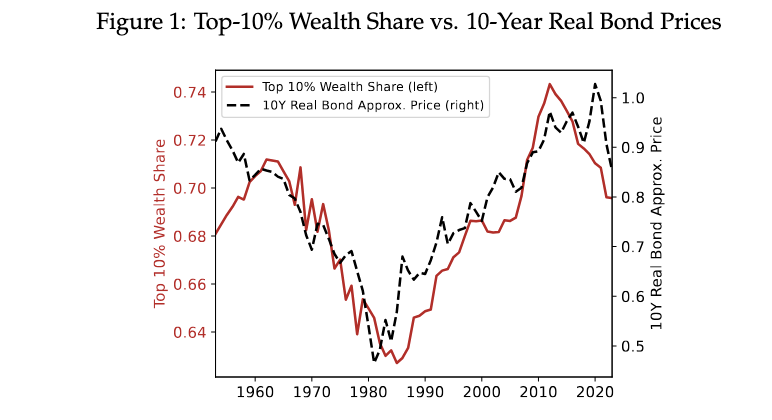
If you're an expert on wealth inequality, you have to start by acknowledging the basic asset valuation dynamics that drive financial wealth inequality. real rate r ↘️ implies top 10% wealth share ↗️, and vice-versa. Picture for US below.
The red solid line displays the top-10% financial wealth share for the United States from the World Inequality
Database. The black dash-dot line displays the 10-year real bond price approximating the real yield using the 10-year nominal yield and contemporaneous inflation.
https://t.co/Pi46lvKzh9
I think this critical point is totally lost on both the NIMBY left and the fascist right.
Countries with shrinking populations see a *massive* relocation from smaller to largest cities -- Tokyo, Madrid, Lisbon, Athens, Milan -- because, again:
Agglomeration effects are real.
@OjaKaspar 3/
It’s no longer “are we doing better than last year?” but “are we ahead of the EU average?” Even if fundamentals are kinda okay, the perception shifts when you’re always comparing to someone else’s scoreboard or travel abroad where you enjoy lower prices.
@OjaKaspar 2/
Eurostat rankings on inflation, real estate, electricity, birth rates, security concerns are all widely shared by ERR & other media, create a constant benchmark against Europe. People travel more, see differences firsthand, and judge Estonia's development accordingly.
OECD food inflation fell to 4.5% from 4.8% in March, while core inflation (inflation excluding food and energy) remained broadly stable at 4.6% from 4.5% in March.
🔗 https://t.co/0yuu96FUoY | #OECDstats | @OECD_Stat
@OjaKaspar That’s part of the reason why, at least in the West, TFR is crashing particularly among lower socio-economic strata. Stable relationship rates in these groups have collapsed, while those in higher socio-economic strata have declined more modestly.