From ocean waves to architecture 🤯
Idea → motion → form → final design
Built entirely with AI
And it still carries real-world elegance.
Prompt in the comment 👇🏻
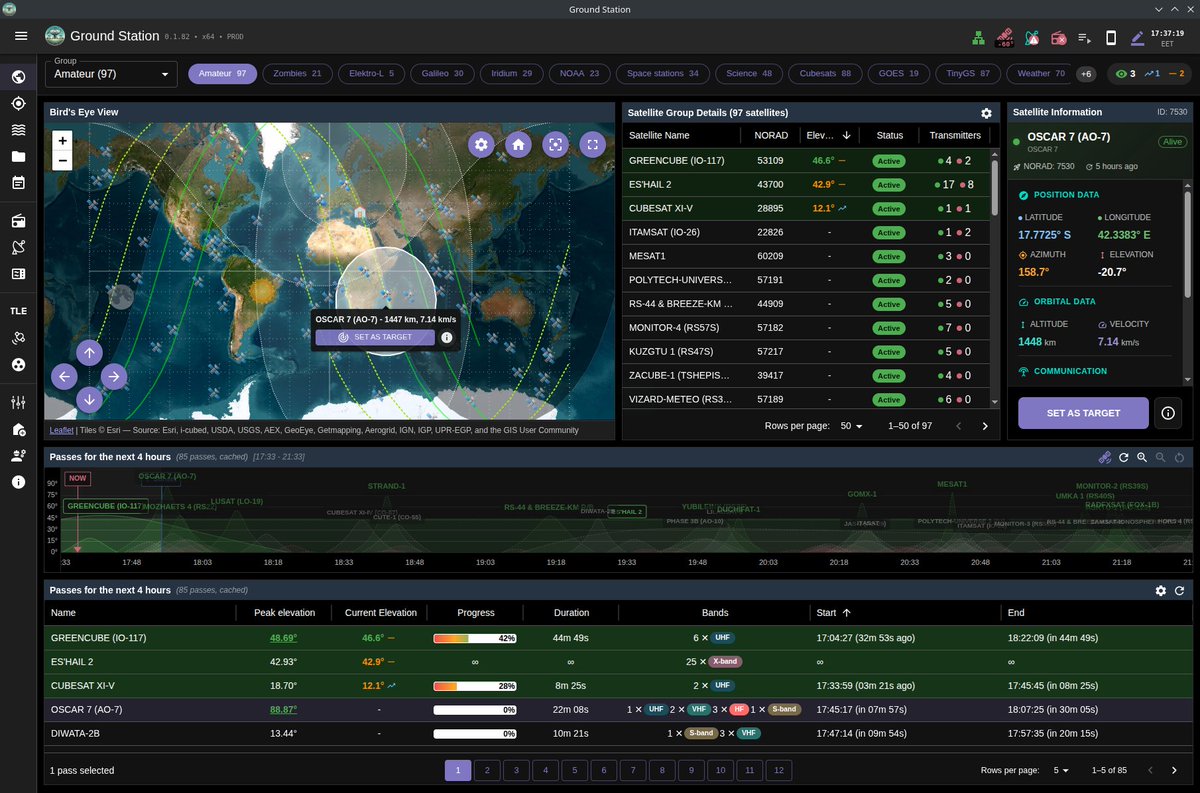
🚨 BREAKING: A developer built a full toolkit for pulling live weather imagery and raw data straight from satellites locally.
It's called Ground Station.
Basically, it needs no internet. It uses an SDR to download weather images and raw data straight from satellites in space and save it to your hard drive.
100% Open Source.
Wow!
AI ASSISTED GARAGE MANUFACTURING IS ABOUT TO EXPLODE!
CAD Drawings From Just A Picture!
MIT just released something profound for creators and engineers alike. Picture this. You take a photo of an object, upload it, and an AI delivers a fully parametric CAD model, complete with editable code and construction history.
This is open source GenCAD, from MIT's Decode Lab. It uses autoregressive transformers and diffusion models, trained on hundreds of thousands of images and CAD files. Input a 2D photo or sketch.
Output valid CadQuery Python code that beats models like GPT-4.5 in accuracy.
Why does this matter?
It speeds up reverse engineering, prototyping, and part searches in vast databases.
No more hours spent modeling from scratch. Field repairs, custom designs, education, all transformed. It even retrieves similar parts from libraries of thousands.
For industries like manufacturing and aerospace, it cuts costs and boosts innovation. Hobbyists gain pro tools without the steep curve.
I am testing it now on random objects and can not believe how much of a super power this is.
I can start dozens of companies just on this AI model.
This open-source gem is here: https://t.co/fm1VVrWuAW
The future of building stuff arrives in a snapshot.
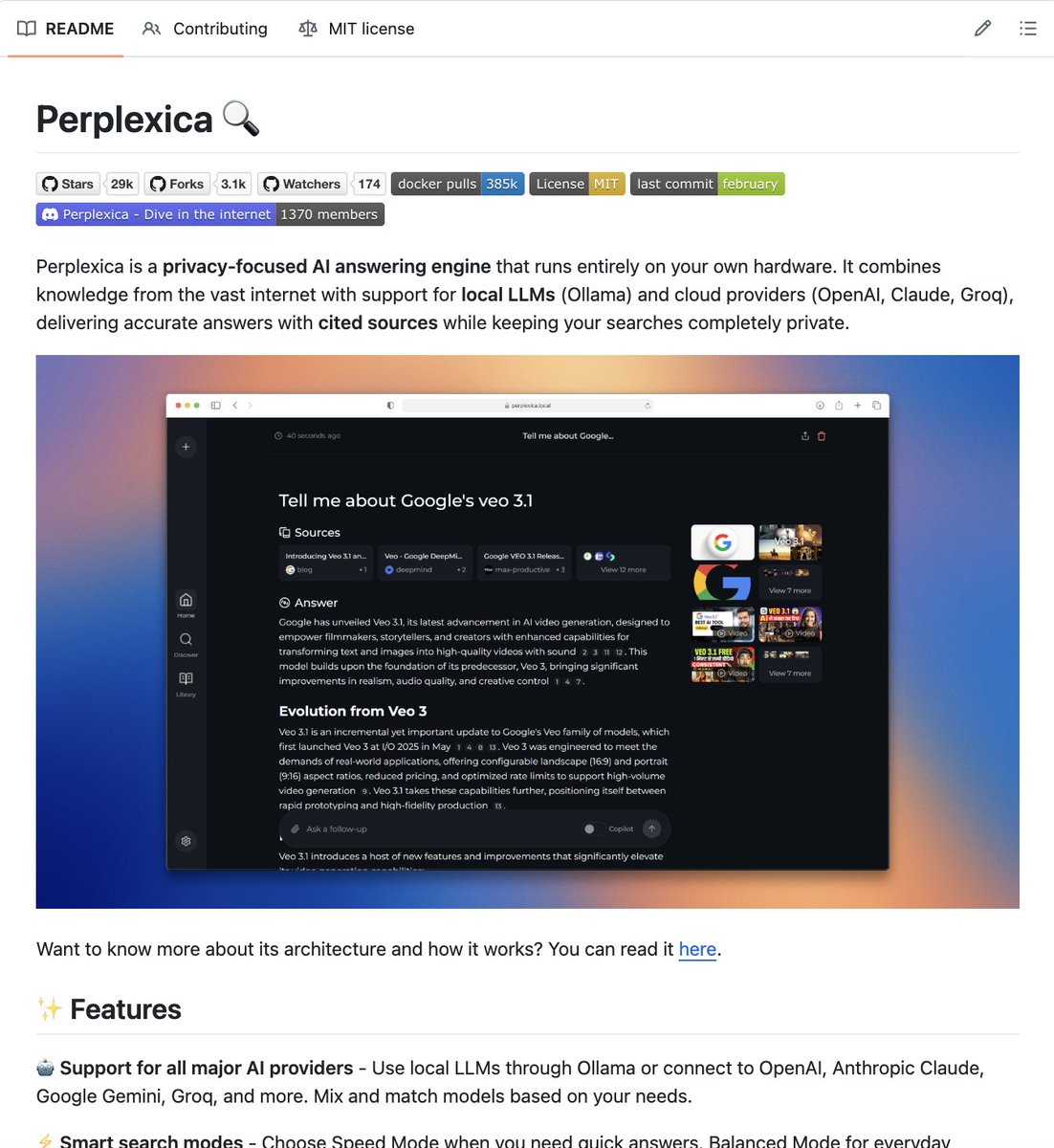
🚨 Someone built a full Perplexity clone that runs 100% locally for $0.
It's called Perplexica.
→ Searches the web in real-time
→ Cites every source it uses
→ Works with Ollama local models
→ Multiple search modes (general, academic,
YouTube, Reddit, writing)
→ Zero API costs. Zero data collection.
Perplexity charges $20/month for this.
This runs on your machine for free.
29K stars. MIT license.
(Link in the comments)
🚨 BREAKING: Gemini can now write and design an entire book in 48 hours.
Here are 5 insane prompts to become a published author this month:
(Save for later):
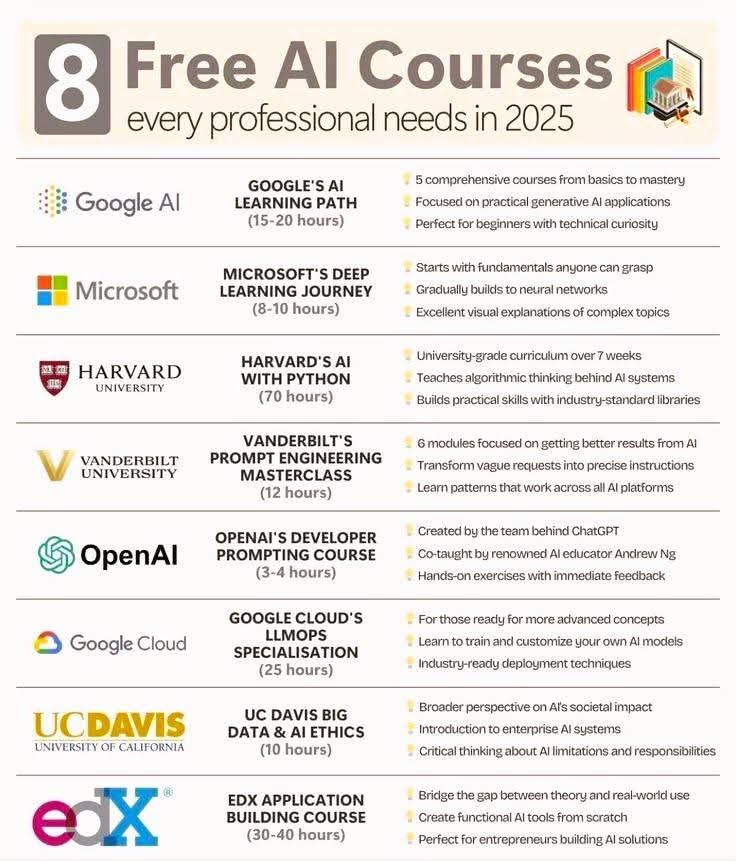
🚀 8 Free AI Courses Every Professional Needs in 2025
AI isn’t optional anymore — it’s the skill that separates top performers from the rest. I’ve curated 8 free courses from Google, Harvard, Microsoft, OpenAI & more that will skyrocket your career in 2025 🔥
💡 Whether you're a beginner or ready to build your own AI tools — there's something here for you:
1️⃣ Google’s AI Learning Path (15–20 hrs)
→ 5 practical courses from basics to mastery
→ Ideal for curious beginners
2️⃣ Microsoft’s Deep Learning Journey (8–10 hrs)
→ From fundamentals to neural networks
→ Visual explanations that make it click
3️⃣ Harvard’s AI with Python (70 hrs)
→ University-grade curriculum
→ Build real-world AI with Python libraries
4️⃣ Vanderbilt’s Prompt Engineering Masterclass (12 hrs)
→ Learn how to talk to AI effectively
→ Works across all platforms
5️⃣ OpenAI’s Developer Prompting Course (3–4 hrs)
→ Co-taught by Andrew Ng
→ Hands-on exercises with instant feedback
6️⃣ Google Cloud’s MLOps Specialization (25 hrs)
→ Train & deploy your own AI models
→ Advanced, industry-ready skills
7️⃣ UC Davis Big Data & AI Ethics (10 hrs)
→ Understand AI’s societal impact
→ Think critically about limitations & risks
8️⃣ edX Application Building Course (30–40 hrs)
→ Build functional AI tools from scratch
→ Perfect for entrepreneurs & builders
🎓 All courses are FREE + certificate included!
📌 Save this post. Share it with your team. Level up your skills.
👇 Drop a comment:
Which course are you starting first?
❤️ If this helped, give it a like to help others discover it too!
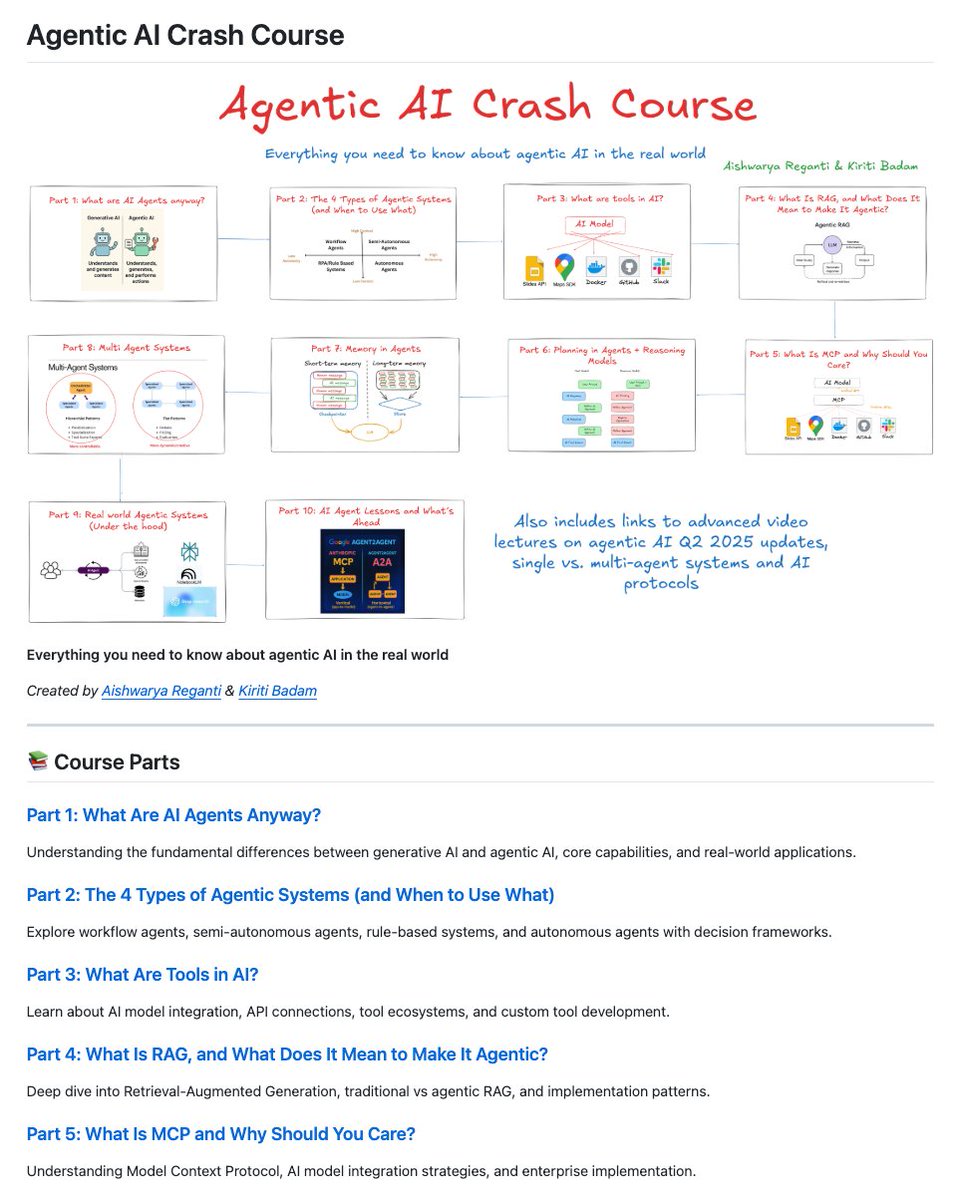
MIT and Oxford released their $2,500 agentic AI curriculum on GitHub at no cost.
15,000 people already paid for it.
Now it's on GitHub!
It covers patterns, orchestration, memory, coordination, and deployment.
A strong roadmap to production ready systems.
Repo in 🧵 ↓
My updated vibe coding tech stack, as a vibe coder who’s won three hackathons:
@lovable for websites or web apps. Makes it really easy to spin them up quickly with their own AI gateway and backend (rebranded Supabase).
@GoogleAIStudio for fun prototypes. Really easy to incorporate Gemini APIs, but harder to actually publish (for now. I’ve been reassured that they’re working on this.)
@boltdotnew for slightly more complicated websites/web apps/apps. For when you need access to the terminal.
@YouWareAI for websites and web apps. Lets you choose your model, and has an integrated backend product in YouBase.
@Replit for kind of in-between projects.
@anything for websites/web apps/mobile apps. Backend included, and makes publishing to the App Store easy.
@cursor_ai for anything you can think of.
@AnthropicAI Claude Code. Useful even when you aren’t working with code. Ask it to organize your files.
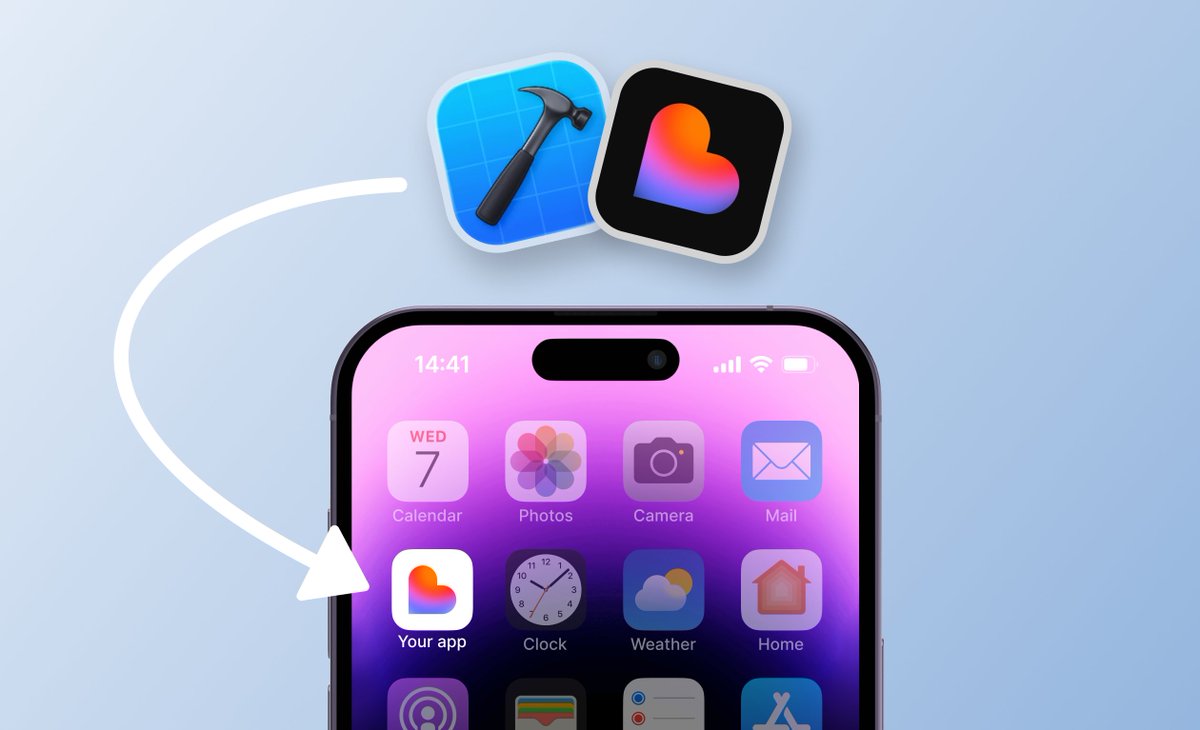
@rork@v_computer and @natively_dev for mobile apps.
@wabi for mini apps
@github for obvious reasons (Very useful for everything. If you’re starting out, I recommend thinking of it like a gateway between your code and your deployment/hosting provider.)
@Netlify for deploying and hosting. Here’s an example: you’re building in Cursor, you commit and push to GitHub, you start a new project in Netlify and adjust your settings so your project auto deploys every time you commit a change to GitHub. Easy!
@ChatGPTapp for brainstorming, collecting my thoughts, occasionally PRDs.
@NanoBanana Pro assets for your projects. Images, icons, etc.
@canva pro for their magic erase tool, and background removal tool. Use magic erase to remove image model watermarks, use the background removal tool to remove backgrounds and create transparent pngs. Also great for making favicons and open graph images.
@convex for databases
@supabase also for databases
@Namecheap for domains
@googlefonts for fonts (yes, you need to change the default font on your site)
@coolors_co for coming up with color palettes.
@mobbin and @dribbble for ideas.
Anything I’m missing?
Opus 4.5 for initial feature.
Gpt 5.2 to fix the edge cases and bugs opus can’t fix (trust me, ignore the hype, it is bad at times)
Gemini 3 pro to make it look nice (or use a claude ui-ux skill).
Composer1 to refactor it all quickly.
🚀 Learn AI in the New Year! Become an AI Engineer | Learn by Doing | Cohort 3
After the amazing success of Cohorts 1 and 2 (with close to 1,000 engineers joining and building real AI skills), I’m excited to announce the launch of Cohort 3 of Become an AI Engineer!
This isn’t just another course on AI tools and frameworks. Our mission is to equip engineers with the solid foundation and complete end-to-end skill set required to excel as AI engineers in today’s fast-moving world.
Here’s what sets this cohort apart:
- Learn by doing: Build real-world AI applications hands-on, far beyond just watching videos.
- Structured, systematic curriculum: Progress step by step from core fundamentals to advanced concepts in a carefully crafted learning path.
- Live feedback and mentorship: Receive direct guidance and reviews from experienced instructors and peers.
- Strong community support: Learning solo is tough — learning together with a motivated community makes it enjoyable and effective!
If you missed the previous cohorts and want to 𝐥𝐞𝐚𝐫𝐧 𝐀𝐈 𝐢𝐧 𝐭𝐡𝐞 𝐍𝐞𝐰 𝐘𝐞𝐚𝐫, this is your perfect opportunity to join Cohort 3 and level up your AI engineering career.
Check it out here: https://t.co/nqd3c8gugY
Just Recorded a Tutorial on How to Build a $12M AI Diet Planner App without writing a single line of code (step-by-step)
With Lovable + n8n, you can now launch a full AI meal plan app with custom plans, recipes, and shopping lists in minutes
Like + Comment "APP" to get the FULL Tutorial + n8n workflow FREE
(Must be following)
Turn complex documents into RAG-ready data!
Agentic Document Extraction (ADE) lets you convert visually complex documents into structured, grounded data and return a hierarchical JSON with exact element locations.
Traditional OCR pipelines only extract plain text, missing layout, structure, and visual context. LLM-based systems can interpret documents semantically but often struggle on large tables or complex multi-column layouts.
ADE bridges that gap. It combines visual understanding and structured parsing to extract not just text but also relationships, context, and layout. It identifies tables, figures, and visual regions, and links every extracted field back to its exact position on the page for full traceability.
ADE now comes with the new Parse Jobs API, an asynchronous API built for large-scale document processing.
Large files can slow everything down. With the Parse Jobs API, you can submit a document, get a job ID instantly, and continue your workflow while it processes in the background.
It supports files up to 1GB or 1,000 pages, making high-volume batch ingestion fast, reliable, and scalable.
Key features:
• Handles complex, large tables where typical VLMs and OCR pipelines fail
• Processes PDFs, images, DOC, and PPT files at scale
• Generates structured JSON and Markdown with hierarchy and layout retention
• Provides visual grounding with bounding boxes
• Built for async workflows
Link to the Github Repo in the comments!
Introducing: Sora Extend!
Generate Sora 2 videos of INFINITE length :)
Bypasses OpenAI's 12-second limit with intelligent prompt enhancement and additional last-frame context.
Open source, link here: