Bravo to @stevenstrogatz for attempting the impossible task of presenting the renormalization group method for singular perturbation problems in one lecture!
Here's a short thread that he inspired me to write while taking a break from final exam grading & COVID-19 work for UIUC.
Here's a thread about renormalization group and asymptotics. It's at the other place, which is nicer than here. I've never been trolled there. Maybe it's because there's nobody there 😞.
https://t.co/LliPWVmbeE
It's about this new paper
https://t.co/4jGnqcBrWT
@KameronDHarris News to me! Feel free to followup in email please. When you say it didn't work, do you mean (1) it didn't give the textbook answer, (2) it gave the same as the textbook so no improvement 😀, (3) gave a wrong answer or (4) couldn't give any result. Lots of failure modes! Thx.
@stevenstrogatz might be interesting to you for when you next teach asymptotics and perturbation theory. The thread is over at Bluesky but refers to the thread I posted a few years ago on Twitter about RG, after the video from your course on RG.
@CornellCAS@QuantaMagazine@stevenstrogatz Thanks to @stevenstrogatz for inviting me on his podcast, and for not minding when the Lyapunov exponent of the discussion turned positive as we riffed on various important themes at the intersection between science and philosophy.
https://t.co/gLhfqxAKeP
New paper showing that the laminar-turbulent transition in pipe flow is in the directed percolation universality class. We finessed the need for a 4km long pipe and 100 years of data using RG, molecular dynamics, and fine data on puff interactions.
https://t.co/1GTLTRrAM2
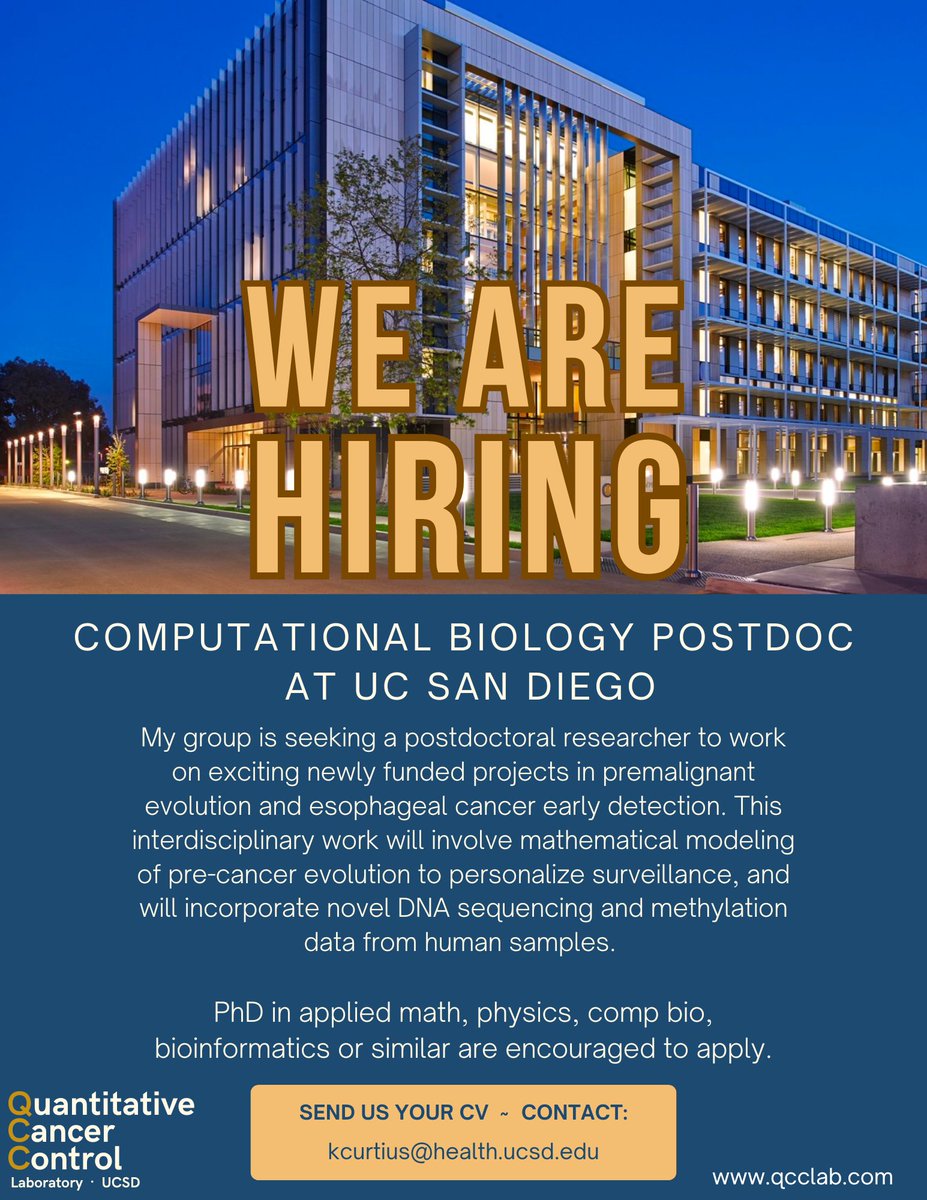
Postdocs! Please apply to join our lab and work on mathematical/computational projects in cancer evolution and screening. Happy to discuss any details and tell you all about us 🤓 Please RT #mathonco
Day 29/30 of great biology papers.
"Phylogenetic structure of the prokaryotic domain: The primary kingdoms," by Carl Woese & George Fox (1977).
Perhaps the most important paper in evolutionary biology. It established a "third domain" of life.
***
This paper is just 2.5 pages in length. It contains a single table as its figure. Its publication went largely unnoticed by biologists, but The New York Times printed a story about a "third type of life" on its front page.
Prior to this study, all life was divided into two categories: Cells that have a nuclear membrane (eukaryotes), and cells that don't (prokaryotes).
Francis Crick first proposed "comparing sequences to infer relationships" as early as 1958. But this paper heralded the dawn of molecular phylogenetics.
Woese and Fox claimed, provocatively, that "all cellular life falls into one of three large relatedness groups: eukaryotes...eubacteria, and archaebacteria."
(See https://t.co/JqGIpcfGJu)
They made this claim by sequencing a single, highly-conserved gene across many organisms: Ribosomal RNA. This is the catalytic part of ribosomes, the protein-making machines inside of cells. By studying how rRNAs had mutated over eons and eons, Woese and Fox inferred the evolutionary connections between cells.
Many well-regarded microbiologists at the time believed that the relationships between microbes could not be determined without a fossil record. This sounds hilarious in hindsight. But it was a real, mainstream belief.
Roger Stanier, who helped modernize microbiology and was a respected professor at UC Berkeley and the Pasteur Institute, wrote in his textbook, The Microbial World, in 1970:
"[r]eflection and experience have shown, however, that the goal of a phylogenetic classification can seldom be realized. The course that evolution has actually followed can be ascertained only from direct historical evidence contained in the fossil record. This record is at best fragmentary and becomes almost completely illegible in Precambrian rocks more than 400 million years old."
Overturning dogma and telling professors that they're wrong is fun! A classic.
One more day to go!
Paper: https://t.co/Phthq9tutl
@KateClancy Transposons are awesome! You can see them jumping in real time ...
https://t.co/xdfTApimSb
... and they may even have been a driving force for the emergence of the ancestral eukaryotic cells
https://t.co/f7NorbCSVG
Work done with my and the amazing Tom Kuhlman groups!
... to a naive and ignorant but enthusiastic kid. My first paper was an NPL internal report "Theoretical study of some properties of the selective interferometer filter".
Thank you, John. Never forgot you over the intervening years.
https://t.co/blSmvcb2Iv
Fondly remembering John Harries. He gave me my start as a professional scientist. I worked with him in my gap year before university, at National Physical Laboratory. My job was to compute infra-red absorption by the upper atmosphere.
... the basic equations describing the experimental setup of the apparatus, saw how basic physics could be turned into a predictive engineering design tool. I'd never seen anything like that before and it opened my eyes to how science is done. John was very kind & encouraging ..
We are all playing Covid roulette. Without clean air, the next infection could permanently disable you.
All, except apparently the members of UK parliament, world leaders at Davos ...
@kprather88 @jljcolorado https://t.co/9vgqDEY9HN
@chrischirp I'm in Japan right now. Everyone masks, 50% surgical, rest n95 or equiv. BUT everyone takes off masks in restaurants, bars, etc, & tend to stay socializing for long time, not eat & run. Health warnings are about fomites not aerosol but masking included. Not surprised by data.
@ToruNogawa@LumiereGalerie@musica_nao@riruha_xxx Absolutely stunning art! The technique and composition, especially of the watercolors, is unprecedented. I love the one of Issay. Thank you for sharing these beautiful creations.
Lumiere Gallery totally worth the visit if you're in Tokyo!


![NikoMcCarty's tweet photo. Day 29/30 of great biology papers.
"Phylogenetic structure of the prokaryotic domain: The primary kingdoms," by Carl Woese & George Fox (1977).
Perhaps the most important paper in evolutionary biology. It established a "third domain" of life.
***
This paper is just 2.5 pages in length. It contains a single table as its figure. Its publication went largely unnoticed by biologists, but The New York Times printed a story about a "third type of life" on its front page.
Prior to this study, all life was divided into two categories: Cells that have a nuclear membrane (eukaryotes), and cells that don't (prokaryotes).
Francis Crick first proposed "comparing sequences to infer relationships" as early as 1958. But this paper heralded the dawn of molecular phylogenetics.
Woese and Fox claimed, provocatively, that "all cellular life falls into one of three large relatedness groups: eukaryotes...eubacteria, and archaebacteria."
(See https://t.co/JqGIpcfGJu)
They made this claim by sequencing a single, highly-conserved gene across many organisms: Ribosomal RNA. This is the catalytic part of ribosomes, the protein-making machines inside of cells. By studying how rRNAs had mutated over eons and eons, Woese and Fox inferred the evolutionary connections between cells.
Many well-regarded microbiologists at the time believed that the relationships between microbes could not be determined without a fossil record. This sounds hilarious in hindsight. But it was a real, mainstream belief.
Roger Stanier, who helped modernize microbiology and was a respected professor at UC Berkeley and the Pasteur Institute, wrote in his textbook, The Microbial World, in 1970:
"[r]eflection and experience have shown, however, that the goal of a phylogenetic classification can seldom be realized. The course that evolution has actually followed can be ascertained only from direct historical evidence contained in the fossil record. This record is at best fragmentary and becomes almost completely illegible in Precambrian rocks more than 400 million years old."
Overturning dogma and telling professors that they're wrong is fun! A classic.
One more day to go!
Paper: https://t.co/Phthq9tutl](https://pbs.twimg.com/media/F0eF-eXX0AEZ_zC.png)




![NikoMcCarty's tweet photo. Day 29/30 of great biology papers.
"Phylogenetic structure of the prokaryotic domain: The primary kingdoms," by Carl Woese & George Fox (1977).
Perhaps the most important paper in evolutionary biology. It established a "third domain" of life.
***
This paper is just 2.5 pages in length. It contains a single table as its figure. Its publication went largely unnoticed by biologists, but The New York Times printed a story about a "third type of life" on its front page.
Prior to this study, all life was divided into two categories: Cells that have a nuclear membrane (eukaryotes), and cells that don't (prokaryotes).
Francis Crick first proposed "comparing sequences to infer relationships" as early as 1958. But this paper heralded the dawn of molecular phylogenetics.
Woese and Fox claimed, provocatively, that "all cellular life falls into one of three large relatedness groups: eukaryotes...eubacteria, and archaebacteria."
(See https://t.co/JqGIpcfGJu)
They made this claim by sequencing a single, highly-conserved gene across many organisms: Ribosomal RNA. This is the catalytic part of ribosomes, the protein-making machines inside of cells. By studying how rRNAs had mutated over eons and eons, Woese and Fox inferred the evolutionary connections between cells.
Many well-regarded microbiologists at the time believed that the relationships between microbes could not be determined without a fossil record. This sounds hilarious in hindsight. But it was a real, mainstream belief.
Roger Stanier, who helped modernize microbiology and was a respected professor at UC Berkeley and the Pasteur Institute, wrote in his textbook, The Microbial World, in 1970:
"[r]eflection and experience have shown, however, that the goal of a phylogenetic classification can seldom be realized. The course that evolution has actually followed can be ascertained only from direct historical evidence contained in the fossil record. This record is at best fragmentary and becomes almost completely illegible in Precambrian rocks more than 400 million years old."
Overturning dogma and telling professors that they're wrong is fun! A classic.
One more day to go!
Paper: https://t.co/Phthq9tutl](https://pbs.twimg.com/media/F0eGFOAXsAEOmXT.png)


