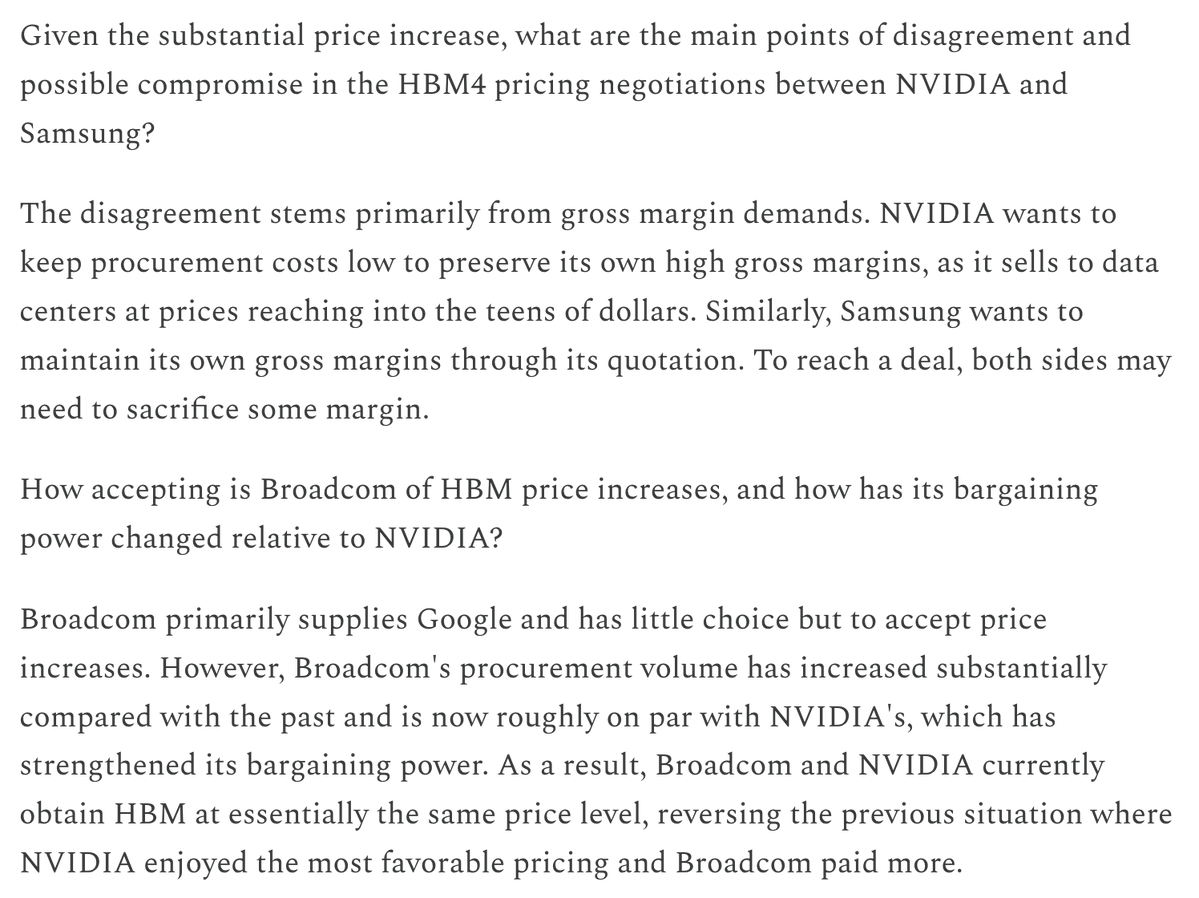
"However, Broadcom's procurement volume has increased substantially compared with the past and is now roughly on par with NVIDIA's, which has strengthened its bargaining power."
Broadcom’s volumes in 2027 will be massive. Many Taiwanese sources say TPU volumes will exceed NVIDIA’s in 2027.
The presumption that the Fed raising short-term rates reduces inflation is predicated on the belief that higher rates reduce demand and investment.
But what if higher rates don’t reduce demand and investment because the demand for intelligence and energy is unaffected by higher rates because winning the race for super intelligence has a near infinite ROI and the demand for compute will remain incalculable.
Why won’t higher rates at this unique moment in history therefore lead to more inflation as interest costs are embedded in everything?
And the problem is compounded as the more the Fed raises rates, the more inflation we will have and the more the Fed will need to raise rates further and so on.
But what if the old models don’t apply to the current paradigm and the Fed is wrong?
I think the Fed might have just made a mistake. Am I right or am I wrong?
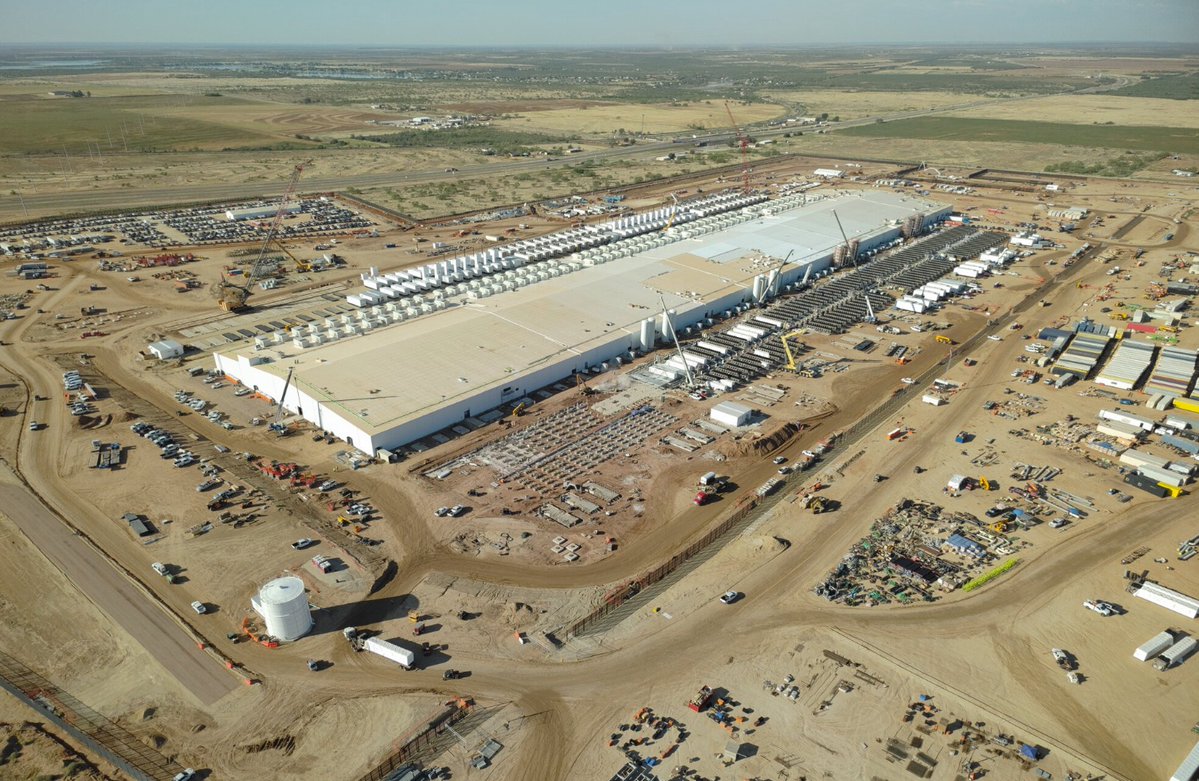
Cipher Digital Expands Barber Lake Lease Term to 20 Years, Increasing Revenue to Over $9 Billion
· Additional 10-year term adds ~$5.2 billion of contracted revenue at Barber Lake
· In connection with change orders and continued evolution of the tenant’s design, the lease amendment establishes a phased delivery schedule for the site, with individual data halls expected to be delivered between Q4 2026 and Q1 2027
· Cipher remains on track with the revised delivery schedule
“Extending Barber Lake’s contracted life reflects the enduring value of the infrastructure we're building,” said Tyler Page, CEO. “Barber Lake was designed as a long-lived, mission-critical asset, and securing a firm commitment that extends well beyond the original lease term demonstrates the long-term utility and strategic relevance of the campus, as well as the durability of demand for hyperscale computing capacity.”
Read the full press release here: https://t.co/CrHvKIKk7N
When the stock market goes down we dont check our portfolios
When the stock market goes up we check 20 times and tell everyone how good we are at investing
This is the way
$CRWV Dilution: Real Context with $IREN, $NBIS
There is an unjustified amount of hate on $CRWV's ATM + Convertible today. Some people are calling out that it's double dilution without doing homework on how much total dilution each Neocloud has done this year.
Convertibles vs ATMs
The same people calling for their favorite Neocloud to multi-bagger, are the same people saying convertibles are better than ATMs. These people ignore that if their favorite Neocloud becomes a multi-bagger, convertibles are share dilution just like an ATM. These people probably do not understand how capped calls work on convertibles.
But with convertibles, there is a capped call premium to the tune of hundreds of millions and semi-annual interest payments. Yes, I'm admitting this as an $IREN investor. Both, $IREN and $NBIS have relied more on convertibles than ATM. If you expect your stock grow significantly, convertibles are bad unless you can get them at 0-1% interest rates which $IREN has done for a good portion of theirs.
Effective Use of Dilution: Dilution vs ARR
Now, we want to measure how effective the capital from dilution is being used. In other words, how much incremental ARR each Neocloud will build out using that dilution.
CRWV
Incremental AI ARR = 2026 ARR - 2025 ARR = 19B - 5.1B = 13.9B
2026 Dilution: 10.5B
ARR per Dollar Dilution: 1.32
NBIS
Incremental AI ARR = 2026 ARR - 2025 ARR = 8B - 0.5B = 7.5B
2026 Dilution: 14.89B
ARR per Dollar Dilution: 0.5
IREN
Incremental AI ARR = 2026 ARR - 2025 ARR = 4B - 17m = 3.83B
2026 Dilution: 5.5B
ARR per Dollar Dilution: 0.69
$IREN has stated that they have only tapped 2.49B of their 6B ATM in 2026 and are funded for this year (1).
Conclusion
We can see here that $CRWV has the most effective use of dilution, with $IREN in second place, and $NBIS in last place.
$CIFR has played out almost exactly as expected.
We called the breakout, then identified yesterday that another selloff was likely. After today’s move, I’m watching for a potential bounce and the next leg higher.
Watch the video for the setup and why I’m bullish. 👇
Demand for Astra is really unprecedented. We're pulling all the levers possible to sustain the demand, but I've not seen anything like it until now and we went through very steep growth before. Priority will always be to keep excellent service for existing users, but we might have to pause new Pro subscriptions for a bit if this continues.
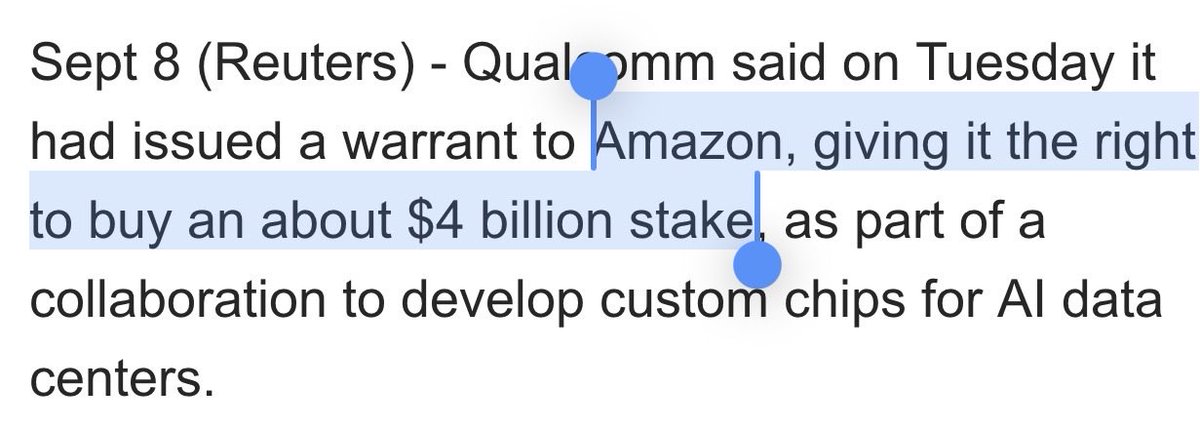
$AMZN signs a new deal with $QCOM, giving Amazon the right to buy a ~$4B stake of Qualcomm through warrants.
At this rate.. Amazon will be more of a semi ETF than $NVDA?
Given their existing equity/warrants with AlChip, $MRVL, $ALAB, $AAOI, and others.
This of course is linked with up to $60B in milestone revenue from Amazon/Qualcomm custom silicon partnership.
Good for both companies, moreso Qualcomm.
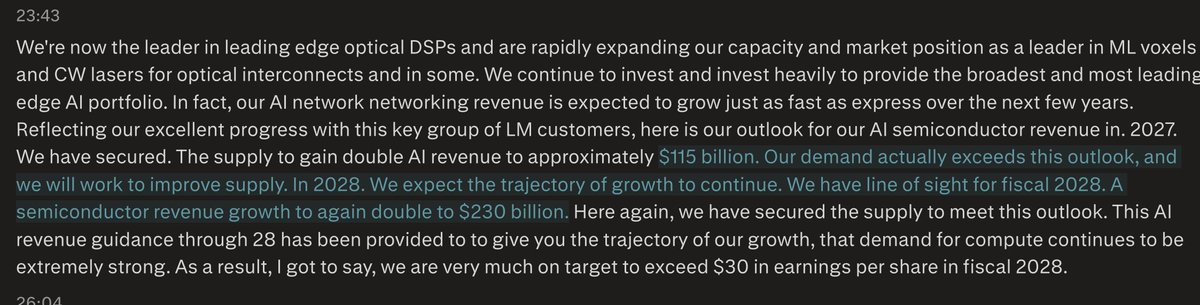
There we go, $AVGO earnings call to clarify miss. Broadcom expects:
FY27E: ~$115B (+100% growth)
FY28E: ~$230B (+100%), think analysts were modeling ~$180B.
Demand actually exceeds this outlook, and Broadcom will work to improve supply. This is way above street estimates, similar to $NVDA earnings.
"very much on target to exceed $30 in earnings per share in fiscal 2028." ~12.2x forward p/e (of $367/share)
Also just a brownie quote: "AI networking revenue is expected to grow just as fast as XPUs over the next few years."
Way more bullish forward guidance relative to next soft quarter revenue projections, think the few percent AH selloff was an overreaction.
Just my initial thoughts.
$QCOM v $ARM
We have some clarification on what is going on in the case - I'll cover it in the following tweets. (It's going to be a long one so buckle up).
TL;DR: October trial will still happen potentially on all counts(except 6 & 3), depending on how the bench trial goes.
As we saw from the minute entry on the docket (image 1) a new bench trail is happening the week of September 14th, and Arm won a summary judgement against count 3.
Regarding the bench trial it's fairly complicated why this is happening and most certainly will end up at appeal at the Third circuit. The bench trial is for Count 6, and for liquidated damages defense (I'll get into both). Qualcomm has count 4, 5, and 6. Which are core issues in the case and are intertwined with each other.
Count 4 is the alleged Intentional Interference with Prospective Economic Advantage. To win this claim Qualcomm is required to prove that Arm intentionally engaged in "independently wrongful conduct" that was designed to disrupt Qualcomm’s business relationships with third-party customers (like Meta and major device OEMs).
Count 5 is the alleged Negligent Interference with Prospective Economic Advantage. The alternative claim asserting that even if Arm did not intend the full extent of the market disruption, Arm owed a duty of care, knew or should have known that leaking confidential cancellation notices would disrupt Qualcomm’s customer deals, and acted negligently in causing that harm.
Qualcomm alleges that Arm executed a coordinated campaign to sabotage Qualcomm’s commercial relationships and sow fear among customers adopting Qualcomm’s custom Oryon/Snapdragon processors:
1. The October 22, 2024 Breach Letter: Arm sent Qualcomm a formal 60-day notice threatening to terminate Qualcomm's foundational Architecture License Agreement (ALA).
2. Within hours of sending the notice, Arm and its public relations firm (FGS) leaked the confidential letter to Bloomberg News.
3. Bloomberg published an article broadcast worldwide stating that Arm was moving to cancel Qualcomm’s architectural license within 60 days, raising immediate industry doubts about whether Qualcomm could legally manufacture or sell its chips.
4. Arm executives (including Chief Marketing Officer Ami Badani and the Board Chairman) made follow-up statements to reporters and customers claiming Qualcomm’s license would expire in 2025 and that TLA chips were jeopardized statements Arm’s CEO (Rene Haas) admitted under oath were "confusing" and "misleading."
Count 6 is the thing that 'ties this together' but also makes this trial extremely complicated. Count 6 is an equitable claim, which is heard at a bench trial (I'll explain a bit later how 4 and 5 relate to 6)
Count 6 is the Unfair Competition Law(UCL) which prohibits any "unlawful, unfair or fraudulent business act or practice." To succeed Qualcomm needs to show that QC and Arm are corporate competitors AND Qualcomm must prove conduct that:
1. Threatens an incipient violation of an antitrust law; OR
2. Violates the policy or spirit of an antitrust law; OR
3. Otherwise significantly threatens or harms market competition.
Qualcomm is alleging through their expert witness - who is an antitrust economist- an "Economic Input Foreclosure Model" where he attmpts to establish that Arm holds monopoly power in mobile ISAs, that alternative ISAs (like RISC-V or x86) are not viable substitutes for high-performance mobile devices, and that Arm’s refusal to license v10 on reasonable terms constitutes vertical foreclosure that harms overall market competition.
Along with their expert witness they have evidence that in 2020 after Qualcomm tried to elect a v10 extension there was an internal Arm communication that Arm employees explicitly discussed a deliberate internal plan to delay and obstruct Qualcomm's renewal.
In a recent hearing, General Dunn (Qualcomm's counsel), showed the Court the 2020 internal Arm email described above. Arm’s counsel Jason Wilcox attempted to explain it away by claiming it was just an internal discussion about deadlines. But as you can see Arm counsel is not exactly happy about the email:
│ The Court: "Pretty crappy e-mail, though, for a jury, got to tell you, you can't explain that away."
│
│ Mr. Wilcox (Arm Counsel): "It's not my favorite e-mail, either, Your Honor, but regardless I think that it doesn't go to whether the claims overlap."
Circling back to the logistics of Count 6. Since like I said above count 6 is an equitable claim it is tried in front of the court - not a jury. Generally, we would hear count 4 and 5 to the jury and in the evenings - or after the jury trial have the bench trial for count 6. This is based off Kairys v. Southern Pines Trucking, Inc. (75 F.4th 153 (3d Cir. 2023)) which is binding Third Circuit precedent governing federal judges in Delaware.
The core rule of Kairys is:
When a lawsuit contains both legal claims (decided by a jury) and equitable claims (decided by a judge) that share common factual issues, the Seventh Amendment requires the jury to decide the common facts first. The judge is then legally bound by the jury’s factual findings when ruling on the equitable claims.
Qualcomm is using Kairys to try to force all of its antitrust and unfair competition evidence in front of the jury. For Qualcomm to win its legal claim for Tortious Interference (Counts 4 & 5), it must prove that Arm engaged in independently wrongful conduct.
Qualcomm chose to use violations of the California UCL (Count 6) as that wrongful conduct. Therefore, Qualcomm argues that the facts underlying the UCL claim and the tortious interference claim are identical.
Under Kairys, Qualcomm argues Judge Noreika cannot hold an early bench trial on the UCL because doing so would strip the jury of its constitutional right to decide those facts first.
│ The Court: "You know what, we're not going to talk about this anymore. If I screw it up, I screw it up. I'm deciding the UCL issue before trial.
She asked Arm's counsel (some of the best research litigators in the U.S. from Kirkland) to file essentially an emergency 'legally find a way to let me hold this bench trial before the jury trial' which is why we have D.I. 925 on the docket.
This is why I am saying an appeal is coming. If she finds Arm did not violate UCL Qualcomm's whole case gets blown up as count 4 and 5 are moot. This is ripe for an appeal - which she knows.
│ The Court: "If I screw it up, I screw it up... You can appeal that. I am perfectly happy to have you appeal that and maybe it will be one less trial I have to have if I'm right."
So, why doesn't she just hold the bench trial after? You may ask. She's attempting to keep the "Antitrust Muck" away from the Jury. This is Judge Noreika’s primary concern, which she and Arm’s counsel raised repeatedly. The UCL claim is where Qualcomm brings in its broad, high-stakes competition theories that I highlighted above:
• Professor Posner’s "input foreclosure" economic theories.
• Arguments that Arm has a 99% monopoly in mobile ISAs.
• Internal Arm emails about market power and broken neutrality promises.
All of that seemingly is making Judge Noreika fearful of jury prejudice. The other counts in the case are simple contract and tort disputes. Judge Noreika is concerned that parading broad antitrust accusations in front of a lay jury will poison the well and lead to a runaway, emotional verdict against Arm.
If Qualcomm Wins the count 6 UCL bench they get to bring all that in for count 4 and 5 - and it strengthens their story.
So, what she's trying to do is hear the UCL evidence first in a clean, 3-day bench trial and if she rules that Arm did not commit an unlawful or unfair business practice under California law, she can exclude all of that prejudicial antitrust evidence from ever reaching the jury in October.
Another reason she may want to hold the UCL first is a timing issue. This case will need 3 trials (One jury, and 2 bench.) In Arm v. QC there was a bench trial held in the evenings to try the equitable counts. The October trial will do the same, trying count 1 and 9 before the bench after the Jury goes home. Then to have yet another trial the week after for count 6 (even if the jury finds no on 4, 5) seems to be annoying her.
Now we're not done yet - also being heard in the September bench trial is a threshold legal validity defense from Arm surrounding something called 'liquidated damages'. In Qualcomm's ALA and TLA they have a provision, Section 8.3 (which reduces royalties to zero upon certain breaches) which Arm is arguing it is an unenforceable penalty because it results in a forfeiture disproportionate to any actual damage suffered. Arm claimed Qualcomm is attempting to turn minor support omissions into an excuse to withhold royalties. Arm argued that allowing royalties to drop to zero over minor technical disputes creates an absurd, disproportionate 'windfall'.
Qualcomm argues Section 8.3 was intensely tailored and negotiated over two years by sophisticated counsel and was strictly restricted to catastrophic breaches. Under California law, enforceability is judged by the harm anticipated at the time of contracting, not hindsight damages. Withholding chip deliverables threatens Qualcomm's entire silicon roadmap. Section 8.3 contains an express cure period (giving Arm the choice to perform or cure) and a liability cap. Qualcomm emphasized that Section 8.3 was negotiated as the sole and exclusive remedy, meaning if the Court struck it down, Qualcomm would be left with no remedy for intentional deliverable withholding.
Qualcomm is also arguing that It is NOT a 'liquidated damages' but a contractual condition / price term. That is another way but a bargained-for contractual condition / price adjustment which kicks in If Arm delivers the technology, Qualcomm pays royalties; if Arm fails to deliver the technology, the royalty rate is $0. If it is just an agreed price term or alternative performance, California’s strict "penalty" laws do not apply at all.
What does the judge think?
Well first, she is leaning towards liquidated damages, which is why I put the first paragraph first, and Qualcomm's "not a liquidated damages" second:
│ The court: "Let me give you some insight as to my thinking which is as to whether the provisions are, in fact, liquidated damages clauses, I think I am leaning towards the fact that they are. That liquidated damages... there is some cases that have been cited that suggest that liquidated damages clauses do not always have to offer complete certainty at the time of the breach.
Now that she's established (sorta) that they're liquidated damages, what does she think about liquidated damages:
��� The court: "I get your point, Mr. LoCascio, that they think they have like a lottery card, doesn't seem like a strong lottery card to me, but I haven't yet decided it, so you're going to have to play with that risk, too.
The burden of proof is entirely on Arm to prove that Section 8.3 was unreasonable as of the ALA/TLA signing back in i guess it was 2013.
1. Qualcomm must show that in 2013, predicting the dollar value of Arm withholding critical architecture deliverables was virtually impossible (a delayed silicon tape-out can cost billions or wipe out a multi-year processor generation).
2. Qualcomm must prove that tying the remedy to royalty relief made economic sense: If Arm fails to deliver the architectural tech needed to build the chips, Qualcomm should not owe royalties on that tech.
3. Show Judge Noreika that Section 8.3 is not an arbitrary hammer - it has a mandatory 30-day notice and cure window (Arm had the choice to cure) and a liability cap.
This sets up a two-step process between September and October:
Step 1: (September Bench Trial: Legal Validity): Qualcomm must prove to Judge Noreika that back at contract signing, Section 8.3 was a reasonable liquidated damages clause designed to protect against catastrophic deliverable withholding, not an arbitrary penalty.
Step 2: (October Main Trial: Factual Breach): If Judge Noreika upholds Section 8.3 in September, Qualcomm then proves the factual breach at the main trial -showing that Arm freezing 100,000 ACK test vectors and OOB validation suites was an actual breach of Section 5 Deliverables (rather than mere 'support tickets'), officially triggering the $0 royalty remedy.
So, what should Qualcomm counsel focus on?
1. The Architecture Conformance Kit (ACK) is not general customer service. It is the proprietary test suite (hundreds of thousands of test vectors) that verifies whether a custom CPU core (like Oryon) accurately executes the Arm Instruction Set Architecture (ISA).
• Without the ACK updates, a chip designer cannot verify silicon functionality, cannot tape out with foundries (like TSMC), and risks catastrophic silicon-level bugs.
2. The 100,000 Test Metric:
• Qualcomm must put engineers on the stand to testify that 100,000 missing ACK tests and Out-of-Band (OOB) patches meant Qualcomm was building custom silicon blind, without the essential compliance tools Arm was contractually bound to provide under Section 5 of the ALA.
3. Connecting Breach to Section 8.3:
• In the ALA, Section 8.3 triggers only for Section 5 deliverable withholding.
• Qualcomm must establish that Arm's decision to freeze ACK test deliverables was an intentional, structural attempt to halt Qualcomm’s custom silicon program the exact event Section 8.3 was designed to remedy.
Perhaps the withholding of the test vectors is why the x-elite cpu has so much errata (here are two such examples):
1) Some instructions crash the CPU: https://t.co/3NbHLT5iJE
2) Qualcomm's implementation of some random number generator needs to be disabled because it doesn't work: https://t.co/1E7xNEtNC0 "RNDRRS is still broken just like X1E, so disable the RNG feature"
So what does John Dorbal think? I think, like I said above, the ALA is the stronger of the two section 5 breaches. I think Judge Noreika will find for Qualcomm that Section 8.3 is a valid and reasonable liquidated damages.
Section 8.3 is the "Sole and Exclusive Remedy". When the parties negotiated the ALA, Arm insisted that Section 8.3 be Qualcomm’s sole and exclusive remedy for deliverable withholding under Section 5. Arm bargained to ensure Qualcomm could not sue them for massive, open-ended consequential damages (like lost market cap or billions in consequential silicon delays). In exchange, Qualcomm received the right to royalty relief under Section 8.3.
The Problem with Arm’s Argument, If Judge Noreika strikes down Section 8.3 as an "unenforceable penalty," Arm gets the ultimate free pass.
1. Arm contractually blocked Qualcomm from seeking general consequential damages.
2. Arm would now have successfully voided the sole contractual remedy (Section 8.3).
3. Arm could withhold Section 5 architecture deliverables with total impunity while continuing to collect billions in royalties.
Under contract law, that would make Arm's delivery obligation completely illusory (a promise with zero legal enforceability).
I think if she does go for QC on 8.3 she'll be annoyed and tell Arm and their counsel 'well you put it into the contract' in the blunt manner I've come to love from her. But we will see.
Lastly on summary judgement, I outlined what was going on here (https://t.co/pQiayX7pJK) I thought QCOM would win their #1 SJ – which they didn’t – but really they did as Arm asserted it wouldn’t try to relitigate Arm v QC which made their SJ somewhat moot. Arm lost their #1 SJ which I thought they would, but in a surprise turn of events Judge Noreika granted their #2 SJ. Probably because she let Qualcomm’s count 9 in which encompasses count 3. (Qualcomm is suing for the exact same v10 conduct under both an implied covenant theory (Count 3) and an express breach theory (Count 9).
More updates as they come out.
Project R.I.S.E Beta is almost here!
SIGN UP FOR THE BETA TEST RIGHT HERE: https://t.co/rLbRmiMA88 and join us on our Discord right here: https://t.co/ie0nnyuSnR so you can provide feedback on the game once you start playing.
We will see you on our Discord on August 19th!