PE portfolio company chairman and Investor. Husband, dad, grandpa and dog owner. Telemark skier & golf enthusiast. Tweets in English, på Svenska ja Suomeksi
Modern engineering is designed to fail.
Not because engineers are bad. Because the business model requires it.
The Voyager probe, launched 1977, is still transmitting from 24 billion km away.
Your laptop lasts 4 years. Your earbuds - 2.
We don't lack the capability to build for centuries. We lack the incentive.
This is the biggest lie in engineering: "We're pushing the limits."
No. We're managing them.
A matter of trust.
Every year, Finland tops the World Happiness Report. Economists point to welfare systems. Sociologists cite education. But having visited Finland — and eventually bought an apartment in Vantaa — I think the real answer is something harder to measure.
It's trust. Not as a value on a poster. As the actual foundation of how society works.
From the very first trip, it struck me. People trust strangers. Institutions trust citizens. The state trusts its people to make good decisions, and people trust the state not to abuse that. It sounds simple. It is anything but.
When I went through the process of buying property in Finland, the contrast with other places I know was almost surreal. The system assumed good faith — at every step. No one treated me like a potential problem to be managed. That trust wasn't naive. It was structural, built over generations into laws, culture, and everyday habits.
And here's the thing about trust: it's self-reinforcing. When people trust each other, they cooperate. When they cooperate, things work. When things work, trust deepens. Finland isn't happy despite its challenges — it's resilient through them because the social fabric holds.
Happiness reports measure outcomes. Trust is the mechanism. That's what Finland quietly taught me. 🇫🇮
He killed 542 men in 100 days without ever looking through a scope.
Then he disappeared back into an ordinary life — so ordinary that the world nearly forgot he had ever existed.
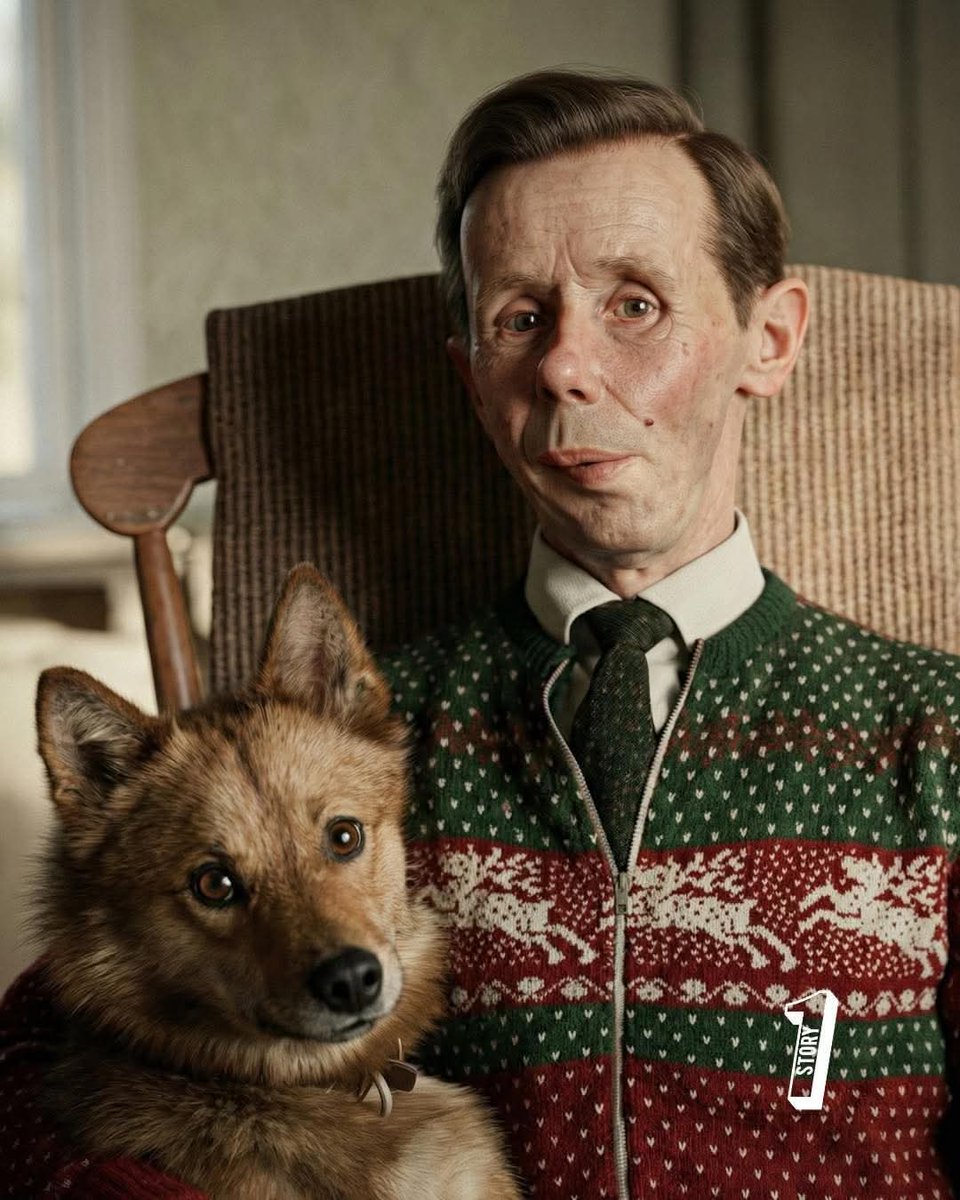
Simo Häyhä was small in stature — five foot three — stocky and quiet. His hands were calloused from farm tools, not polished by ceremonial sabers. In the rural southeast of Finland, near the village of Rautjärvi, he was known as a dependable neighbor. He hunted. He farmed. He kept to himself.
Nothing about him suggested legend.
Then came November 30, 1939.
The Soviet Union invaded Finland, beginning what would later be known as the Winter War. Moscow expected a swift campaign. The Red Army brought roughly half a million soldiers, along with tanks, aircraft, and artillery. They outnumbered Finnish forces by nearly three to one. On paper, it looked less like a war and more like an inevitability.
But snow does not follow paper calculations.
That winter was merciless. Temperatures dropped to minus 40 degrees. Engines froze. Metal stuck to bare skin. Forests swallowed sound. The Finns knew the terrain the way farmers know their fields and hunters know animal tracks.
Simo Häyhä was one of those men.
He had grown up skiing through those forests, reading wind and shadow, standing motionless until game appeared. When he joined the Finnish Army, he did not transform into something new. He simply applied the skills he had built over years to a different purpose.
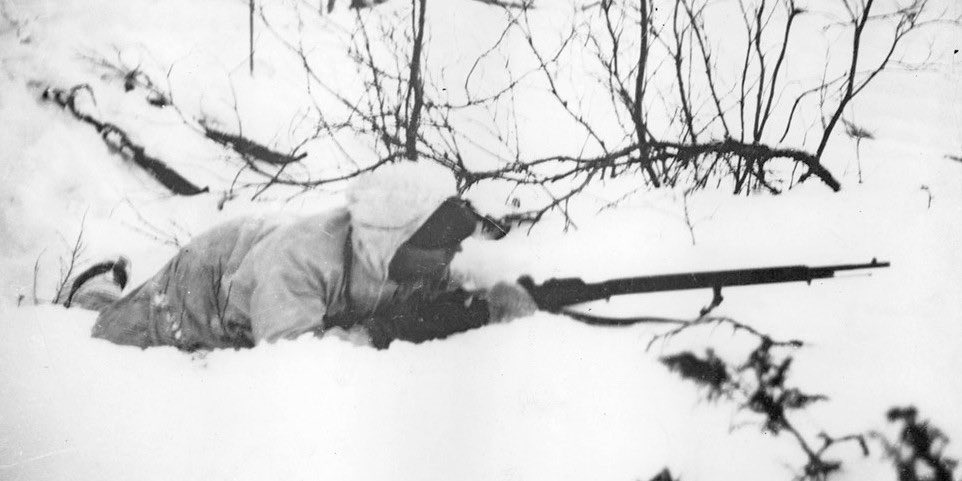
Dressed head to toe in white, he vanished into the snowfields. He packed snow in front of his rifle barrel so the muzzle blast would not kick up powder and reveal his position. He held snow in his mouth to cool his breath, reducing the visible vapor that could give him away in the cold air. He lay still for hours, sometimes entire days, letting the forest settle around him.
He did not stalk.
He waited.
What made him especially dangerous was a choice most snipers would consider illogical.
He refused to use a telescopic sight.
While others relied on scopes, Häyhä used only iron sights — the simplest aiming system available. He believed a scope could reflect sunlight like a signal mirror. It required lifting the head slightly higher, increasing visibility. In extreme cold, lenses could fog or freeze. Iron sights were lower, sturdier, and more reliable.
He trusted his rifle and his eyes.
In fewer than 100 days of combat, he recorded more than 500 confirmed kills with his rifle. Some estimates place the number at 542. That figure does not include additional enemy soldiers he killed with a submachine gun in close combat.
Five hundred men. In forests locked in ice. In a war his country was not expected to survive.
The Soviets gave him a name: the White Death.
White Death.
Sniper teams were dispatched to hunt him. Entire units were tasked with finding one farmer in a white jacket. Artillery shelled forests where scouts believed he might be hiding. Officers warned soldiers against careless movement across open ground. The idea that one man could inflict such damage deeply unsettled them.
He was no longer just a sniper.
He became winter with a trigger.
On March 6, 1940, a Soviet explosive bullet — designed to maximize damage — struck him in the face. It shattered his jaw, tore through his cheek, and disfigured the left side of his face. Comrades found him unconscious, barely recognizable, and carried him from the battlefield, assuming he would not survive.
He fell into a coma.
Seven days later, he opened his eyes.
The day he regained consciousness was the day the war ended.
Despite overwhelming odds, Finland endured. The country lost territory but retained its independence. Häyhä, disfigured and permanently changed, survived the conflict that turned him into a myth.
Then he did something almost no one expected.
He went home.
No book deals. No speeches about heroism. No attempt to turn reputation into money. He returned to Rautjärvi, to fields and forests.
Idag hissade vi 🇺🇦 flagga på @FinAmbSthlm. Finland stöder Ukrainas självständighet, självbestämmanderätt och territoriella integritet. Vi står vid det ukrainska folkets sida – så länge det krävs. #StandWithUkraine
How seriously do we Finns take skating, exactly?
Each green square on the map represents an open outdoor skating rink maintained by the city of Tampere.
As of now, there are ~150 open skating rinks for a population of ~260k.
Plus, there are routes on the lakes!
Ruotsi on tehnyt juuri oikein kotimaisen yksityisen pääoman kerryttämiseksi ja kannustamiseksi investointeihin.
Norjalla on varaa mokata tämä.
Suomella ei ole.
Tehdään kuten Ruotsi! 👍
”Alkoholinkäyttö on vähentynyt 20 v samaan aikaan, kun alkoholipolitiikkaa on monin tavoin vapautettu. Teorian mukaan niin ei pitänyt käydä. Tutkijoilla on ollut vaikeuksia selittää, miksi heidän ennustuksensa ovat kerta toisensa jälkeen menneet pieleen”. https://t.co/zTQLlG8GBx
Loistava kirjoitus @KL näkyvästä 5mrd€:n talouden jarrusta!
Perintövero tulppaa Suomeen sitoutuneiden perheyritysten investointeja, kun varaudutaan verojen maksuun.
Ne pitäisi käyttää yrityksen kehittämiseen, kasvuun ja työllistämiseen.
#Perintövero https://t.co/LuhN73uDit
Stalin sent half a million troops into Finland in 1939, confident the country would collapse in days. Instead, the Red Army met Simo Häyhä, a quiet Finnish farmer. Five feet tall. Iron-sighted rifle. No scope. In less than 100 days, with temperatures below –40°C, Häyhä recorded 505 confirmed kills, the highest sniper tally in military history. Soviet troops gave him a name that spread fear through the ranks: “The White Death.” But this isn’t a fairy tale about one man winning a war. It’s a lesson in what happens when individual resolve is aligned with a cause greater than the self.
Häyhä didn’t fight for fame or ideology. He fought for his home. He avoided scopes so sunlight wouldn’t betray him. Packed snow into his mouth so his breath wouldn’t fog the air. Used patience, terrain, and discipline against an army that underestimated both the land and the people defending it.
Finland didn’t fall in days. It held out, shattered Soviet assumptions, and forced the world to rethink power.
Häyhä survived a devastating facial wound, lived to 96, and never boasted. When asked how he became so deadly, he replied with one word:
“Practice.”
The story doesn’t prove that one man can win a war. It proves something more enduring:
When a nation is worth defending, a single determined defender can make an invader pay dearly, and sometimes stand as the clearest expression of a people’s will to endure.
Looking back, a lot of choices across my career ended up compounding in ways I didn’t fully see at the time.
And if I have a default mode, it’s just doing things.
So I did.