Verification doesn't have to be formal to build trust.
System One models are informal proof checkers that strike a balance between accepting what is "intuitively correct" while still forcing the author to spell things out at a higher level of detail.
https://t.co/iMFfd2vzrS
This is a great talk with a gem slipped in during the last couple of minutes: codemode combined with decision models let agents codify judgement and decision criteria—in a way that is repeatable, cheap, introspectible by humans, yet still bitter lesson pilled.
Management is an interface into which we’ve built increasingly expressive forms of intelligence. Hierarchies, standards, and APIs encode ways to coordinate work but are kind of dumb computationally. AI adds more expressiveness to this interface
@barsisyphus@sachinnbenny Software architecture lens on org design? Total catnip, great work @sachinnbenny. Feels like this is highly complementary reading to @jack s https://t.co/UfEyvMHG2L
Verification doesn't have to be formal to build trust.
System One models are informal proof checkers that strike a balance between accepting what is "intuitively correct" while still forcing the author to spell things out at a higher level of detail.
https://t.co/iMFfd2vzrS
Verification doesn't have to be formal to build trust.
System One models are informal proof checkers that strike a balance between accepting what is "intuitively correct" while still forcing the author to spell things out at a higher level of detail.
https://t.co/iMFfd2vzrS
Jev is also flawed in the same way a human reviewer is: when a claim admits multiple readings of which only one is correct, Jev picks the obviously dominant one like a human reader would.
The promise is not perfection but scalable agentic verification of domains that are hard to formalize, or where the resulting formalization is too complex for humans to follow allong.
@_chenson__ I just wrote about this. The idea is to use a System One model as a proof checker for informal proofs. That has at least the potential to get to the necessary scale while making it easier for human readers to follow along.
https://t.co/iMFfd2vzrS
E.g. anything where complex infra (security, governance, inference, distributed transactions...) is currently only available through prescribed UI/workflows. Squinting as an outsider, but what @hexanalytics did with their recent 4.0 platform seems like an interesting example https://t.co/K6z61U2GH5
The point of a database is to structure your data in advance to enable efficient retrieval. This need doesn't go away with agents. But the space of interesting prearrangements gets dramatically more interesting! I've been enjoying chatting with @NikolasGoebel about this and excited for you to see it too.
I wrote about databases (what else) as part of the @AmplifyPartners writing fellowship.
We revisit the oldest trade-off in databases: performance vs flexibility.
Thank you to @barsisyphus for editing, and to @narayanarjun for sanity checking.
Many are proclaiming the death of the database and saying agents will just use filesystems. This is dumb.
Instead, agents may enable everyone to “3D print” their own custom DBMS e.g. a @TigerBeetleDB for every company.
https://t.co/zNnbcRG0Zr
Economically viable specialization also has security implications. As @halvarflake observed in https://t.co/GoVsxndzzp:
> For most of human history, a more complex device was more expensive to build than a simpler device.
> This is not the case in modern computing. It is often more cost-effective to take a very complicated device, and make it simulate simplicity, than to make a simpler device.
Now with AI we could potentially end up using an insanely complex device to build simple devices optimized for specific use cases — and thus much less exploitable.
A DuckDB database is a really expressive interface to the data lake, because it lets the producer control every physical aspect (partitioning, format, compression) in a way that is completely transparent to the consumer. Even white box compression is possible, because the producer can encode whatever query plan is needed to reconstruct the full dataset.
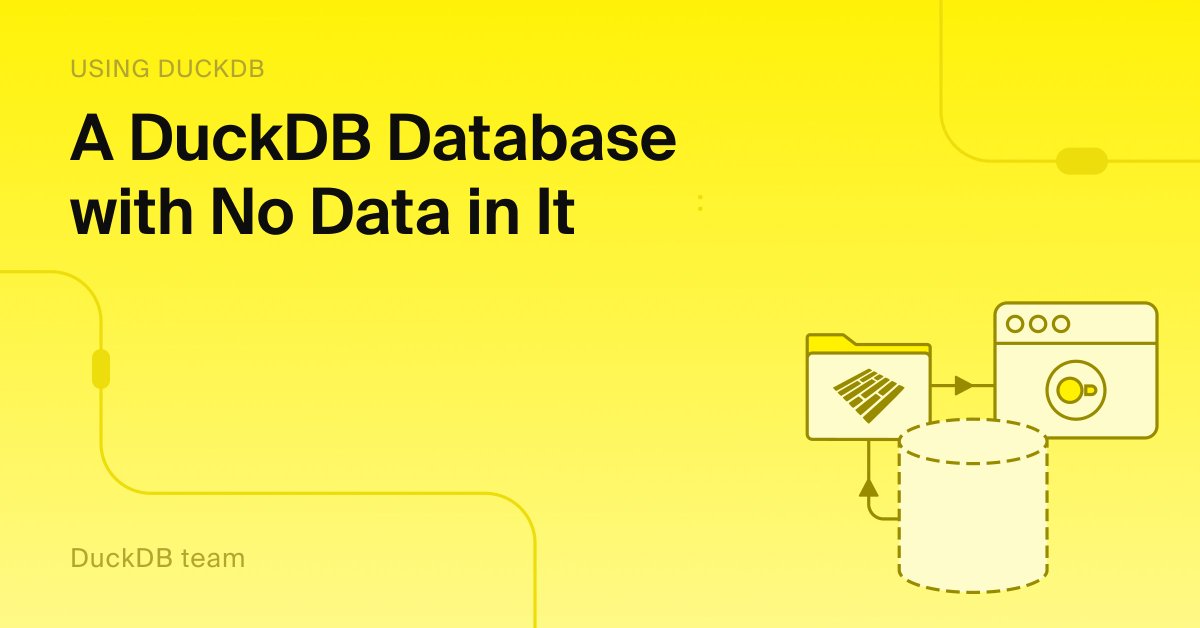
A DuckDB Database with No Data in It 🦆 🫨
A DuckDB database file does not have to contain any data. It can store nothing but view definitions that point at files stored somewhere else, such as Parquet on object storage.
The file stays a few hundred kilobytes no matter how large the data it describes, and anyone who attaches it sees a set of named relations that are ready to query.
@NikolasGoebel described this idea in his post “DuckDB doesn't need data,” which argues that modern databases have separated where data is stored from how it is read, to the point that most databases no longer need to hold any data of their own.
From that perspective, #DuckDB becomes a browser for the data cloud, where you access a dataset through a URL rather than a copy on your own disk.
In this blog post, we turn that idea into a small, shareable catalog: https://t.co/bWkhrEqEay