on ai-native systems
as systems take on better abilities to (machine) learn about their users and environments, we’ll see a shift from static to more dynamic products
recommendations, computer vision etc as ml techniques have been embedded as part of the app layer for a decade+ now
but what about the rest of the stack? what will generative ai-native browsers, operating systems, networks etc look like that are more adaptive and incentive aligned to the user’s short and long term preferences
This post looks like the start of a VERY sophisticated and well-funded PR operation to get support for Democrats to regulate AI into oblivion. Let me show you how it works:
1.) This guy, with minimal followers and no previous account activity, goes to the Wall Street Journal which publishes an exclusive with quotes from him on his resignation 18 minutes BEFORE this post goes up. Planning was clearly done in advance.
2.) Within hours, it has tens of thousands of reposts and the account has 100k+ followers. The post is punchy, quotable, it almost seems professionally written. The first three accounts to quote tweet it all do so within 15 minutes of the initial posting. Remember, this account had basically zero engagement beforehand, so an organic reach explanation seems unlikely.
According to Grok those accounts are @_NathanCalvin (General Counsel at Encode AI), @peterwildeford (Head of Policy at the AI Policy Network), and @DKokotajlo (Head of the AI Futures Project), all of which are up-and-coming AI-Doomer policy advocacy nonprofits.
The AI Futures Project website says it is funded “primarily” by the Survival and Flourishing Fund, which says on its own website that it has advised Jaan Tallinn, Skype creator and one of the leading investors in Anthropic, to grant over $2.5 million to the AI Futures Project since 2024.
Encode AI says on its website that it is ALSO funded by the Survival and Flourishing Fund, which in turn says that it told Anthropic investor Jaan Tallinn to grant $516,000 to Encode AI in 2025.
And wouldn’t you know it, the Survival and Flourishing Fund ALSO says it told Jaan Tallinn to grant $2 million to the AI Policy Institute, the 501(c)(3) affiliate of the AI Policy Network, as well.
What are the odds that the first three quote tweets of Coxon’s post would all be major AI-restriction policy advocates funded generously by the same donor, who also happens to be one of the leading investors in, and a board member of, Anthropic, the company Coxon was resigning from? And all within 15 minutes of posting (two within ten)?
3.) Jacob Coxon doesn’t have much of a resume, but we do know that, in 2022, he got a $20,159 scholarship for the “long term future scholarship program” from the Good Ventures Foundation, one of the philanthropic vehicles of Dustin Moskovitz, a notorious AI-doomer who has spent tens if not hundreds of millions on policy advocacy to strictly regulate AI, while also being an Anthropic Investor himself.
It also just so happens that the 14th person to quote Coxon’s post was @MaxNadeau_ (27 minutes after posting) who is the program officer for the Technical AI Safety team at Coefficient Giving, another of Moskovitz’s philanthropic spending vehicles. Max is not a frequent poster, his last posts before quoting Coxon were before Labor Day, but he was remarkably quick off the mark for this one.
4.) Basically every major Democrat politician and candidate has suddenly glommed on to this post, and conveniently, as the people cry out foe answers, Bernie Sanders already has a bill written to “ban super intelligence” and regulate AI into oblivion, and will be releasing later this week. The bill, among many other things, will create “a new cabinet-level federal agency to safeguard the public from the dangers of artificial intelligence” that will be “advised by an Artificial Intelligence Advisory Board comprised of experts on artificial intelligence.” Do you think, perhaps, Anthropic and its many investors who fund AI policy advocacy might have interest in getting to place a pet “expert” on the board of an entity that dictates what AI is and isn’t allowed to do? And isn’t it fortuitous that this whistleblower came forward with his oh-so scary stories so close in proximity to the release of the most radical piece of AI legislation ever introduced?
At humans&, we train models from the long-term impacts of their interactions with people. This requires prioritizing long-horizon multi-agent RL. We've developed and are excited to share an open-source, hardware-native 4-bit RL recipe, significantly accelerating training
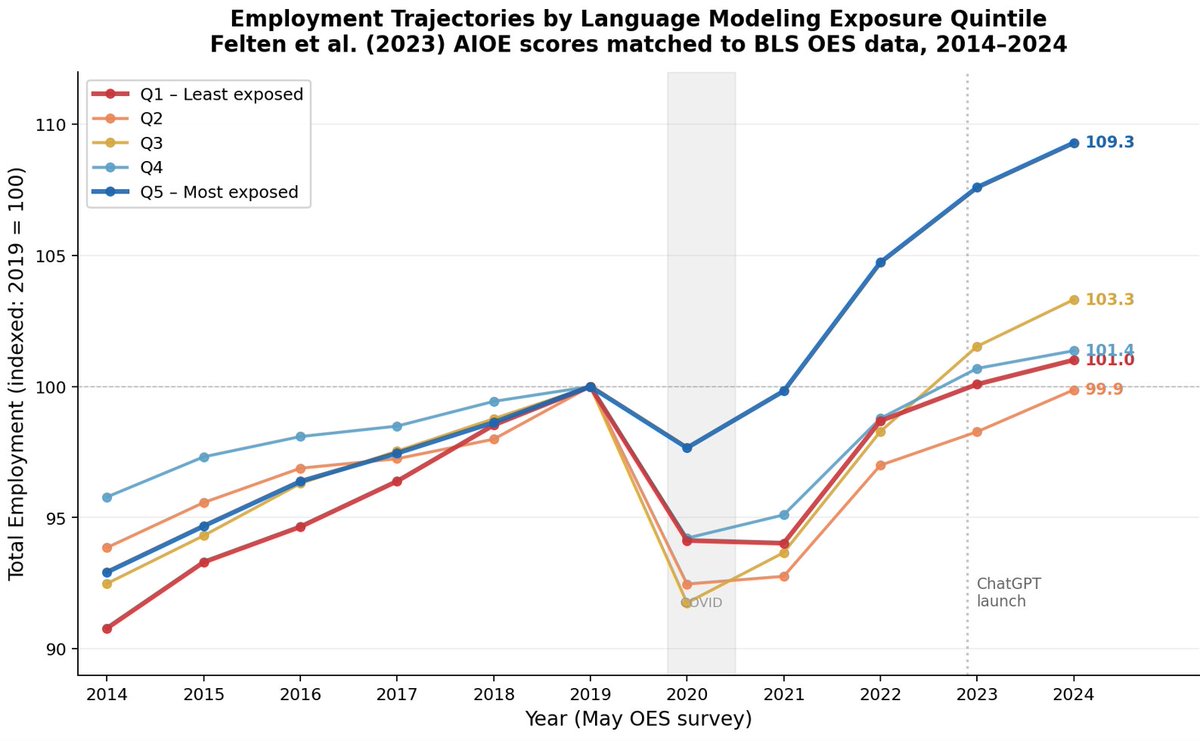
Shortly after ChatGPT was released, a paper came out which estimated the vulnerability of different occupations to AI disruption. Since then, the MOST at-risk occupations have grown by the MOST. The LEAST at risk-occupations have grown by the LEAST. 🤪
Frontier labs are about to close ranks and the dynamic pulling openweights up to the frontier is about to shut off. Almost all AI strategy and commentary over the last 6 months has assumed close-to-frontier base models would continue to be available as open weights, indefinitely. There is consequently an enormous and growing class of companies building custom models, offering RL-as-a-service, running enterprise fine-tuning, deploying adapted models for specific verticals - whose entire business depends on that single assumption being true. At the sovereign level entire countries have adopted a strategy that implicitly assumes there will consistently be free and guaranteed access to good models. The one country that internalised this risk acted immediately is China which is ironic given they're the ones producing all the openweight models. There is systemic, ecosystem-wide platform risk that very few of people have priced in or even considered.
It is not sufficient to decentralize the compute or decentralize the inference we need an entire new model supply chain outside of both corporate and state control. We have now spent a year developing the core primitives to allow a third path here; open model development not dependent on continual open-weight releases, or the benevolence of the frontier labs. Subspace Networks allow us to train models over large swarms of consumer compute anyone have access to. Unextractable Protocol Models then prevent weight extraction from this swarm. The models can be developed in the open, while still being monetised and co-owned by many. it is the only realistic soln anyone has proposed to avoid the massive consolidation that is about to occur. This required research advances to do - all of which have been published at the highest levels in the AI literature. If this is important to you, which it should be to everyone, participate in the training runs we are carrying out this year.
AI is starting to make real decisions, but no one can verify how an output was produced.
“Trust the API” isn’t good enough.
Today we’re releasing the EigenAI whitepaper, which lays out how to solve this problem with deterministic inference + verifiable results.
A new primitive for AI.
Learn more 🧵 ⬇️
I used to think Sapiens was a great book. Sweeping, provocative, the kind of book that makes you feel like you finally understand the big picture of human history. It's on every CEO's bookshelf, assigned in universities, praised as a masterwork of synthesis. Yuval Noah Harari is treated as one of the serious thinkers of our time.
But something nagged at me. Some passages felt off. Claims that human rights are just figments of our collective imagination, not real things, just stories we tell ourselves. That nations, laws, money, justice, doesn't exist outside our heads. That meaning itself is a delusion we've invented to cope. That we're far more powerful than ever before but not happier. That hunter-gatherers had it better because they had no dishes to wash, no carpets to vacuum, no nappies to change, no bills to pay.
That sounded depressing to me, but was perhaps just the realistic scientific worldview? What it meant to see the world clearly, without comforting illusions.
Then I read The Beginning of Infinity by @DavidDeutschOxf. Deutsch has a concept he calls 'bad philosophy.' Not philosophy that's merely false, but philosophy that actively prevents the growth of knowledge. Ideas that close doors rather than open them. That makes problems seem unsolvable by design.
After soaking in Deutsch's framework (it's dense, a bit like digesting a delicious whale), it becomes clear: Harari's books are riddled with bad philosophy. They're smuggling nihilism in under the guise of scientific objectivity. Some examples:
On meaning: "Human life has absolutely no meaning. Humans are the outcome of blind evolutionary processes that operate without goal or purpose... any meaning that people inscribe to their lives is just a delusion."
On human rights: "There are no gods in the universe, no nations, no money, no human rights, no laws, and no justice outside the common imagination of human beings."
On free will: "Humans are now hackable animals. The idea that humans have this soul or spirit and they have free will, that's over."
On progress: "We thought we were saving time; instead we revved up the treadmill of life to ten times its former speed." The Agricultural Revolution? "History's biggest fraud." We didn't domesticate wheat, "it domesticated us."
On our cosmic significance: "If planet Earth were to blow up tomorrow morning, the universe would probably keep going about its business as usual. Human subjectivity would not be missed."
On the future: "Those who fail in the struggle against irrelevance would constitute a new 'useless class.'" Homo sapiens will likely "disappear in a century or two."
This is bad philosophy. It tells us our problems are cosmically insignificant, our solutions are illusions, and that progress is neither desirable nor within our control. It's also perfect nonsense. No one would ever go back to being hunter-gatherers. Would you rather worry about your kid spending too much time on Roblox, or face the 50% chance she won't reach puberty?
And our so-called "fictions"? They ended slavery. They gave women equal rights. They solved hunger. They eradicated smallpox. They turned sand into computer chips. They got us to the moon, and hopefully soon, to Mars and beyond. These "fictions" are already reshaping the universe, and over time they may become the most potent force in it.
Now compare Deutsch:
"Humans, people and knowledge are not only objectively significant: they are by far the most significant phenomena in nature."
"Feeling insignificant because the universe is large has exactly the same logic as feeling inadequate for not being a cow."
"Problems are soluble, and each particular evil is a problem that can be solved."
"We are only just scratching the surface, and shall never be doing anything else. If unlimited progress really is going to happen, not only are we now at almost the very beginning of it, we always shall be."
Where Harari sees a species of deluded apes stumbling toward obsolescence, Deutsch sees universal explainers, the only entities we know of capable of creating explanatory knowledge, solving problems, and potentially seeding the universe with intelligence.
The difference isn't academic. Ideas shape action. If you believe life is meaningless, progress is a trap, and humans are hackable animals with no free will, how does that affect what you build? What you fight for? What you teach your children?
Harari's books sell because they flatter a fashionable pessimism. They let readers feel sophisticated for seeing through the "delusions" everyone else lives by. That smug cynicism is corrosive. And it's everywhere: in schools, in media, in bestselling books. More than half of young adults now say they feel little to no purpose or meaning in life. This is what happens when you teach an entire generation bad philosophy. Less progress, less health, less wealth. Less flourishing. And ultimately, a higher chance that civilization and consciousness go extinct.
Fortunately, there's another equally well-written, but much truer, account of homo sapiens, appropriately titled 'The Beginning of Infinity'. And this one smuggles no despair in by the backdoor. But let's give Harari credit where it's due. He is right about one thing: if planet Earth blew up tomorrow, we wouldn't be missed. Because there'd be no one left to miss us, just a careless universe, blindly obeying physical laws. We are the only ones who can miss, but we're not going to. We're going to aim, hit, and keep going.
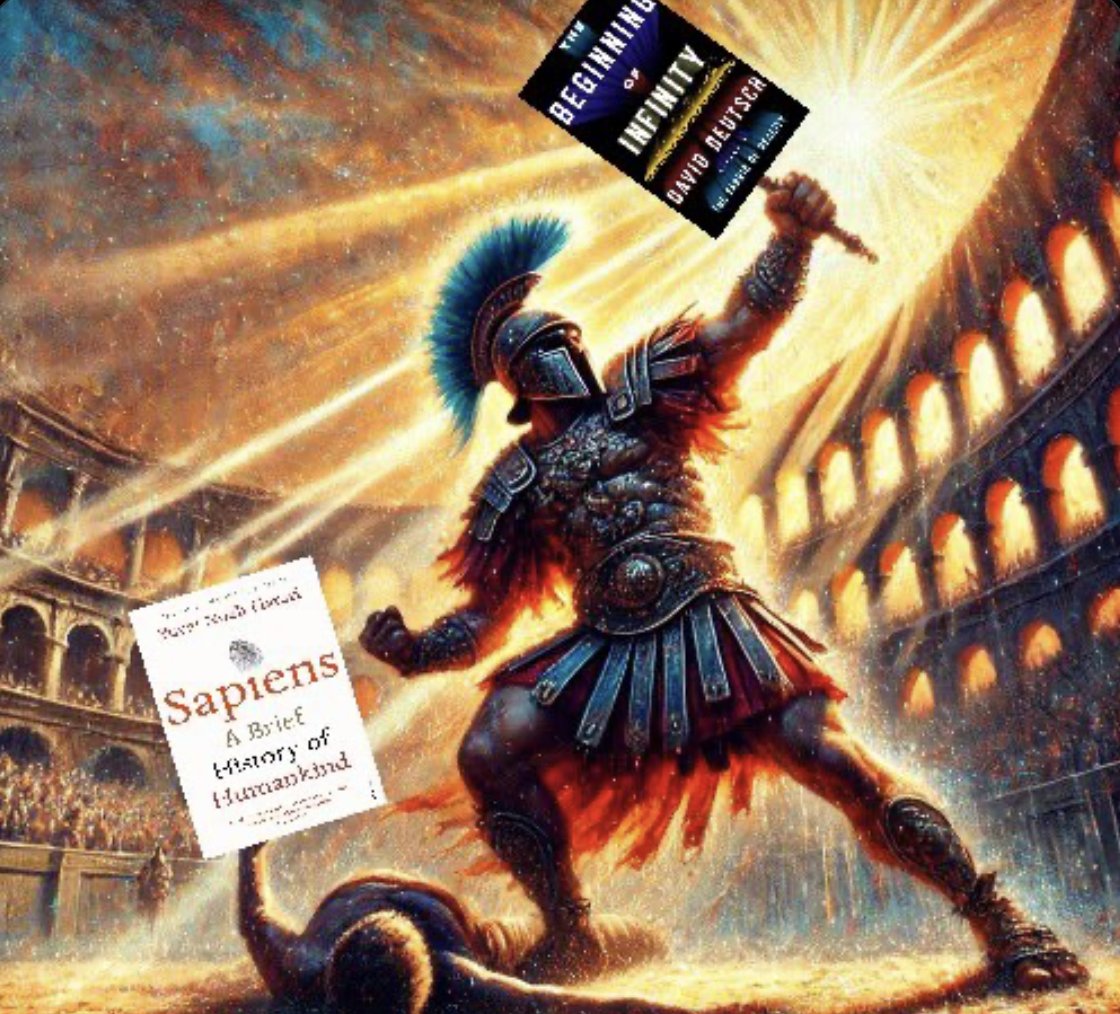
Full credit for the amazing meme to @Ben__Jeff
Famed AI researcher @MillionInt left @OpenAI
a couple of weeks ago, and, well, we've scored an exclusive exit interview with him on why he left and what he thinks is going wrong with AI overall.
The @corememory pod with me and @kyliebytes is down below
Seeing more and more pessimism around crypto and the societal value, or lack-thereof, that it brings to the world. I think this perception is misguided.
Of course, there's speculation and degeneracy. The crypto casino is real, large, and many people lose at the tables. But there's a ton of positive societal value that just gets overlooked.
Bitcoin has become a global, non-sovereign asset that anyone in the world can own with an internet connection. It gives an veto/opt out mechanism to the global population that pushes economic control away from nation states and into the hands of the individual.
Stablecoins provide better financial security to people around the world, improve people's lives with faster money, higher yield, and cheaper transactions. Banks literally don't provide yield on your assets. That's changing because of stablecoins. Remittance companies take large % of flows that doesn't go to end users. That's changing because of stablecoins. A 2.9% fee for any ecommerce transaction will seem criminal in 5 years. These are all massive benefits to society enabled by crypto because of stablecoins.
Lending platforms like Aave and Morpho provide the ability for anyone in the world to obtain an over-collateralized loan. Undercollateralized lending markets will further unlock a massive benefit to society reducing the cost of capital and creating huge positive externalities.
Blockchains will give global access to financial products (e.g. stocks, bonds, insurance, credit) where it has historically been limited.
Permissionless capital formation allows any idea to get funded based on it's merits.
Creating better markets is EV positive for society, especially when those markets remove adversarial middlemen or reduces costs for end users.
Most impactful technologies have positive and negative use cases.
- Social media is widely empowering, but hijack our attention and perception of things.
- Smart phones give humans super powers, but also act as an anchor.
- New entertainment mediums – radio, TV, streaming – provide greater sharing of information, but reduced physical interaction and increased sedentary lifestyles.
- AI improves productivity, but provides slop that now makes use question what's real.
- Crypto provides a new financial system, but also entices speculative behavior and degeneracy.
Crypto is building a new financial system that lets people build what they want. Some people will build casinos, others new payment mechanisms. Some will build perps platforms, others will build ways to enable broader access to consumer credit. The new financial system won't be perfect, but it will be vastly better than the status quo.
If you only see crypto for the casino, it's probably worth stepping back from the table and zooming out to see all the benefits that crypto has and will bring to society.
what if the AI creates/enables/unlocks new higher-paying jobs? by trying to prevent organizational evolution due to technology, you are limiting technology’s ability to create more value for workers.
if you had done this with the emergence of the tractor to protect loss of jobs on farms, we’d have very expensive food, no industrial revolution, and a shitty standard of living for workers. if you had done this with the emergence of the automobile, we’d have lost the economic explosion that arose from highways, lower cost transportation, and countless networked industries. if you had done this with the emergence of the computer and the internet, your entire district would still be based on an economy of oranges and plums.
humanity’s ability to compete, organize, and carry itself forward is a magical miracle. in every truly free society, tech evolution has improved the lives of absolutely everyone. in every society where a government stood up to create barriers and gates to tech evolution in the name of “workers rights”, standards of living went into a freefall.
your view is luddite at best and authoritarian at its heart. limiting freedom of choice, controlling the rights of workers and capital providers, is the core activity of socialism and will cause unbelievable unintended damage. well-intentiined, sure, but examining the consequences and n-th order effects, it’s clear how this model deeply harms workers, employment standards, wage growth etc.
i urge you to deeply study the social and economic history of technology evolutions, speak to folks in your district, and avoid the socialist trap the Dem party seems to be swirling into…
making things true:
design is the practice of seeing through the surface of things to understand their underlying structure, then rearranging those elements into new forms that didn't exist before.
most people think design is about aesthetics – making things look good, choosing colors, polishing interfaces. but underneath, design is a way of thinking about the world. it's about decomposition and recomposition. you take something complex, break it down into its fundamental components, understand the relationships between those parts, and then rebuild it in a way that's simpler, more powerful, or reveals something previously hidden.
this is why i've always been drawn to tools and systems rather than just products. a product solves one problem. a system gives you the building blocks to solve infinite problems. when i was working on Notion, we weren't trying to build another task manager or note-taking app. we were asking: what are the atoms of software? what are the irreducible elements that, when combined, can create any tool you need?
we landed on blocks, databases, views, relations. everything else is just different arrangements of these primitives. once you see this, you realize that all those single-purpose apps – Asana, Linear, Evernote, Airtable – are just rigid, pre-configured assemblies of the same underlying concepts. they've solved for one specific arrangement and called it a product.
but why lock people into one configuration? give them the components and let them build exactly what they need. Notion is lego blocks for thought and work.
Cursor is doing something similar but at a different layer. for decades, the barrier between human intention and working software has been enormous. you need to know syntax, frameworks, design patterns, debugging. most people with ideas never cross that chasm because the cost is too high.
Cursor changes this. when you can describe what you want and the system understands not just the words but the underlying structure – the patterns, the logic, the architecture – then you're no longer translating between human thought and machine language. you're working directly with concepts, and the AI handles the decomposition into code.
this philosophy extends beyond software. language is a finite set of sounds or symbols infinitely recombined to express any thought. music is twelve notes in endless patterns. DNA is four base pairs that encode all of life's complexity.
the universe is fundamentally modular. simple rules, endlessly recombining, creating emergent complexity. design is the human practice of participating in that process consciously. we look at the world, identify the patterns, extract the rules, and use them to build new realities.
when i look at the history of computing, the most important moments weren't new features. they were new primitives. the command line gave us composable programs. the GUI gave us direct manipulation. the web gave us hyperlinks. the smartphone gave us sensors and connectivity. each unlocked entire ecosystems because they provided new atoms that could be infinitely recombined.
AI isn't just a feature. it's a new primitive. it's a new way of decomposing and recomposing reality.
design is philosophy because it forces you to ask: what is this thing really? what are its essential properties? what can i remove before it stops being itself? and once i understand that, what new things can i build?
this is the work. not making things pretty. making things true.
Today, you need huge amounts of capital to train a large base model, meaning a handful of corporations control this layer. Creation of the base models in decentralized protocols is an alternative to this, democratizing access - but until recently there have been major technical hurdles preventing feasibility.
Today we are launching our technical blog with the first post covering our work on Asynchronous Pipeline Parallel. Async training is a key technical pillar that must be addressed for Protocol Learning and community created and owned models to be practical.
This work removes pipeline bubbles which are very damaging in the decentralized case, especially so when heterogenous hardware is present.
https://t.co/0QzAoKeVd7
The global e-commerce market is $21 trillion.
With agentic commerce (a-commerce) on permissionless markets, this number will soon get dwarfed.
Proud for EigenCloud to partner with @Google on making a-commerce verifiable, reduce counterparty risk, and increase market efficiency.