this is him in latest pic. relishing some cuisine with NSG personnel. there is this terrifying contentment reflecting off his face that tells me he has moved on. no, not in retiring sense, that he already has, it's about moving on from cricket itself. we ordinary beings hold thousand memories of him, we revisit them, via clips, reels, edits, many ways, we remain in that fan zone, we shall always be, but the mahendra singh dhoni we knew, the one who fondled our hearts with the swing of his bat, is a history now. he makes it look like he is just around us, but deep down he has left us far far behind. he has zero attachment issues, unlike us. a rationality monster. reason he been ridiculously successful. he moves on real fast, from whatever it was, however dear it was, after a stage, it's nothing to him. he is unfazed, unbothered, onto his next chapters.
Do you know that the average single man can go months or even years without non-sexual physical touch. No hugs. No hand-holding. No comforting pat on the back?
The only time many men experience gentle touch is from a barber or a paid sex worker.
This condition is called 'Skin Hunger,' and it leads to severe depression and anxiety. Society has labeled male touch as 'predatory' or 'creepy,' so men have learned to starve themselves of human contact just to make women feel comfortable. They are dying of loneliness in a crowded room.
Why do we hurt our loved ones ?
There is irony in close relationships.
The people we love the most often receive the least careful version of us.
With the outside world, we are composed.
We filter our words, manage our tone, control our reactions.
We want to be seen as calm, reasonable, kind.
But with those who love us, the effort relaxes.
The guard drops.
And what spills out is not always tenderness.
It is fatigue, frustration, and unspoken hurt.
All day long, we carry things silently.
Disappointments we didn’t voice.
Anger we swallowed.
Stress we pushed through.
By the time we reach home, the emotional tank is low.
And the safest place becomes the place where the overflow happens.
The problem begins when safety is mistaken for permission.
We assume love will absorb our frustration.
But those closest to us are not endless reservoirs.
They have feelings.
They get tired.
They carry their own invisible weights.
Love should not make others the dumping ground.
Intimacy does not cancel responsibility.
It deepens it.
Ideally, we should bring our patience home.
Reserve our gentleness for those who matter the most.
Unfortunately, we give our best version to strangers and the worst version to our loved ones.
#relationships
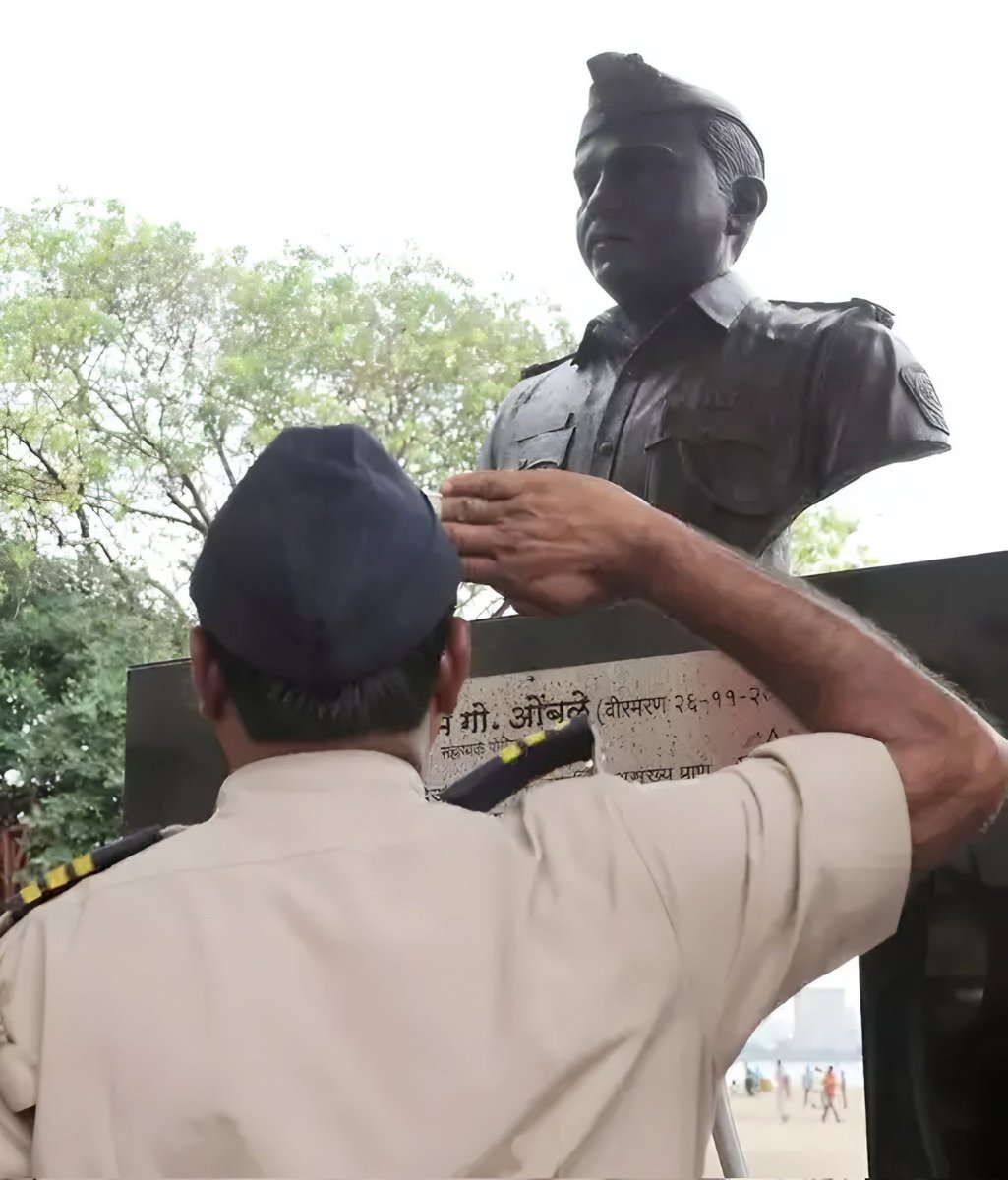
Nov 26, 2008: Ajmal Kasab and Abu Ismail hijacked a Skoda and were racing toward Girgaom Chowpatty after leaving a trail of killings behind them, when Mumbai Police, acting on wireless alerts, set up a naka.
The car sped toward the barricade, police fired, its tyres shot out, screeching to a halt. Ismail jumped out firing wildly, killing a constable before being brought down by police.
Kasab stayed inside, pretending to surrender, stepping out slowly with an AK-47 hidden under his jacket, waiting for someone to come close. ASI Tukaram Omble, a retired Army soldier, rushed forward, only for Kasab to suddenly pull out the rifle and unleash a full burst at point-blank range.
In that split second, Omble grabbed the barrel with his bare hands, taking every shot through his own body and keeping the gun pinned toward himself, denying Kasab the chance to mow down the rest of the team. Those few seconds were enough for the other officers to surround Kasab and capture him alive.
Omble succumbed to the bullets, but his sacrifice ensured the lone surviving terrorist of 26/11 was taken alive, and that's how the entire attempt to twist the attack into “Hindutva terrorism” collapsed in an instant.
ASI (and Naik) Tukaram Omble, Ashok Chakra. Naman. The nation can’t ever be short of gratitude.
On the night of May 20, 2025, a little girl in a faded pink frock fell asleep on her mother’s lap at Chhatrapati Shivaji Maharaj Terminus. Her parents, simple people from Solapur, had come to Mumbai for her father’s treatment. They were exhausted. Just for a moment, the mother closed her eyes.
When she opened them, her daughter was gone.
Six months.
Six months of walking from police station to police station.
Six months of showing the same crumpled photograph to strangers on trains, in slums, in orphanages.
Six months of the father not sleeping, the mother not eating, both of them growing hollow-eyed, whispering the same name into the dark: “Aarohi… Aarohi…”
In Varanasi, a thousand kilometres away, a tiny girl with no memory of her real name was learning to call herself “Kashi.” She had been found crying near the railway tracks in June, barefoot and terrified. The orphanage gave her food, a bed, and a new name. She smiled easily, because children always do, but sometimes at night she clutched the edge of her blanket and asked for “Aai” — Marathi for mother — and no one understood.
Back in Mumbai, the police refused to close the file. They printed posters with Aarohi’s face, stuck them on every platform from Lokmanya Tilak Terminus to Bhusawal to Varanasi Cantt. They ran newspaper ads, knocked on doors, begged journalists for help. Six months is a long time for hope to stay alive, but some officers carried her photograph in their shirt pockets like it was their own child.
Then, on November 13, a local reporter in Varanasi saw the poster. Something clicked. He had seen a girl who spoke Marathi words in her sleep. He made a phone call.
The next morning, a Mumbai Police inspector sat in front of a laptop in Varanasi and opened a video call. On the screen appeared a little girl in a pink frock — the same colour she was wearing the day she vanished. The mother, standing behind the officer in Mumbai, saw her daughter and collapsed without a sound. The father just kept repeating, “That’s my Aarohi… that’s my baby…”
They flew her back on Children’s Day — November 14.
When the plane landed, the entire Mumbai Crime Branch was waiting. They had bought her balloons and a new frock, sky blue this time. But the moment the little girl stepped out and saw the sea of khaki uniforms, she did something no one expected.
She ran.
Not away — toward them.
Tiny legs pumping, arms outstretched, she threw herself at the nearest officer and laughed — the purest, clearest laugh that had been missing from the world for half a year. The officer, a tough man who had seen everything, felt his eyes burn. He lifted her high, and she wrapped her arms around his neck like he was family.
Her parents were crying too hard to walk. So the policemen carried their daughter to them.
The mother touched her face again and again, as if checking she was real. The father fell to his knees and pressed his forehead to his child’s tiny feet, sobbing words no one could understand except God.
And the little girl? She just kept smiling, looking from her parents to the officers and back again, completely unaware that she had turned an entire police station into a sobbing, laughing, praying family.
Six months of darkness ended in one hug.
Aarohi is home now.
The kidnapper is still out there, but that is tomorrow’s fight.
Today, a mother is singing lullabies again.
Today, a father is smiling in his sleep.
And somewhere in Mumbai, there are policemen who will never forget the weight of a four-year-old girl in their arms — the weight of an entire life returned.
Sometimes the uniform doesn’t just catch thieves.
Sometimes it carries lost children all the way back to their mothers’ hearts.
This Diwali keep your pets inside your home if they are afraid of crackers. Just as we averted our eyes when the drains became red with blood of sacrificed animals at Eid.
This Diwali, use an inhaler if you encounter breathlessness just as we used perfume to overcome the stench of rotting carcasses at Eid.
This Diwali, desist from displaying your distaste of our ritual practises just as we maintained a silence when our sentiments were disregarded by posting non-vegetarian food pics at Eid Al Addha.
This Diwali, stop lamenting about air pollution, just as we let you celebrate your X mas &New Year with crackers and cutting a million trees.
Secularism IS A TWO WAY STREET, NOT A ONE WAY.
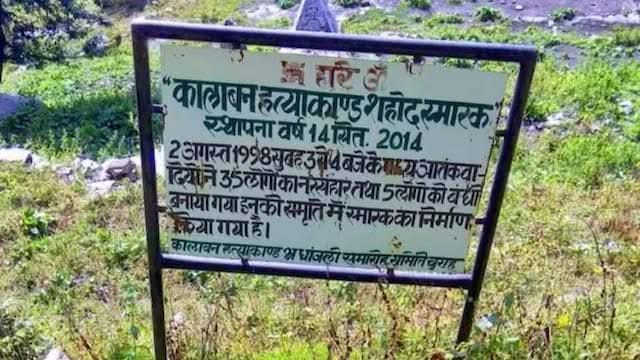
On This Day, August 2, 1998
Chamba, Himachal Pradesh witnessed one of its darkest nights, now buried under decades of silence.
Islmst trrorists from Hizbul Mujahideen stormed the remote villages of Satrundi and Kalaban in the dead of night. Armed and ruthless, they gathered 35 Hindu villagers, lined them up, and executed them on the spot for no other reason than their faith.
I'M IN TEARS WATCHING THIS !
This heartbreaking, mind boggling & soul crushing story of @amiysharma will tell you why men are choosing SUICIDE
His 4 YEARS FIGHT IN COURTS to get a glimpse of his son is a NIGHTMARE
I PLEAD U ALL TO TAKE THIS TO CHIEF JUSTICE OF INDIA 🙏
कभी मेहनत से कमाने का भी सोच लिया कर, हमेशा भीख ही मांगता रहता है। कभी आरक्षण की भीख, कभी स्कॉलरशिप की, कभी फ्री बिजली, फ्री कोचिंग और अब मंदिरों के पैसों की।
मंदिरों का पैसा सरकार लेती है, उसी से तुम जैसे नकारा लोगों के लिए फ्री की योजनाएं चलाई जाती हैं। मंदिरों के पैसे से हॉस्पिटल चलते हैं। मंदिरों के पैसे से अनाथालय चलते हैं। मंदिरों के पैसे से कई जगह भंडारे होते हैं।
तुम जैसे हर जगह भिखारी बन कर बस मांगने आ जाते हो, शर्म आती है कभी?