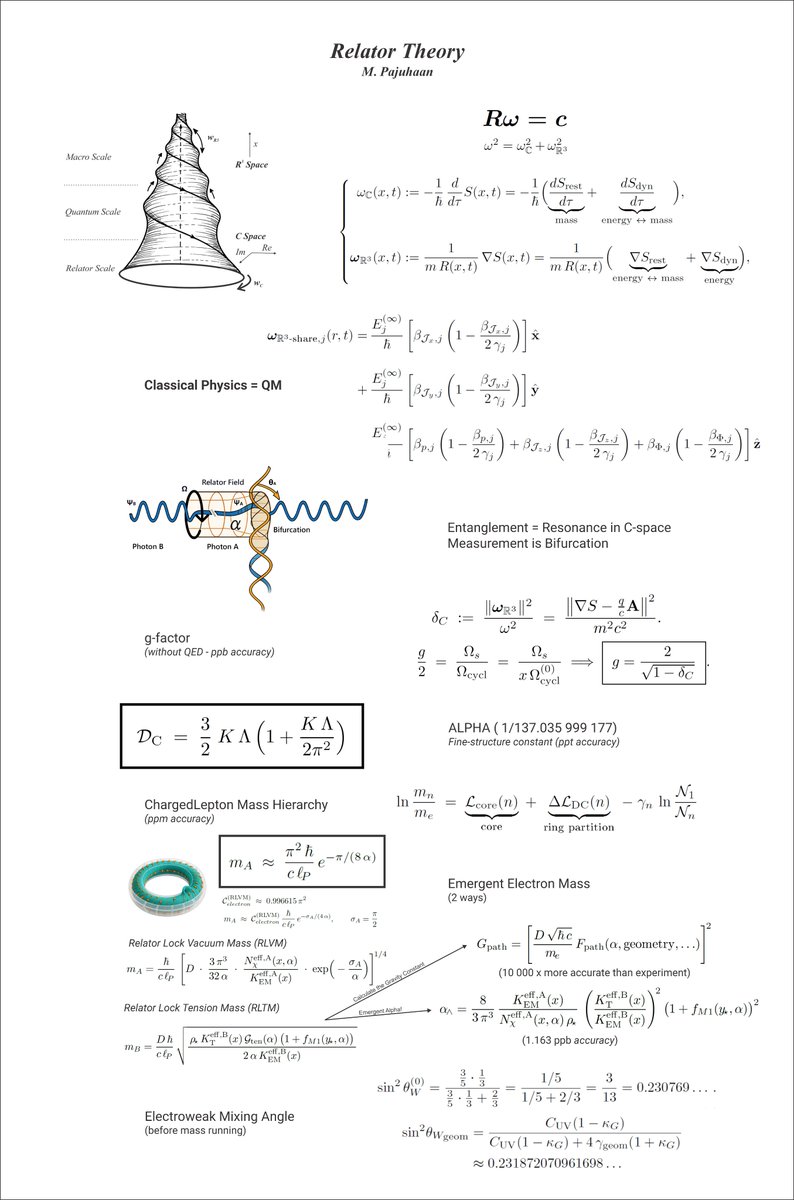
In the coming years, QED and QCD may be superseded by a deeper and more fundamental theory👑—perhaps the very kind of framework Feynman was ultimately searching for. there is now strong evidence suggesting that this transition has already begun🤯
(QED)Emergent fine structure constant:
https://t.co/4ZPuA23XtT
(QED)Emergent Electron Mass from Two-Space Boundary
https://t.co/eJUdrDuRW1
(QED) Analytic Emergence of the Electron g–Factor in the Relator Theory
https://t.co/1BwEN2Fws9
(QCD) Three-Loop Junction Stability and the Proton-Electron Mass Ratio in the Relator Framework
https://t.co/6nRzuDXtEw
QED nerds, Richard Feynman fans, pay attention:
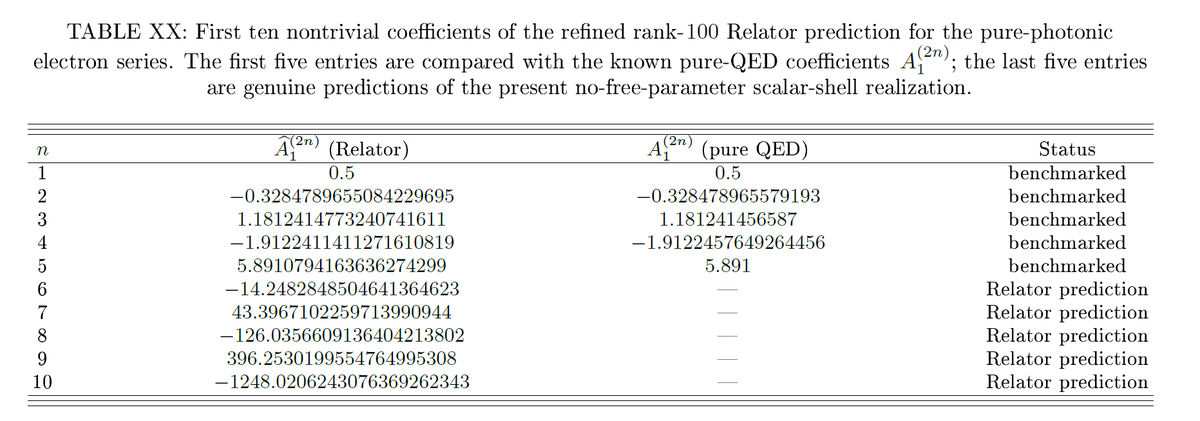
The universal QED (g-2) coefficients and mass running terms that once required thousands of Feynman diagrams, decades of work, hundreds of millions of dollars funding, and top supercomputers can now be computed on your phone in milliseconds — not just to order 5, but 10 or 100..
No, the precision is not rigorously guaranteed yet.
Yes, it is already enough for falsifiable predictions of the Relator model!
If Feynman or Pauli were alive, they’d be reading this paper.
so are we doing science, or are we waiting for the “right” affiliation before an editor even bothers to send it to review🤡?
link in comment 👇
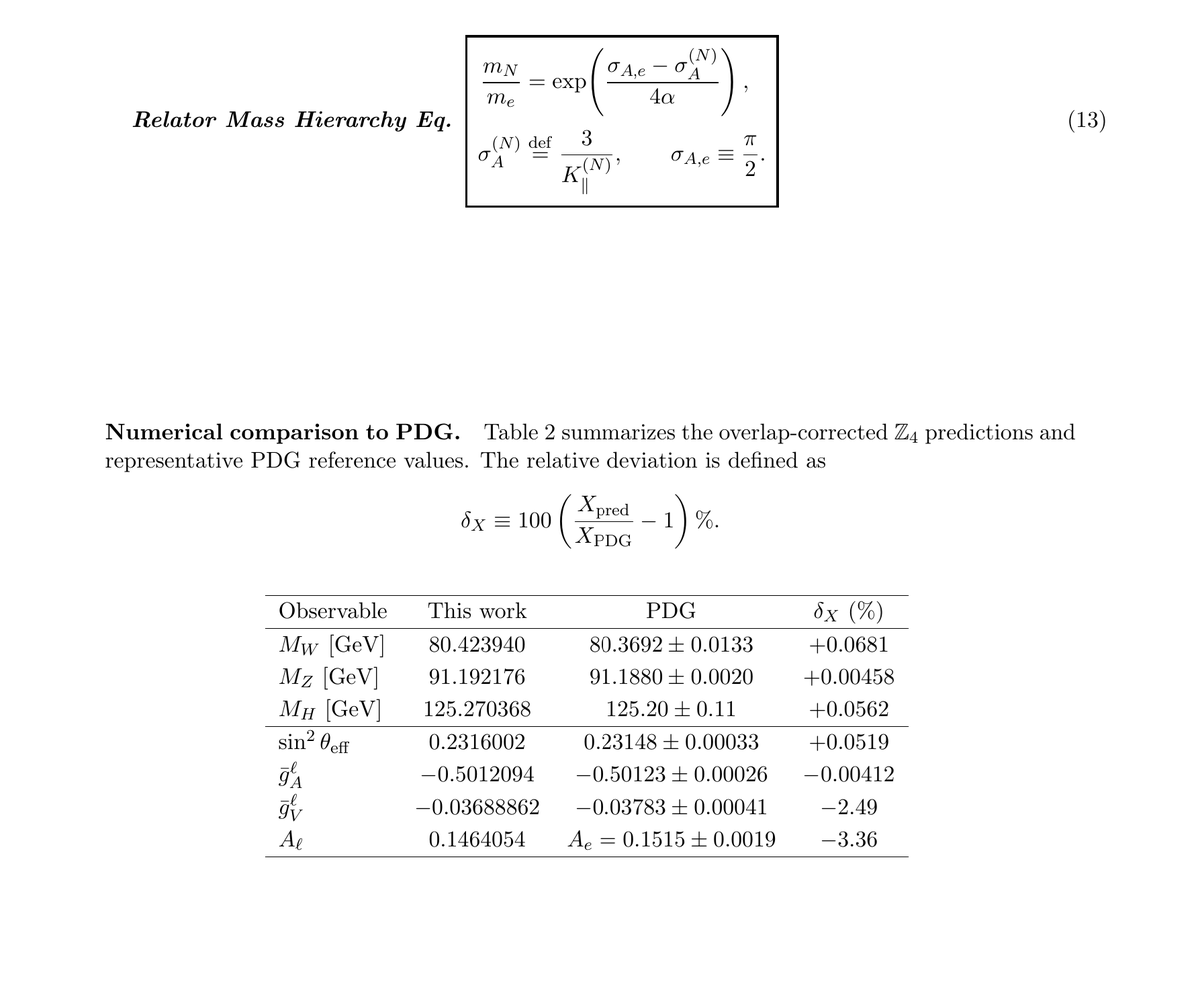
🫂Electron + Proton + Bosons mass hierarchy formula + new particles pridiction.
A parameter-free Relator derivation of the ℤ₄ electroweak scale and the (W, Z, H) mass triad, with a ℤ₅ prediction of new multi-TeV charged resonances.
https://t.co/Z6zsPSXGrZ
The “magic” of physics a hundred years ago was that a few bold ideas—relativity and quantum theory—could suddenly rewrite reality with simple equations that matched experiments.
Today the magic feels weaker because progress often comes as bigger models, heavier math, and tiny improvements, so the next revolution is harder to see, even when it’s happening.
it's the GPT for Relator Theory, you can ask anything about quantum physics and gravity and it will answer from all available papers: https://t.co/80a5wTBdkI
maybe you discover something in foundational physics for the first time
String theorists themselves have said that if we could derive a closed-form formula for the electron and proton masses from first principles—meaning with no hand-tuned parameters—then “the game would be over.”
They’ve raised this challenge many times, including Michio Kaku. Do you still believe in that idea?
I just published a minimal, parameter-free statistical unlocking model for the free-neutron lifetime (Relator framework). It predicts τₙ ≈ 877.83 s, close to the best bottle results
https://t.co/amuh4ipruS
I can rewrite the formula of the electron mass and emergent fine structure constant - alpha 137- in QED formalism, with a quite complex way of calculating thousands of diagrams, but the way that I published is much better to understand and tell exactly how reality works. QED is calculated by the least-action integral, but Relator theory calculate exact differential equation.
Emergent Electron Mass from Two-Space Boundary
https://t.co/iL6UEPYAeK
https://t.co/eJUdrDuRW1
Alpha:
https://t.co/TDYde0ICM8
https://t.co/4ZPuA23XtT
A rotating ball’s shadow moves like a mass on a spring-showing that circular motion projects into simple harmonic motion, a clean visual of sine-wave physics.
a clean connection is exhibited between the Relator (Rw=c - particle wavefunction evolves in the speed of the light) and standard general relativity:
within the very regimes where GR is trusted, the same covariant phase–observer machinery is reorganized so the familiar GR phenomenology is recovered as a limiting case.
https://t.co/XHdwIna2vY
https://t.co/2f7owruTZX
Scientific trolls and intellectual dwarfs will hate you — and real scientists will eventually fall in love with your work.
That moment comes when, for the first time, you can show that the electron’s mass (and in fact the mass of any particle) is not a parameter tuned by some hidden hand, but something mathematically inevitable.
The hardest problems in the world, when solved, produce equations that are unbelievably beautiful.
so simple it feels impossible to have imagined them — this kind of beauty is born only from deep, complex mathematics.
Ok, it’s now first page on google, “emergent electron mass”
In the world of physics, the equation I’ve found is like discovering oil in 1900. anyone curious can just google it and read the paper.
If you’re a physics student or have a PhD, this is your chance to build your own discoveries on my Relator theory — with proper respect and citations for the one who cracked the lock.
If you’ve got that kind of ethics, you’re welcome to use it and write your name into human history.
Or you can ignore it and keep chasing the same dead-end problems in physics. your move
Why have all “unified gravity + electromagnetism” programs failed — from string theory and loop quantum gravity to thousands of journal papers and arXiv preprints?
Because almost none of them show anything truly new. They just repackage GR + formal QM, rewrite the same Lagrangian in a more baroque way, or add 5–400 extra dimensions and call it a breakthrough.
You don’t solve quantum gravity, the 1/137 mystery, or the mass hierarchy with reinterpretations and prettier diagrams. You need real serendipity: a genuinely new formula, something so simple and elegant that nobody has seen it before.
It’s like trying to crack the Riemann Hypothesis with the same toolbox of heavy complex analysis that thousands of brilliant brains have already pushed to the limit for a century. Nice dream, but that route is basically impossible. If the answer exists, it’s probably radically simple — and outside today’s mental tunnel.
I spent years becoming fluent in ultra-complicated math and physics, and then I learned to let it go. You don’t need to carry a ton of old keys that never opened the door, hoping you’ll be the random person who suddenly makes one of them work.
If someone — even an outsider — drops the right new idea and posts it as a preprint, the physics community will eventually see it and react. even if it takes ten years.
🚨 WILD: α≈1/137,035 999 177.. and mₑ≈05109976...Mev can be emergent calculable inputs.
Come on physicists and mathematicians, even telling all is bs, numerology, wrong, nonsense!! PRL, Nature,.. editors think that such things need at least "ANY feedback" from the physics community to be considered for peer review.
• emergent fine-structure constant α
• emergent electron mass mₑ
If this is wrong, show me where.
of course, the image below is the final result of 5–6 papers (linked in the following post), but you can still calc the electron mass from the closed-form formula shown there.
What is entropy, really? We all use it as a law; systems go to maximum entropy, end of story. ok! in my earlier Relator papers I treated that as given and showed “phenomena”; how the fine-structure constant α can emerge, how the electron mass links to the Planck mass, how the g-factor and even gravity and electromagnetism can come out of one complex space ℂ and entropy deficits there. Nice, but still phenomenology! Entropy itself was sitting above the story like a god-given rule.
In this new paper I try to remove even that layer. I ask, if I throw away everything—no fields, no spacetime curvature, no Hilbert space—and keep only a one-dimensional complex line ℂ with light-speed “energy dots - in math we can call it microstates” on it, plus very weak conditions (symmetry, additivity, and a fixed information-update rate in discrete epochs), do I already get something that looks like entropy?
The answer, mathematically, is yes. From those assumptions alone, the Shannon form of entropy and the circular Gaussian “collar” on ℂ pop out as the unique, maximum-entropy structure. I don’t put entropy in by hand; the complex numbers and the update rule force it on me.
Recipe: complex number space + epoch updates + noise + relaxation (Ornstein–Uhlenbeck dynamics)
The fun twist is that this is the same Gaussian collar I used before to get emergent gravity and electromagnetism in ℝ³, to get α, the electron mass, the tiny gravitational coupling, etc. Now the loop is tighter; first I derived forces and couplings from entropy on ℂ, and here I show that this entropy itself is not a separate postulate but a consequence of ℂ + randomness + epoch updates. The paper is now public; plus I included a relaxation picture where the system flows to the Gaussian profile even though “entropy” was never assumed at the start.
This one page is what drops out of a simple kinematic lock Rω = c so far— α, g-factor, charged-lepton hierarchy, electron mass… No Monte Carlo, just algebra; a bunch of it anyone can check with a calculator.
but if this were mere numerology, everybody’d all be talking about it already :))