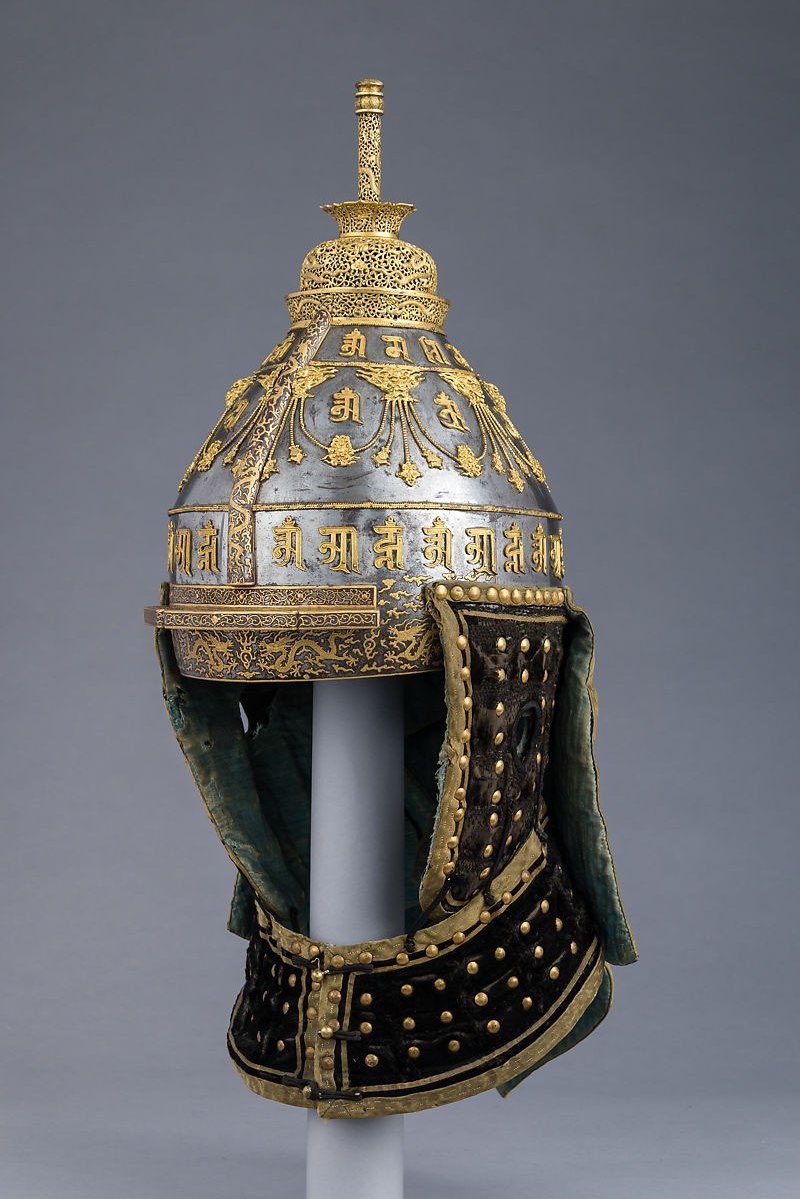
The Manchus who invaded and ruled China had imperial crowns bearing inscriptions in Sanskrit and Indic scripts, indicating their reverence for these writing systems as sacred and divinely sanctioned.
Manchu Qing Dynasty Helmet embossed with the Sanskrit Mantra "Om mani padme hum" in Ranjana/Lantsa Script.
Sil Batta (सिल बट्टा) from Dholavira, Gujarat, dated 2500 BCE, in @NMnewdelhi, #Delhi.
Sil = Stone , Batta = Crushing
Sil Batta = Food ingredients prepared by crushing on a stone.
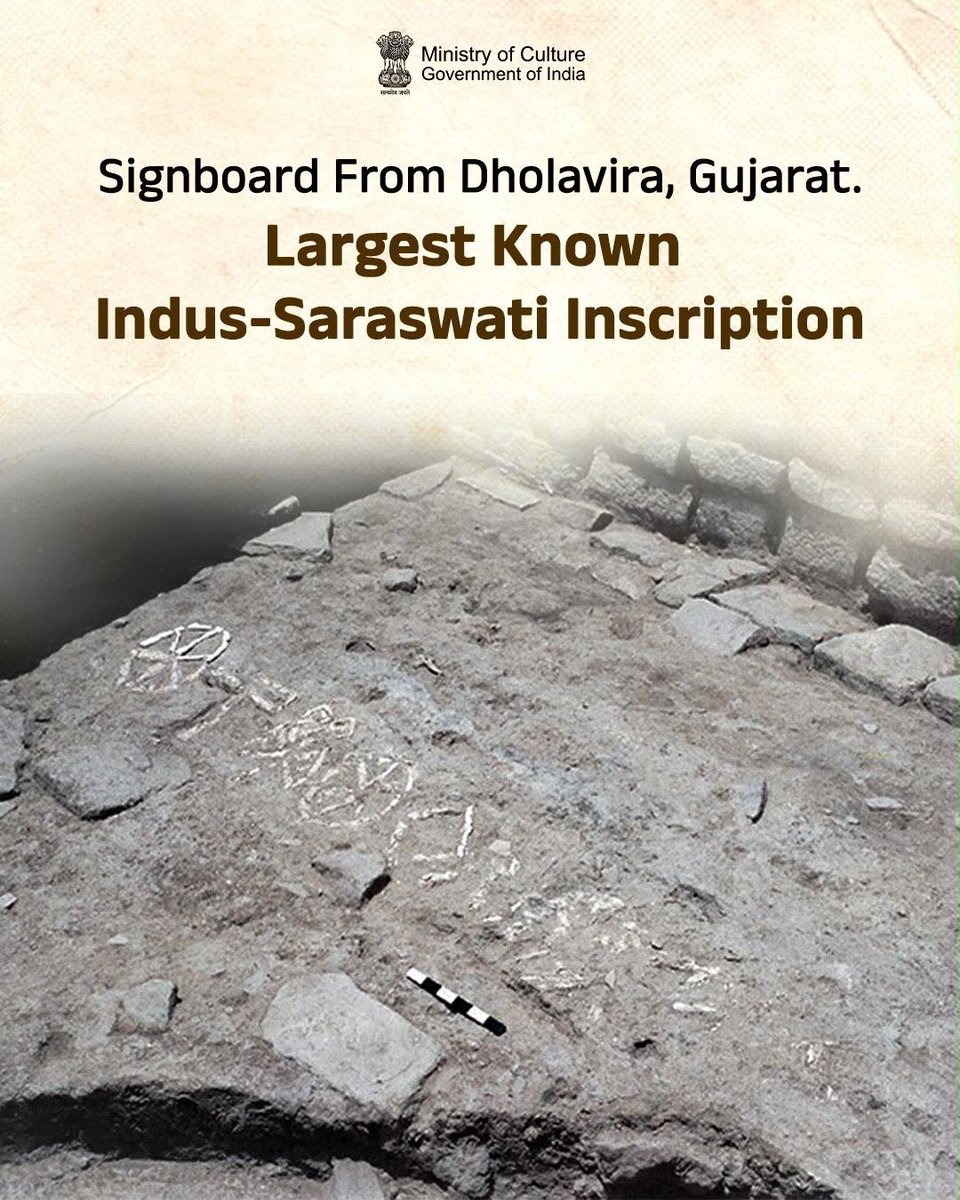
One of the most remarkable discoveries from Dholavira, Gujarat, is this monumental Signboard, the largest known inscription from the Indus-Saraswati Civilisation and 𝐰𝐨𝐫𝐥𝐝’𝐬 𝐨𝐥𝐝𝐞𝐬𝐭-𝐤𝐧𝐨𝐰𝐧 𝐒𝐢𝐠𝐧𝐛𝐨𝐚𝐫𝐝. Comprising 10 large signs/letters made of Gypsum (each sign being appx. 36 cm tall) and the entire inscription stretching nearly 3 metres in length.
The site, located on the arid island of Khadir in Gujarat, was extensively excavated by the @ASIGoI over 13 field seasons from 1989 to 2005, unveiling indigenous urban sophistication in ancient Bharat.
From advanced water engineering to public inscriptions, Dholavira continues to reveal the remarkable capabilities of the Indus-Saraswati people, a legacy deeply rooted in the cultural and civilisational heritage of Bharat.
#IndusSaraswatiCivilisation #Dholavira #CivilisationalContinuity #BharatLivingCivilisation
7,000 years before Egypt attempted it, Bharat reconciled 13 lunar months with the solar year. The evidence is carved into Ratnagiri Petroglyph — 13 grooves, horizon line, astronomical precision.
It sits exposed. Endangered. Documented but unprotected.
If this stone survives monsoon and vandalism, it's the earliest solar-lunar calendar reconciliation on record. Globally.
We fund ₹4,000 crore annual ASI budgets. We cannot afford a roof.
The oldest astronomical knowledge crumbles under open sky while we debate which colonial monument needs another coat of paint. 🪨☀️🌙
Who decided 7,000 years wasn't old enough to matter?
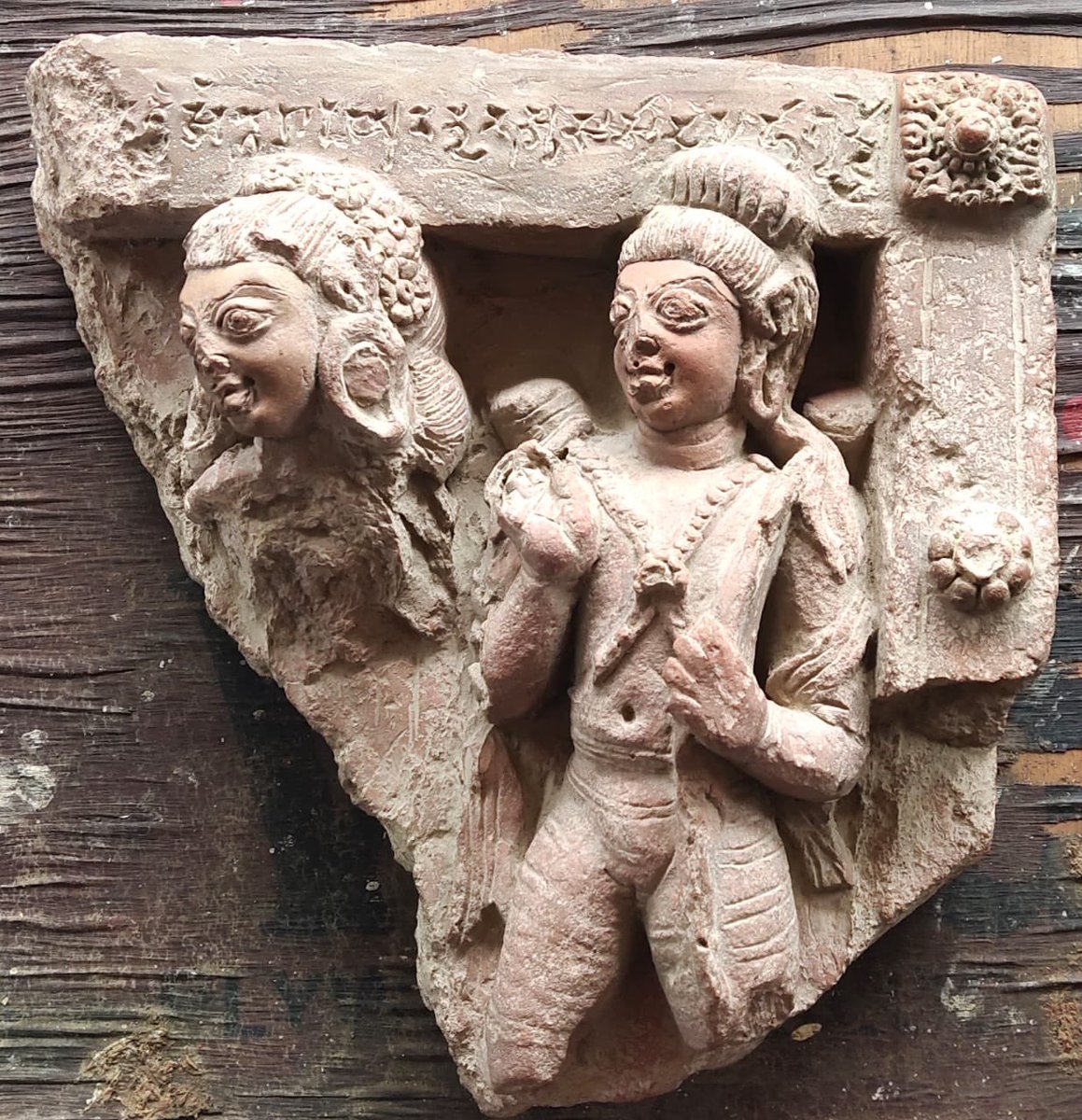
Inscribed terracotta panels depicting Rāmāyana, from Nachārkheḍa,Haryana
The inscribed terracotta panels from Nachārkheḍa,Hisar district, Haryana. At present they are preserved in the Swami Omanand Saraswati Archaeological Museum at Gurukul Jhajjar, Jhajjar District, Haryana.
These two inscriptions are written in Sanskrit language and Brāhmī characters.
The first fragmentary panel reads: _..........chhan antarā raghunandanaḥ | Āsasāda mahāgṛdhraiḥ_
*It mentions that, Śrī Rām had met a huge and very powerful vulture, i.e., Jatāyu.*
The second panel reads: _Triśira_(name of demon engraved in the middle of the panel) _chaturdaśa rākshasā sujitvā Rāmadheyaśa_.
*It mentions that Śrī Rām had obtained glory after winning over the fourteen demons*
Courtesy :Sri Virjanand Daivkarani, Gurukul Jhajjar
ANCIENT VEDIC SYSTEM OF INFINITESIMAL TIME MEASUREMENT
Shatapatha Brahmana (12.3.2.5) defines time units through a mathematical sequence, where each successive unit is 15 times smaller than the previous one.
1. Muhurta: 48 Minutes
2. Kshipra: 3.2 minutes (192 seconds)
3. Etarhi: 12.8 seconds
4. Idani: 0.85 seconds (850 Milliseconds)
5. Prana: 56.67 milliseconds
6. Aktana: 3778 microseconds
7. Nimesha: 251.87 microseconds
8. Lomagarta: 16.79 microseconds
9. Svedayana: 1.12 microseconds (1120 Nanoseconds)
10 Stoka: 74.66 Nanoseconds
GOPATHA BRAHMANA (1.5.5)
ANCIENT VEDIC SYSTEM OF INFINITESIMAL TIME MEASUREMENT
Gopatha Brahmana (1.5.5) also further defines time units through a mathematical sequence, where each successive unit is 15 times smaller than the previous one. Slightly different names but follows the same method given in Shatapatha Brahmana (12.3.2.5).
1. Muhurta: 48 Minutes
2. Prana: 3.2 minutes (192 seconds)
3. Apana: 12.8 seconds
4. Vyana: 0.85 seconds (850 Milliseconds)
5. Samana: 56.67 milliseconds
6. Udana: 3778 microseconds
7. Etadi: 251.87 microseconds
8. Etarhi: 16.79 microseconds
9. Svedayana: 1.12 microseconds (1120 Nanoseconds)
10. Kshiprayana: 74.66 Nanoseconds
11. Romakupa: 4.98 Nanoseconds (4980 picoseconds)
12. Varshatodhara: 332 picoseconds
Gopatha Brahmana (1.5.5) also further defines time units through a mathematical sequence, where each successive unit is 15 times smaller than the previous one. Slightly different names but follows the same method given in Shatapatha Brahmana (12.3.2.5).
1. Muhurta: 48 Minutes
2. Prana: 3.2 minutes (192 seconds)
3. Apana: 12.8 seconds
4. Vyana: 0.85 seconds (850 Milliseconds)
5. Samana: 56.67 milliseconds
6. Udana: 3778 microseconds
7. Etadi: 251.87 microseconds
8. Etarhi: 16.79 microseconds
9. Svedayana: 1.12 microseconds (1120 Nanoseconds)
10. Kshiprayana: 74.66 Nanoseconds
11. Romakupa: 4.98 Nanoseconds (4980 picoseconds)
12. Varshatodhara: 332 picoseconds
Recent carbon-dating studies have suggested that urbanisation at Mohenjo-daro may have begun earlier than traditionally assumed, possibly before 3300 BCE. If one applies a chronological error of 661 years, the Mature Harappan phase could be tentatively placed around 3900–2600 BCE.
There is also evidence of continued activity at the site in later periods. Findings reportedly include Brahmi script inscriptions from later levels, as well as punch-marked coins associated with the Maurya Empire, coins attributed to Indo-Greek rulers, and issues of the Kushan ruler Vasudeva I.
Based on the traditional chronological framework—which includes a proposed 1381-year revision in the dating of Gautama Buddha—it has been argued that the Kushan Empire may have flourished around 1150–1000 BCE. If this revised timeline is accepted, it would imply that Mohenjo-daro remained occupied or reused over a much longer span, potentially from about 3900 BCE to 1000 BCE.
The real Trojan horse in Indian academia is not IKS. It is the colonial hangover that still decides what counts as “knowledge” only after the West has stamped it.
Western universities can produce endless jargon-heavy papers on gender studies, race theory, decolonial studies, post-humanism, sexuality, identity, embodiment, consciousness, trauma, ritual, memory, and lived experience - and somehow all of that becomes “critical scholarship.”
But the moment Indian institutions study Sanskrit, logic, Ayurveda, consciousness, reincarnation, astronomy, linguistics, temple architecture, ritual systems, or Indic theories of mind, the same ecosystem suddenly screams “pseudoscience.”
The hypocrisy is not even subtle anymore.
For decades, the West has freely mined Indic knowledge. Yoga becomes “mind-body wellness.” Dhyana becomes “mindfulness.” Pranayama becomes “breathwork.” Ayurveda becomes “integrative medicine.” Sanskrit grammar becomes a subject of computational interest. Indian logic, linguistics, aesthetics and consciousness studies are quietly studied abroad.
But when IITs study the same civilizational knowledge from within India, by Indians, with Indian frameworks, it is called a “Trojan horse.”
This article takes one case and uses it to condemn an entire field. That is not scholarship. That is prejudice dressed up as concern.
I am myself doing https://t.co/u7BVSYLBuQ from IIT in an IKS-related area, and let me say this very clearly: the academic rigour is crazy. It is demanding, painful and precise. Professors do not allow vague claims, lazy romanticism, or fluffy civilizational pride to pass as research. We are repeatedly taught the difference between rigorous study and intellectual fluff.
That is exactly how it should be.
No serious supporter of IKS is asking for superstition to be inserted into science. What we are asking for is something very basic: stop treating Indian knowledge systems as guilty until proven Western.
Study them. Test them. Debate them. Critique them. Refine them. Reject what fails. Preserve what is profound. But do not shut the door before the work even begins.
The deeper problem with this article is its civilizational insecurity. It assumes that Indian categories of knowledge are automatically a suspect, while Western academic categories are automatically respectable.
That is not a scientific mindset. It is colonial.
And yes, it is especially rich when such lectures come from platforms that have spent years normalizing every anti-Hindu, anti-civilizational, anti-India frame as “liberal scholarship,” but suddenly become guardians of rigour when IITs begin studying India seriously.
IKS does not need blind celebration. It needs tough scholarship.
But it also does not need gatekeepers who panic the moment India begins thinking in her own categories again.
The "Meat debate" has started again so let me make a post, very clear on Meat only based on facts.
1. Meat / egg / fish are banned directly for 70-80% Hindus, this is not even debatable.
Out of 4 Ashramas, 3 are prohibited to eat meat. Anyone who practices Yoga / meditation / Pranayama is prohibited to eat meat.
2. Meat is banned for everyone as a source for nutrition, anyone who eats it for nutrition of body is called greatest of sinners
3. Meat is allowed (debatable and disputed) in certain sects (like Shaktas) only after certain rituals, and that too is raw meat roasted over fire without any gravy / spices.
4. Meat is allowed when one has to save their life but even then it is sin and prayashchitta needs to be done after that.
5. Fish, in non ritual context is totally banned and is equal to eating beef according to many scholars including medhatithi.
6. Purchasing cooked uncooked/ meat from market and eating it is not allowed anywhere nor is it part of any ritual.
7. People in certain regions eat meat, it does not mean it is allowed in Hinduism.
8. Thise who eat meat should avtively try to reduce it's consumption and avoid it as much as possible.
Abrahamics hate IKS cause they know it is a civilizational paradigm.
Leftist academia everywhere hates IKS cause they know the strategic and systemic power.
Some H intellectuals hate IKS to feel good about themselves.
Cruelty - Offence only against married women
Domestic Violence - Offence only against women
Verbal Abuse - Offence only against women
Financial Abuse - Offence only against women
Sexual Harrassment - Offence only against women
Rape - Offence only against women
Dowry/Financial Demands - Offence only against women
Stalking - Offence only against women
Molestation - Offence only against women
False promise of Marriage - Offence only against women
No law for men to report such abuse
No data to record this abuse
No protection against such abuse
No statistics to quantify the issue
MURDERS, SUICIDES, COUNTLESS FALSE CASES EVERYDAY
MEDIA COVERAGE OF JUST FOUR CASES : Atul Subhash, Raja Raghuvanshi, Saurabh Rajput & now Ketan Aggarwal
AND GENDER EQUALITY CHAMPIONS HAVE LOST THEIR MINDS
EQUALITY IN INDIA 🤡