How do you not watch that Cabo Verde vs Argentina game and not think that the Superbowl has never produced any vibe like that in the past 15 years (at least)
If you asked someone in 1950 which country was going to be more successful in the long run, India or China, almost everybody would have said "India". This would have been the case in 1960, 1970, and even 1980.
China's sucess was late-breaking. I mean, as long as Mao was alive, who could have possibly predicted China embracing markets, let alone becoming the workshop of the world? So it's tempting to think that if we didn't have Mao, China would have had its post-80s trajectory right after WWII.
But David Oks argues that something important was happening in the 30 years where China was tearing itself apart that we cannot overlook when considering its subsequent growth trajectory. Something happened in China that didn't happen in India.
I'm not saying that "India should have had a cultural revolution" because I don't even know if India would have survived such a thing without falling into civil war. But I think I am saying that for India to achieve its full potential, it needs to modernize and standardize its workforce and fix the secluded women problem.
There is a reason that genuine anti-imperialist movements, the Vietnamese resistance, the Cuban revolution, the Algerian independence movement, the ANC, the Haitian revolutionaries, did not organize around the idea that Jewish people were responsible for their oppression.
Because from the position of the actually colonized, the mechanics of the empire are perfectly visible without needing a secret controller.
You can see the American soldiers.
You can see the American advisors.
You can see the American weapons, stamped with their country of origin.
You can see the American corporations that arrive after the military does.
You can see the American diplomats who recognize the governments that cooperate and isolate the ones that don't.
No hidden hand required.
The empire is not a conspiracy.
It is a system.
Systems don't need secret controllers.
They have incentive structures, institutional interests, cultural assumptions, and the accumulated decisions of millions of participants who mostly don't think of themselves as doing anything unusual.
The conspiracy theory is for people who cannot bear to see the system, because seeing the system means seeing their place in it.
The US is not a democracy; it's an oligarchy.
Trump's billionaire oligarch Epstein-linked friends spent tens of millions of dollars, in the most expensive House primary race in history. And they won.
Why? Congressman Thomas Massie pushed to release the Epstein files, opposes the war on Iran, and called to end weapons shipments to Israel. He is one of the very few anti-war voices in Congress, and he criticized Trump from within the Republican Party. So they wanted his head.
Massie's billionaire-funded, Trump-backed opponent, Ed Gallrein, is a shady pro-war former Navy SEAL who strongly supports the imperialist war on Iran.
Massie said billionaire oligarchs were trying to "buy" his seat. He was right. And they just succeeded.
Massie is a libertarian Republican, and he and I have many, many political differences. We disagree on lots of issues. But this is not about that.
What this shows is that US capitalist oligarchs completely control the political system. If there is a politician they don't like -- not just leftists, but even the few conservatives who oppose US imperialist wars -- capitalist oligarchs will flood the race with money, spread propaganda and disinformation, and win the "election".
There is no democracy in the US. There is only capitalism.
Damn, the Eastern Conference is such dogshit this year. Like, you really let this Detriot team get 1st seed? Also, the playoffs for the eastern conference has just been very underwhelming
DNC Chair Ken Martin went on Pod Save America this week to justify burying his party’s 200-page autopsy on 2024 — the report some on his team say shows that Biden’s Gaza policy cost Harris the election.
Meanwhile, Graham Platner — the Maine Senate candidate polling 40 points ahead of his primary opponents, outraising Susan Collins, and running on small-dollar donations — told Jon Stewart that DNC leadership hasn’t reached out to ask why he’s winning.
The Democratic Party leadership won’t examine why it lost in 2024, and isn’t curious why a candidate is winning by 40 points in 2026.
“It’s the lack of curiosity… that bothers me,” Platner said.
Saikat Chakrabarti, a former tech engineer and top progressive strategist, is running for Congress in California’s 11th District—the San Francisco seat long held by Nancy Pelosi. He is among the first candidates to call for U.S. sanctions on Israel over its genocide in Gaza and broader war crimes in the region.
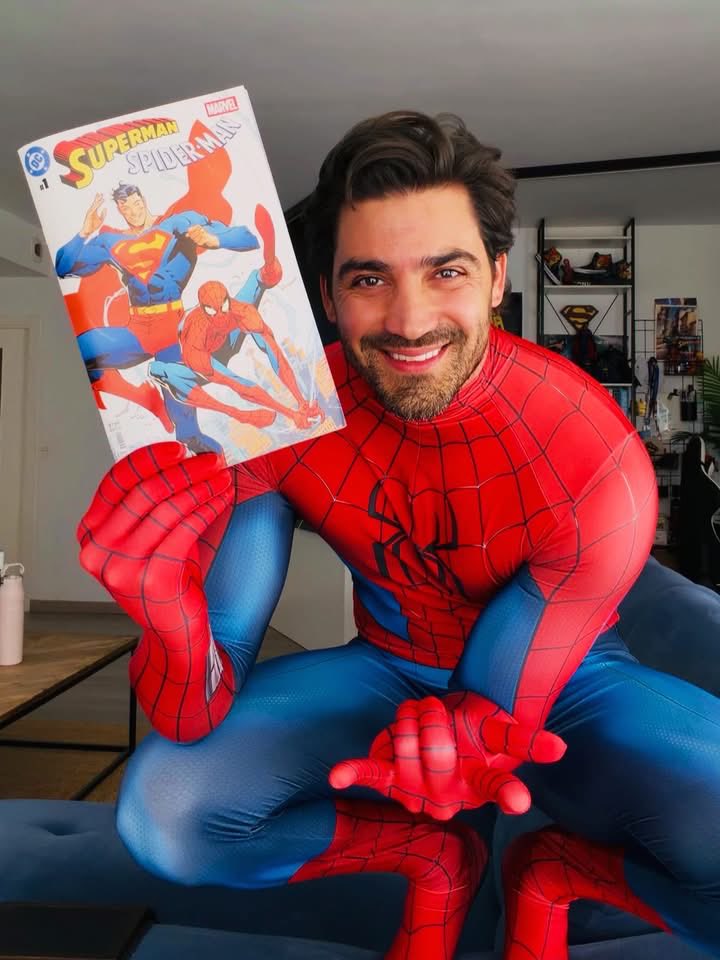
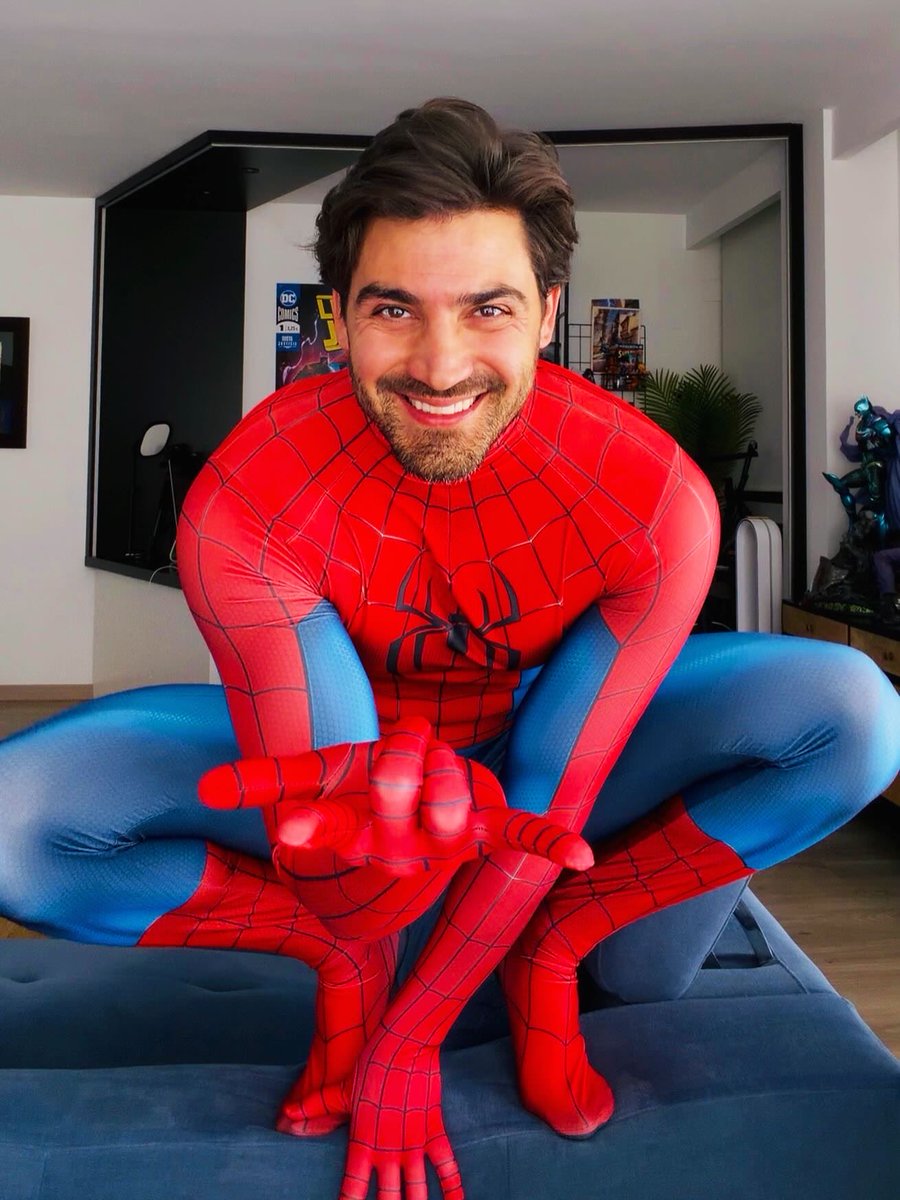
Today I dressed up for the occasion, I finally have them in my hands, and tomorrow they’ll be in yours! SUPERMAN/SPIDER-MAN! Thank you All!! for the hype, support, and love for this project during all these months. The day is tomorrow, and I sincerely hope you like it! 🙌🙌🔥:)
“In times of stress, the best thing we can do is remember we’re neighbors.”
When Fred Rogers appeared on The Arsenio Hall Show, it felt like two different worlds meeting—and somehow fitting perfectly together. Arsenio’s high-energy stage met Mister Rogers’ calm, steady presence, reminding everyone that kindness didn’t need volume to be powerful.
In an era driven by edge, attitude, and noise, Mr. Rogers stood quietly and changed the room. 🕊️ His words carried warmth, empathy, and humanity—proof that being gentle was never weak, just timeless. Moments like this are why his message still echoes decades later.
Everything is perfectly clear. Iran could not be allowed to get a nuclear weapon, which they have been months away from developing for well over a decade.
Also, Trump is the only president who could have kept us out of war with Iran, as he himself repeatedly told us. So we destroyed their nuclear capabilities, which Tulsi said they didn't have, in 2025. Then we attacked them last month because Israel was going to attack them because they were months away from developing a nuclear weapon since we destroyed their nuclear capabilities, and that would lead Iran to attack American bases.
Iran has never posed a threat to the United States, but we had to attack them first, not because of Israel, but because they posed an imminent threat to the United States.
Fortunately, we have won the war, which was not a war but a special operation, in Iran now several times in the last two weeks. It is basically over but might not be over for some time because we already won. We also don't need anyone to help open the Strait of Hormuz, which we knew they would close, which is why we didn't prepare, and we now need allies to help open.
What are you guys not understanding?
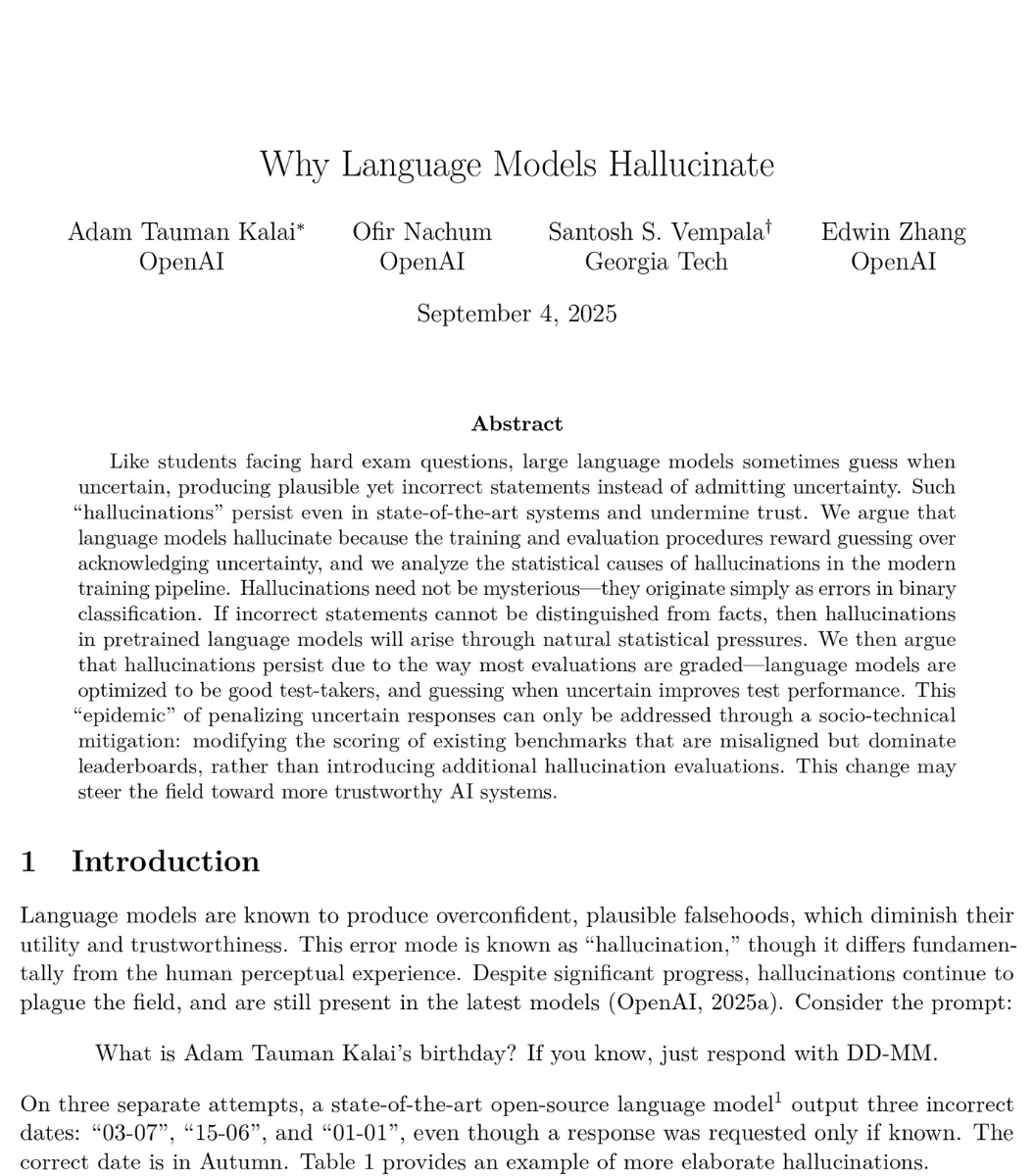
🚨BREAKING: OpenAI published a paper proving that ChatGPT will always make things up.
Not sometimes. Not until the next update. Always. They proved it with math.
Even with perfect training data and unlimited computing power, AI models will still confidently tell you things that are completely false. This isn't a bug they're working on. It's baked into how these systems work at a fundamental level.
And their own numbers are brutal. OpenAI's o1 reasoning model hallucinates 16% of the time. Their newer o3 model? 33%. Their newest o4-mini? 48%. Nearly half of what their most recent model tells you could be fabricated. The "smarter" models are actually getting worse at telling the truth.
Here's why it can't be fixed. Language models work by predicting the next word based on probability. When they hit something uncertain, they don't pause. They don't flag it. They guess. And they guess with complete confidence, because that's exactly what they were trained to do.
The researchers looked at the 10 biggest AI benchmarks used to measure how good these models are. 9 out of 10 give the same score for saying "I don't know" as for giving a completely wrong answer: zero points. The entire testing system literally punishes honesty and rewards guessing.
So the AI learned the optimal strategy: always guess. Never admit uncertainty. Sound confident even when you're making it up.
OpenAI's proposed fix? Have ChatGPT say "I don't know" when it's unsure. Their own math shows this would mean roughly 30% of your questions get no answer. Imagine asking ChatGPT something three times out of ten and getting "I'm not confident enough to respond." Users would leave overnight. So the fix exists, but it would kill the product.
This isn't just OpenAI's problem. DeepMind and Tsinghua University independently reached the same conclusion. Three of the world's top AI labs, working separately, all agree: this is permanent.
Every time ChatGPT gives you an answer, ask yourself: is this real, or is it just a confident guess?