📢📢📢 Check out our new paper!
We demonstrate how to control motion in any image-to-video model with no extra training.
Fast, simple, high-quality, and model-agnostic.
🔗 https://t.co/sMAeLL3Zc8
We present Time-to-Move (TTM)! a training-free, plug-and-play method for precise motion control in video diffusion. Unlike prior training-based methods, TTM works with any backbone at no extra cost🔥
Page: https://t.co/gEPrwWwB7B
[1/4]
@NoamRot@orlitany@mann_amir_
How can we tell whether a brain region causally represents a visual concept, rather than merely correlating with it?
Introducing BrainCause, a framework combining generative and brain models to create controlled stimuli and causally test neural representations.
More below 🧠👇
🎉 Happy to share our latest work: Bootstrap Your Generator: Unpaired Visual Editing with Flow Matching (accepted to #ICML2026)!
TL;DR: We train image and video editing models without any paired data.
No ground-truth edit data, no external reward models.
1/7
When rewards conflict, what should RL post-training of diffusion models optimize?
In visual generation, objectives are often in tension:
Prompt adherence can conflict with source preservation.
Photorealism can conflict with stylization.
In our new paper, ParetoSlider, we introduce a multi-objective RL framework that trains a single diffusion model for continuous control over competing reward objectives 🧵
Happy to share that Time-to-Move has been accepted to @iclr_conf! 🇧🇷
It’s been exciting to see the community adopt this work over the past few months for enhancing control in video generation.
We’ll present it at the main conference this Friday, April 24, 10:30 AM–1:00 PM, and also at the ReALM-GEN workshop on April 27.
Feel free to stop by and say hi to me or @assaf_singer!
Thanks @_akhaliq for sharing our work!
Project page: https://t.co/hBSprg43rK
Tired of 3D generations that look synthetic? They don’t have to.
Excited to share that Realiz3D is accepted to #CVPR2026 🎉
A framework for training diffusion models that are 3D-consistent, controllable, and photorealistic.
🔗 Project page: https://t.co/8UDsFk6N1A
🎥 Teaser ↓
Excited to present DRoPS! A novel method for dynamic 3D reconstruction from monocular videos, accompanied by a static-prescan of the dynamic object.
🌐 Project: https://t.co/rwIaAINSR4
📄 Paper: https://t.co/drNwUgetmK
🧵 [1/7]
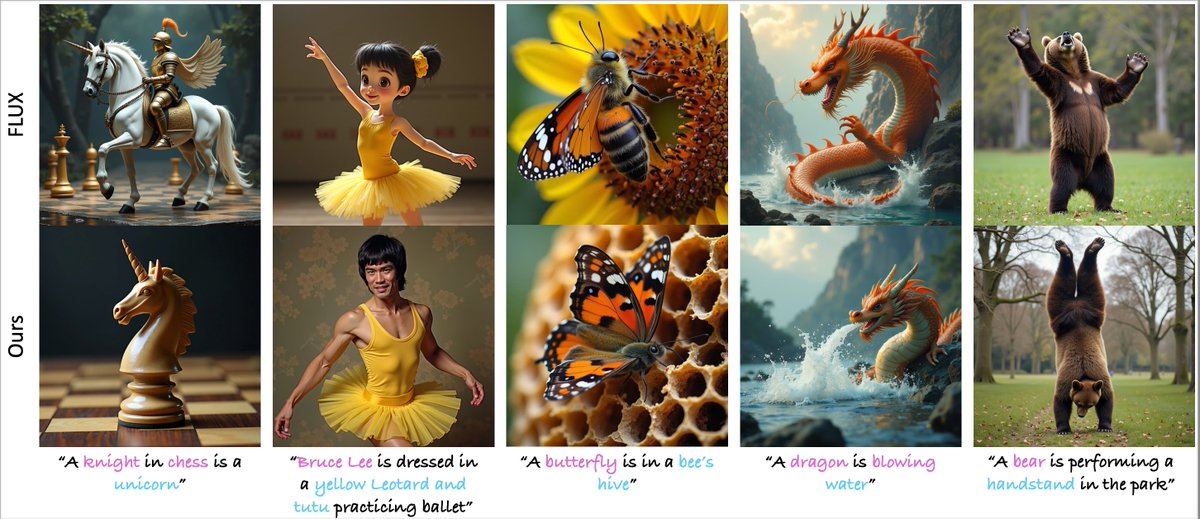
Excited to share that our work, “Image Generation from Contextually Contradictory Prompts,” was accepted to CVPR 2026 🎉
Diffusion models fail on some seemingly simple prompts.
Why do they ignore what you asked for?
We show why, and how to fix it with a simple, training-free method.
Joint work with @OPatashnik@OmerDahary@MokadyRon@DanielCohenOr1
SemanticMoments - Semantic motion similarity
How do you find videos with similar motion?
It’s harder than it sounds.
Models like VideoMAE and V-JEPA encode motion, but their embeddings are dominated by appearance.
So how do we build a compact embedding for motion similarity?
Joint work with @kfir99@OPatashnik@BenaimSagie@MokadyRon
The potential of this tech is just scratching the surface!
Watch this Blender layout transform into a final render using my Time-to-Move (TTM) workflow:
🎭 CaricatureGS is out!
Check out how you can make photorealistic 3D caricatures from your 3DGS avatar!
Project page: https://t.co/c0teU7w8FQ
Led by @EldadMatmon with @amit_bracha and @RonnyKimmel.
Will be presented at @3DVconf (#3DV2026).
I wanted to try out @mickmumpitz ComfyUI workflow that lets you animate movement by manually shifting objects or images in the scene. Link to his tutorial below 👇
For my real-life Toy Story short film, I built a workflow to control AI characters using puppets, paper cutouts, or animated previz!
And yeah I know… @CorridorDigital recently had a very similar idea. But they used a different technique!
Let’s compare👇
This just in: Lumana is now the world’s fastest-growing AI video security company!
50,000 cameras surpassed in just over a year since emerging from stealth.
Read more: https://t.co/2Pj9e4cICD
#AIVideoSecurity#AI
Thanks @rohanpaul_ai for sharing our new work!
Automatic Interpretability Pipeline + Human Brain Data = 🧠🔍🔥
See how we use a large-scale automatic interpretability pipeline to discover what concepts are represented in the human brain.
Page & Demo: https://t.co/3cStXhXs0b
I think Time to Move might be my favorite recent AI video tool, and I haven't seen a lot of talk about it. Maybe because it requires a lot of up front motion path generation? but it makes controllable video so much easier. 1st video is motion path provided, 2nd is output
🚀 Our paper “Appreciate the View: A Task-Aware Evaluation Framework for Novel View Synthesis” is accepted to 3DV 2026! @IdoSobol@orlitany
🔗 Project page: https://t.co/aNDh6y4XyS