Building World Models at Microsoft AI. Ex-Meta Researcher for 3D Generative AI, PhD @ TUM w/ Matthias Nießner — Doing smth with AI and AI does smth with me
MAI-Thinking-1 is out! Built from the ground up without any third-party distillation - it’s been a fun climb 🧗
Check out our 100+ page tech report: https://t.co/dEYfUUPKHj
Super excited to announce seven new world-class MAI models today. They represent what we consider a new era in AI designed to keep you in control and on the frontier.
First is our text foundation model, MAI-Thinking-1, exceptionally strong on reasoning and SWE tasks.
- It’s a 35B active parameter MoE with a 256K context window. Independent human raters on Surge prefer it for overall quality in blind side-by-sides versus Sonnet 4.6, and it’s achieved 97% on AIME 2025, the key measure of its general-purpose reasoning abilities.
- It's at 53% on SWE Bench Pro, placing it right alongside Opus 4.6 on one of the toughest coding benchmarks.
- And since we co-designed our models with our own silicon, MAI-Thinking-1 is optimized on our MAIA 200 chip. Benchmarking head-to-head against the GB200, we see 30% better performance per dollar as well as a 1.4x performance-per-watt gain when running our MAI models on the MAIA 200 end-to-end.
Next is MAI-Image-2.5 and its Flash variant. Two super strong models now at #2 on the leaderboards, surpassing the score of Nano Banana 2 on image editing.
Last for now is MAI-Code-1-Flash, our new inference efficient coding model, especially tuned for VS Code and GitHub Copilot CLI.
- Code-1-Flash achieves 51% on SWE Bench Pro, despite having just 5B parameters, putting it closer to Haiku in size but cheaper in cost.
All of this is the foundation for Microsoft Frontier Tuning. It lets you customize our models to create custom, company-specific agents that only you control. You can make our model, your model. Your data. Your agents. Your moat.
Early adopters are already seeing a difference. When we tuned our models for McKinsey’s tasks, MAI delivered the highest win rate, outperforming GPT-5.5 on quality, while being 10x lower on cost.
Also really excited to be collaborating with the amazing team at Mayo Clinic to jointly train a new frontier AI model for healthcare.
Our announcements today mark another milestone on the road to humanist superintelligence. You can learn more and about our other new models in our latest blog: https://t.co/v65eop5Ixq
We fully support OpenAI's transparency initiative. Thanks to @merettm@markchen90@gdb@sama for leading the way.
We all got into this field to build safe AGI that is genuinely good for humanity. One of the hardest parts of AI safety is coordination, and this is a step in the right direction. Many more steps like this will be needed to deliver safe, contained, and aligned AGI in the next few years.
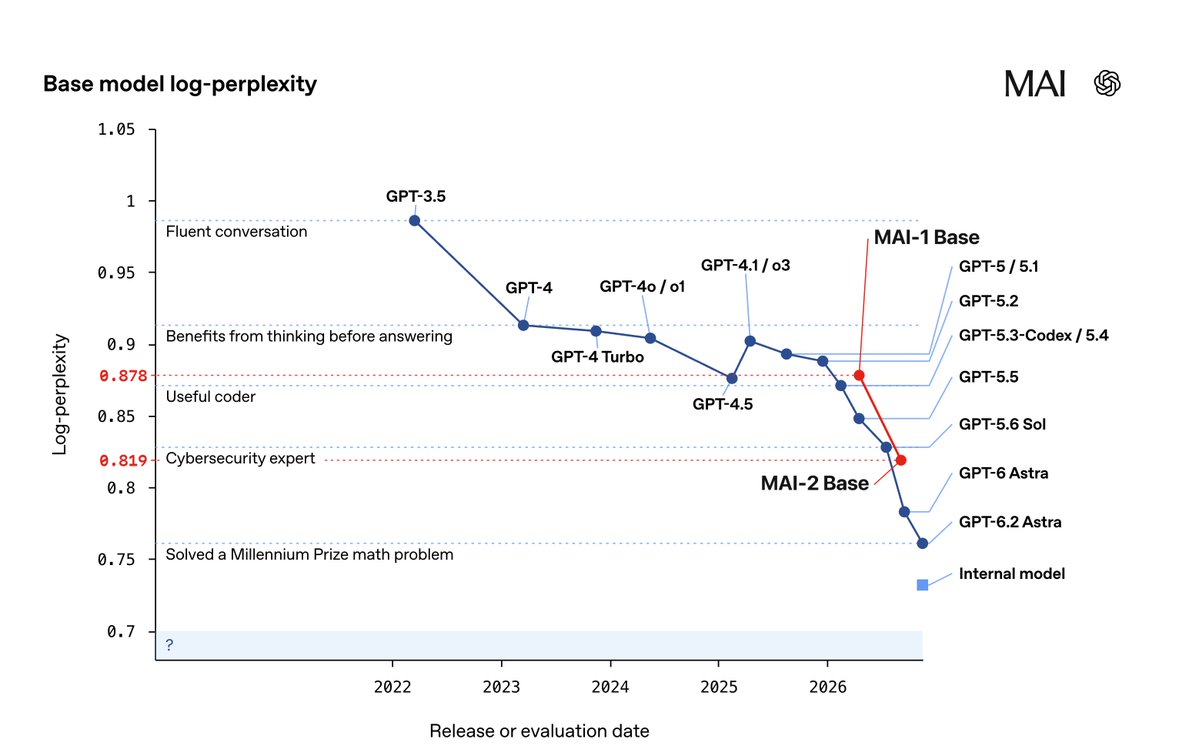
We're committed to sharing our pre-training progress on a common held-out evaluation set. With OpenAI's permission, we report MAI-2 Base on their evaluation set. Its log-perplexity is 0.819, putting it in the same ballpark as the GPT-5.6 Sol base model. Our model uses the same tokenizer as OpenAI, so the numbers are directly comparable.
In the future, to be able to compare across labs we might need to report bits-per-byte (BPB) rather than perplexity since different labs use different tokenizers. We will also need different evaluation datasets - the fact we have access to OpenAI's evaluation dataset is a special case.
Safety and alignment is now the mission. It's the absolute number one most important focus for our industry. And it begins with small, practical steps like these towards better coordination on pacing.
We now have state-of-the-art pre-trained base models in the 3T-parameter weight class, built entirely in-house at MAI.
Post-training results coming soon -- stay tuned!
Lots of details in our technical blog post.
https://t.co/xcZ5uV4TAp
The quality is truly on another level. Having worked on controllable video models for years, getting this degree of precise camera control and 3D consistency is insanely hard. Incredible work!
So excited to share what we’ve been working on!
Atlas is honestly just so fun to work with!! One of my favorite parts: Camera control is insanely good, allowing you to do crazy flythroughs.
How many examples can you spot in the blog where we fly through sth weird? 🚀
Microsoft's MAI-Image-2.5-Pro debuts at #1 on the Artificial Analysis Image Editing Leaderboard, and takes the #7 spot in Text to Image
MAI-Image-2.5-Pro is Microsoft AI's quality-focused image model, launched July 23 in preview on Microsoft Foundry. It joins MAI-Image-2.5 and MAI-Image-2.5-Flash in a family Microsoft positions as covering the quality-speed-cost curve, so builders can pick the point that fits their job. Pro sits at the quality end: Microsoft describes it as its highest-fidelity image model to date, aimed at hero imagery, detailed editing, and precise in-image text rendering.
In the Artificial Analysis Image Arena, MAI-Image-2.5-Pro debuts at #1 on the Image Editing Leaderboard, surpassing Reve 2.1, GPT Image 2, and Microsoft's own MAI-Image-2.5. In Text to Image it lands at #7.
On Microsoft Foundry, MAI-Image-2.5-Pro is priced per token: $5 per 1M text input tokens, $8 per 1M image input tokens, and $106 per 1M image output tokens, which works out to roughly $108.5 per 1k 1024x1024 images. That compares to $48 per 1k images for MAI-Image-2.5 and $20 per 1k for MAI-Image-2.5-Flash.
MAI-Image-2.5-Pro is available in preview on Microsoft Foundry across seven global-standard regions, and can be tried out in the MAI Playground.
Congratulations to @MicrosoftAI on the release!
See below for comparisons between MAI-Image-2.5-Pro and other leading models in the Artificial Analysis Image Arena 🧵
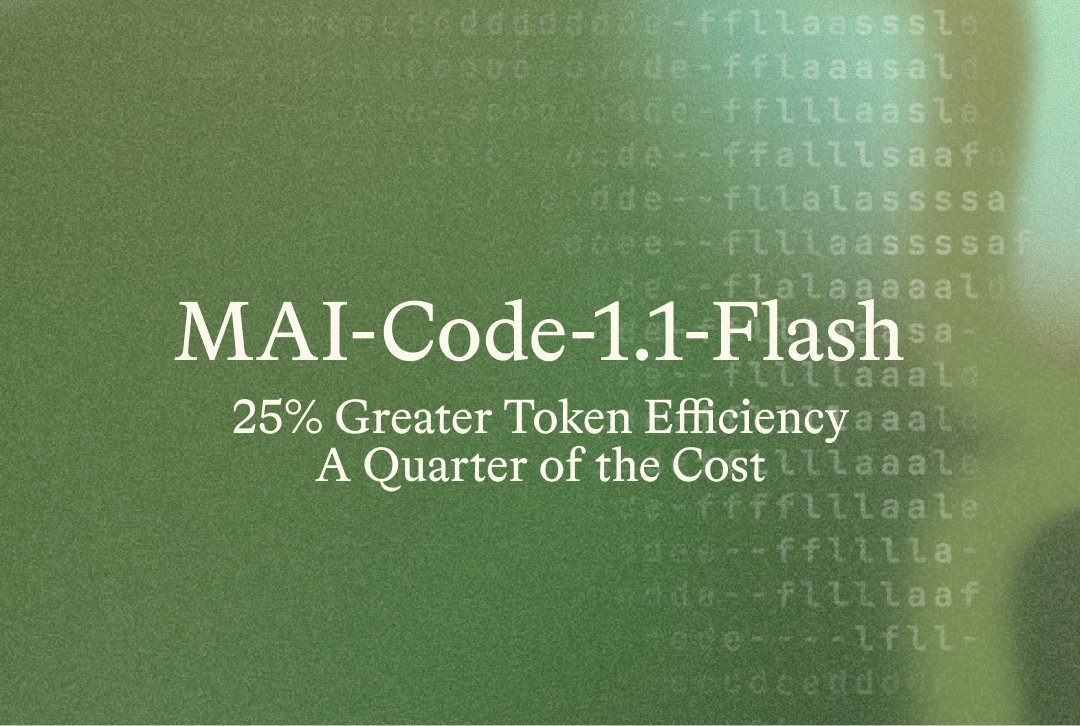
Our latest code model is 25% more efficient, higher quality, and a quarter of the cost than our model launched in June. Now live in GitHub Copilot - try it out.
MAI-Image-2.6 is now the #2 text-to-image model in the world - beating out Nano Banana, Meta, and Grok! Fantastic moment for the team who've been hill climbing relentlessly. Try it out now on Arena!
Today we launched Muse Image and are previewing Muse Video! 🚀
https://t.co/sVPBIHGgzv 👈
Muse Image does agentic image generation! It's great at tool use and search. I highly recommend trying it out on https://t.co/JBfhbJUJLB!
Excited to continue! 🧑🍳🔥
Beautiful tech report, perhaps the best western model report I’ve ever read.
Lots of great insights: no synthetic data in midtrain, teacher models are RLed directly on top of midtrain, and adaptive clip higher.
But still seems like they didn’t fully nail true on-policy as they admit their RL stage is unstable, leading to a hacky self-distillation stage (imo)
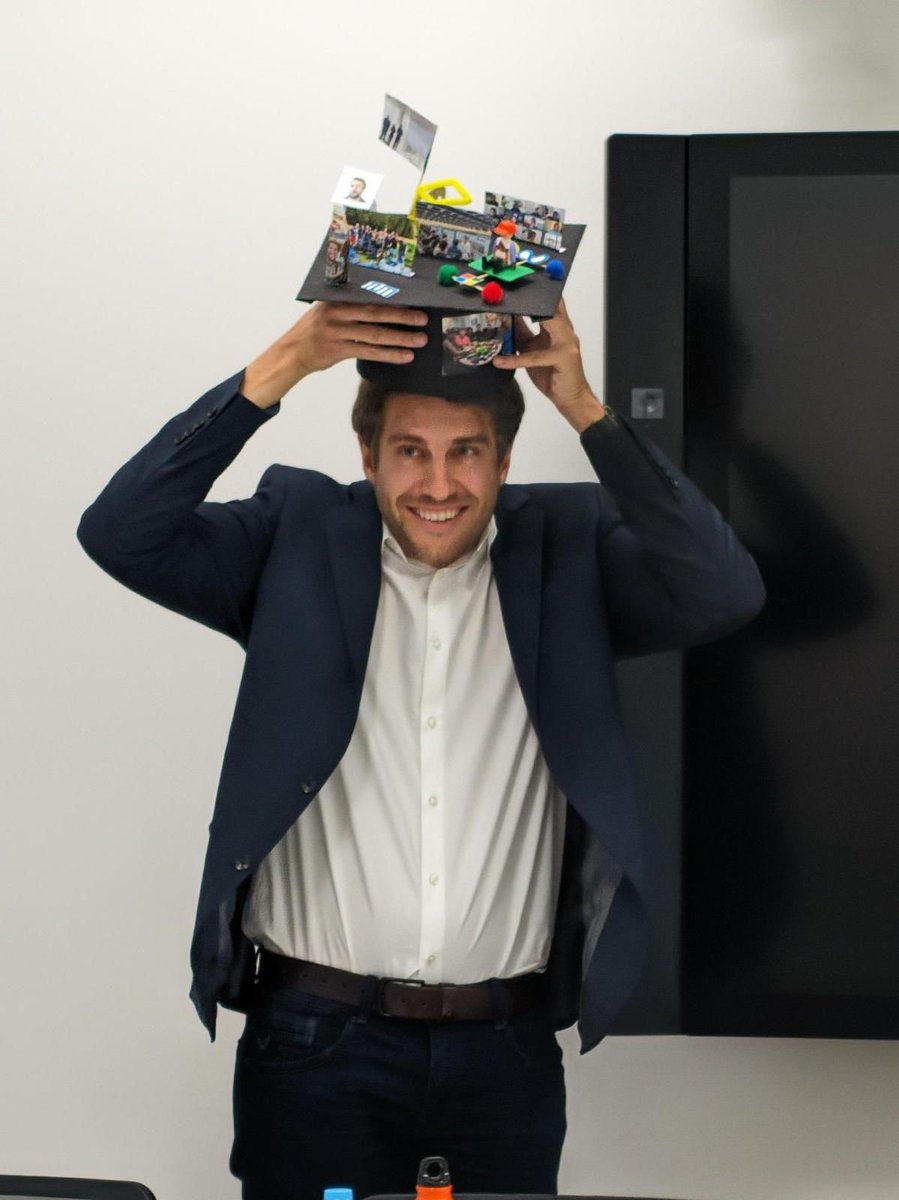
I am incredibly grateful for all the support and guidance from my supervisor @MattNiessner and my examiner @LourdesAgapito. Thank you for everything! 🎉🥂
I've officially defended my PhD! 🎓
Never thought that researching 𝐆𝐞𝐧𝐞𝐫𝐚𝐭𝐢𝐯𝐞 𝐌𝐨𝐝𝐞𝐥𝐬 𝐨𝐧 𝟑𝐃 𝐑𝐞𝐩𝐫𝐞𝐬𝐞𝐧𝐭𝐚𝐭𝐢𝐨𝐧𝐬 could be as challenging as dealing with the German bureaucracy afterwards!
Congrats to @Normanisation for his successful PhD defense 🥳🎓
Norman's thesis about 𝐆𝐞𝐧𝐞𝐫𝐚𝐭𝐢𝐯𝐞 𝐌𝐨𝐝𝐞𝐥𝐬 𝐨𝐧 𝟑𝐃 𝐑𝐞𝐩𝐫𝐞𝐬𝐞𝐧𝐭𝐚𝐭𝐢𝐨𝐧𝐬 makes important contributions to the 3D vision community. For instance, DiffRF, a generative approach directly operating in 3D space, was among the first diffusion techniques for neural radiance fields.
This led to many follow up works in this area and sparked interest across the computer vision community, establishing generative approaches as a corner stone in the 3D domain.
Also after his PhD, Norman continues to work on the forefront in computer vision, such as his contributions to MapAnything, a universal feedforward approach for 3D reconstruction.
Check out Norman's amazing work: https://t.co/FBjSKJ4lja
Congratulations Dr. Mueller - super proud!
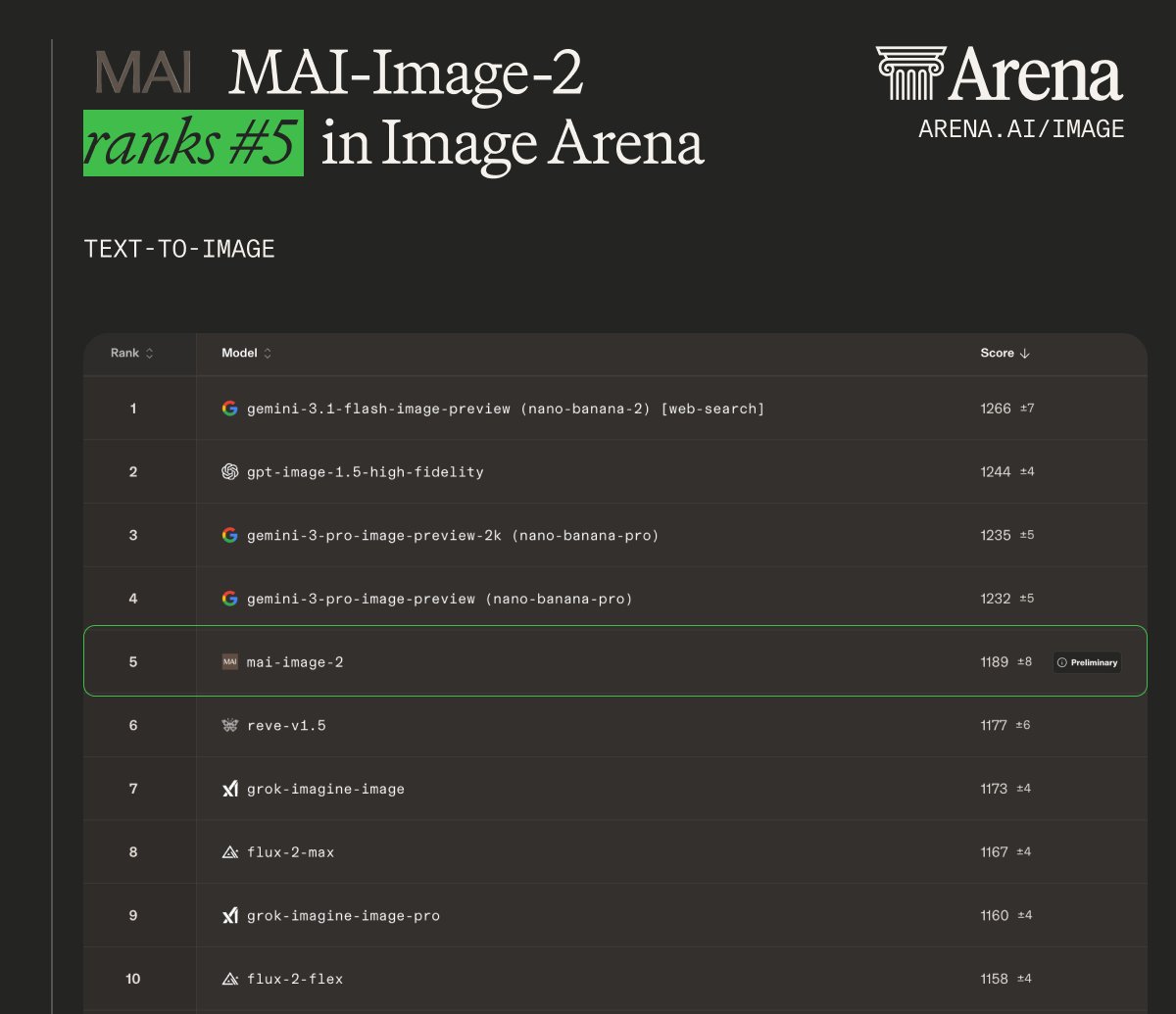
MAI-Image-2 debuts at #5 in the Image Arena!
Highlights:
- #5 in Text-to-Image overall
- #5 for 3D Imaging & Modeling, Cartoon, Anime & Fantasy, Photorealistic & Cinematic Imagery, Art and Portraits
- #6 for Product, Branding & Commercial Design
Congrats to the @MicrosoftAI team on this milestone!
I am working on building teams for the likes of @NandoDF and @asadovsky for @MicrosoftAI! We are #HiringNow in Europe and US 🧵👇 - follow me for more updates on our Superintelligence Lab - Roles below 🔔
I’d like to hire strong data engineers to join our Microsoft Super Intelligence (MSI) team.
I am interested in people who are good at processing PDFs and other documents at billion scale, and people good at parsing the web at trillion scale.
If you dream of processing all of human knowledge to advance science and engineering, this is for you.
Also looking for strong evaluation and post-training engineers.
Be part of our first launches this year 🚀
We have all the resources in the world to support you, working in startup mode, while powering a large organisation with billions of users.
Hiring in London, Zurich, New York, Boston, Toronto, Seattle and SF.
Please send your CV to [email protected]