Nosym Pharma is a fictional pharmaceutical company created by Joe, Julie, Justin, and Spencer of Group 17. Part of the @NU_ChemE Capstone 2 Design Project.
@jabulencia@NU_ChemE Thanks for the question! If we were able to use loratadine, we would likely look to develop an HPLC assay to determine the concentration/release - this is one of the industry standards. We hope to revisit this study in the future, if time and budget allow.
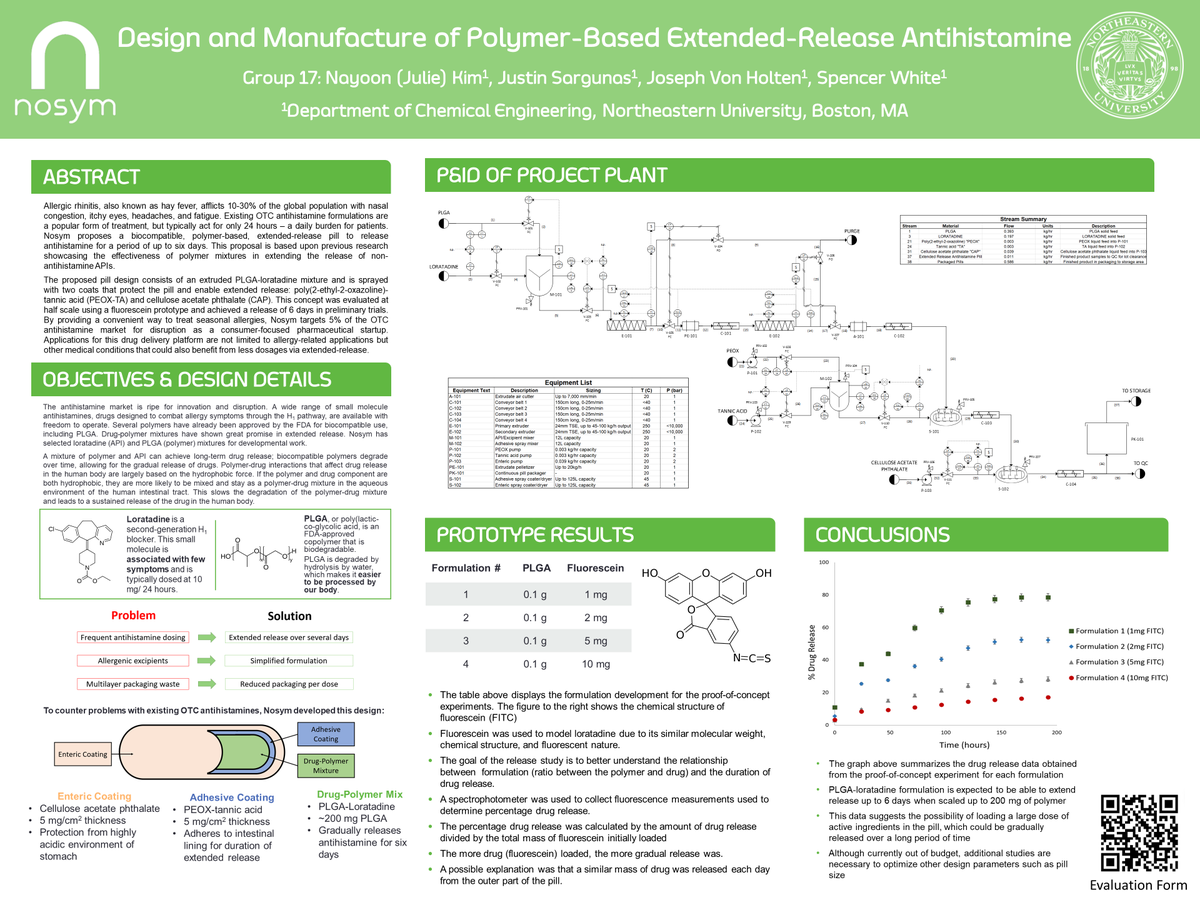
The Nosym team is proud to present our #CHME4703Poster for @NU_ChemE ! Feel free to ask any questions or give us feedback to improve our extended-release antihistamine design & production. 💊😄🌻 #HealthierTogether
@JacobHe18314812@NU_ChemE Our hope in developing this project was that neither coating layer would inhibit nor accelerate the API release. There isn't any evidence in literature that it would perform otherwise, but that is definitely something we'd like to investigate more.
@JacobHe18314812@NU_ChemE Thanks for the question, Jacob! Unfortunately, because of our limited budget, we weren't able to run the proof of concepts with the coatings; however, that definitely would've been desirable!
@WillitsLab@NU_ChemE We at Nosym strive to provide relief to everyone, and are therefore focusing on enrolling diverse trial participants to more accurately capture a full range of responses!
@WillitsLab@NU_ChemE Moving forward with our pill, we will have to test our product for safety and efficacy - this involves animal models and then clinical trials if results are promising. This will be done in compliance with FDA guidelines.
@Celluol_21 @NU_ChemE@nosym Hi Celluol, good question! Degradation studies are absolutely at the top of our priorities for future testing. PLGA shelf stability varies from formula to formula, so we'll definitely need to pick our final candidate with this in mind.
@US44Memes@NU_ChemE Process safety is the most important part of any process! PRV-105 is a spring relief valve - this is necessary because spray driers utilize atomizing air pressure. If pressure begins to build and no relief is present, there may be damage to equipment or harm to operators.
@donepegel@NU_ChemE Thanks for the question! We utilized PBS (pH 7.4) for our release studies due to pricing constraints. We believe that is an appropriate initial model for the small intestine (pH 6-7.4), but there could certainly be deviations for release in simulated intestinal fluid.
@BiotechVert@NU_ChemE Our enteric coating is designed to be pH sensitive and will be eliminated as it passes the stomach. The adhesive coating might potentially interfere with drug release but regarding the thin coating, we assume the effect will be minimum. Ideally, this could be tested in vivo.
@BiotechVert@NU_ChemE Hi Vert Biotech, that is a great question. We can back calculated the amount of drug released if necessary. However, the point of this study was to study how gradual drug release was based o the ratio between the polymer and drug, so % drug release was a reasonable choice.
@Celluol_21 @NU_ChemE To clarify, the extra power from your lignin waste would be great for reducing your utility costs, but would that power generation emit a lot of CO2 into the atmosphere?
@Celluol_21 @NU_ChemE Hello Group 14! Nosym loves the sustainability focus of your project. We were alarmed, though, to discover that lignin waste is commonly disposed of through combustion. Are there alternative sustainable lignin disposal methods that your team is considering?
@BiotechVert@NU_ChemE Because this assay was being done at a smaller scale, we simply wanted to see any effect of a varied polymer to drug ratio. Thanks for the question!
@BiotechVert@NU_ChemE Hi Vert Biotech! We definitely considered running that kind of study; however, our efforts were limited by the amount of material we had available for our proof of concept experiments.
@SweetChlo1@NU_ChemE Hi SweetChloë - we're excited by your work into replacing common pesticides with healthier solutions! We're wondering if you have any initial simulations or prototypes that you used to influence your model, and what unit ops you're optimizing going forward!
@RenewbleRubbish@NU_ChemE The outer coating is used to protect the formulation from the acidic stomach environment, and the inner coating is for attachment to the intestinal lining in order to increase residency time. Hope this provides some clarification!
@RenewbleRubbish@NU_ChemE Thanks for the question! The coatings are not directly related to the release - the polymer addition to
the formulation is what allows the active pharmaceutical ingredient to dissolve at a slower rate than usual.