Capstone 2, Group 21:
We are scaling up the production of donepezil loaded nanostructured lipid carrier based topical gels for the treatment of Alzheimer's.
@SweetChlo1@NU_ChemE Thank you Team 23! Research studies show that patient adherence to AD medication regimens is significantly improved in transdermal treatments compared to current oral treatments, b/c of patient and caregiver preference, reduction of gastrointestinal side effects, and ease of use.
Hi everyone, we are Donepegel (Capstone Group 21)! We are scaling up the production of a transdermal nanostructured lipid carrier based gel loaded with #donepezil, an Alzheimer's medication.
#CHME4703Poster@NU_ChemE
@JacobHe18314812@NU_ChemE With additional time/resources, we would run a series of experiments manipulating the aforementioned process parameters and measure the resulting particle size of our DPB-NLC gels, then use this data to simulate the scaled-up process. (3/3)
@JacobHe18314812@NU_ChemE However, each NLC formulation behaves differently, meaning it would be impossible to simulate changes in our particle size without running bench scale experiments using DPB-NLC gels first. (2/3)
@OxygenlyLLC@NU_ChemE Brilliant idea and poster! Do you need to place the hypoxic chamber inside an incubator or will it operate at 37C? Instead of making multiple sizes or having a standard size, have you considered making it size adjustable to accomodate majority of cell flask sizes?
@Nosym_Pharma@NU_ChemE Great poster, and the proof-of-concept experiment is really interesting! One question: was a biorelevant dissolution media used for the release studies, like fed or fasted state simulated gastric fluid? If not, do you think that would affect your results for release vs. time?
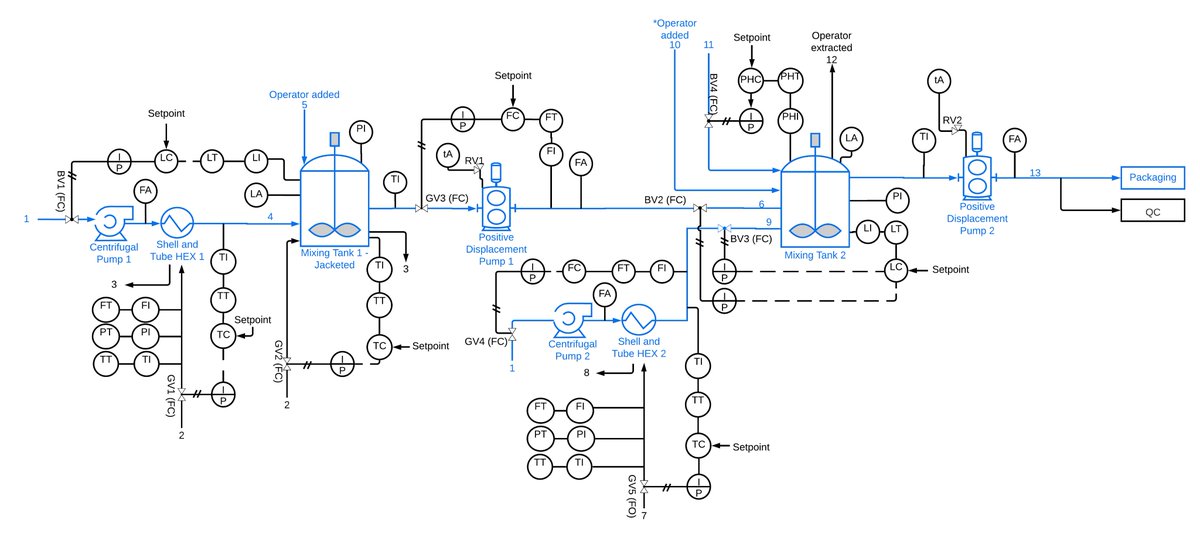
@cellulosers@NU_ChemE For further optimization, we want to look specifically at the mixing occurring in Tank 2, as this critically impacts the resulting product quality/particle size. With additional time and resources, we would use a CFD software to simulate the mixing happening in this tank.
(3/3)
@cellulosers@NU_ChemE The lipids, surfactants, and drug are heated and mixed together in Tank 1, then water is added to form a microemulsion. The microemulsion is dispersed into water in Tank 2 to precipitate the nanoparticles. After this, a gelling agent is added to create the final product. (2/3)
@MilkyWayChemE@NU_ChemE Very interesting project! Could you explain why you chose Pichia pastoris yeast for this process? Are there any advantages compared to other yeast species or other microorganisms?
@WillitsLab@NU_ChemE Blank NLCs (not loaded with donepezil) have a particle size of approximately 161.35 nm, highlighting the importance of a strict acceptable particle size range in our process.
(2/2)
@WillitsLab@NU_ChemE Thanks for the comment! The target particle size range for DPB-NLC gels is 177.05 +/- 2.12 nm. This range was determined by initial proof of concept studies on DPB-NLC gels (linked here), and is reflective of the drug loading of each nanoparticle. (1/2)
https://t.co/raQO5DbspT