Looking for something that actually gives real soft energy without any noise? This service delivers every single time 🚀😌
Gentle start, steady good vibes, nothing forced. Just sat there letting it work. Left feeling lighter and quieter inside. These moments have become my favourite reset.
https://t.co/APHFfcGCQF
#HyperLuckyMove1 #Crypto #CryptoCommunity
Our lying Ontario premier has just stolen $50 from every single person in Ontario. The estimated cost of repairing our beloved Science Center was 200 million dollars. The firm that made the estimate was told to multiply it by 1.85 to make it bigger. We were then told it would be better to build a new science center. Now we learn the new center will be smaller and will cost a billon dollars before the cost overruns. The only win is that the extensive parking lots of the old Science Center will be available for his developer friends.
We ran a large-scale distillation attack on the Kimi K3 technical report by reading it in parallel at the Hugging Face Journal Club :)
https://t.co/C5H7Ox8Jty
Our main takeaway is that there doesn't appear to be any "secret sauce" behind frontier performance.
Instead, K3 is a demonstration of how many difficult algorithmic and infrastructure decisions have to work together (distillation, RL scheduling, environments, quantisation, MoE sharding etc) to push a model to the frontier.
Here’s what we learned:
• Frontier post-training increasingly looks like expert training followed by distillation. K3 trains specialists across three domains and three reasoning-effort levels, then distils the resulting nine experts back into a single checkpoint using multi-teacher OPD
• Reasoning effort is treated as a trainable capability. Token budgets are estimated from the SFT model, and a stage-wise curriculum anneals from long to short rollouts to produce low-, high- and max-effort experts.
• Partial rollouts keep expensive RL infrastructure busy. Completed trajectories can trigger immediate updates, while unfinished ones are carried into later iterations and reprioritised through a priority queue. Per-token corrections help control the resulting off-policy behaviour.
• The reward model is itself an agent. Rather than relying only on fixed or binary rewards, it generates task-specific rubrics and scores responses against them on the fly.
• The environment interface is designed for composition. A unified, white-box abstraction allows the same training system to operate across different agent harnesses like Codex, CC, Hermes instead of specialising around a single one.
• The systems work is as interesting as the algorithmic work. GPUs dynamically switch between training and inference, rollout concurrency responds to KV-cache pressure, and reference models can live on CPU until needed.
• Quantisation is part of training—not merely deployment. K3 uses QAT for weights and activations, while matching the trainer and inference server’s quantisation schemes to reduce train–inference mismatch.
• The chat template is novel and introduces an extensible token markup language is intended to accommodate new tools and modalities without repeatedly redesigning the template.
• Synthetic task generation is becoming increasingly autonomous. Agents traverse a knowledge graph and search the web to generate training tasks at scale, although the report leaves some details of their integration underspecified. (This part was very cool)
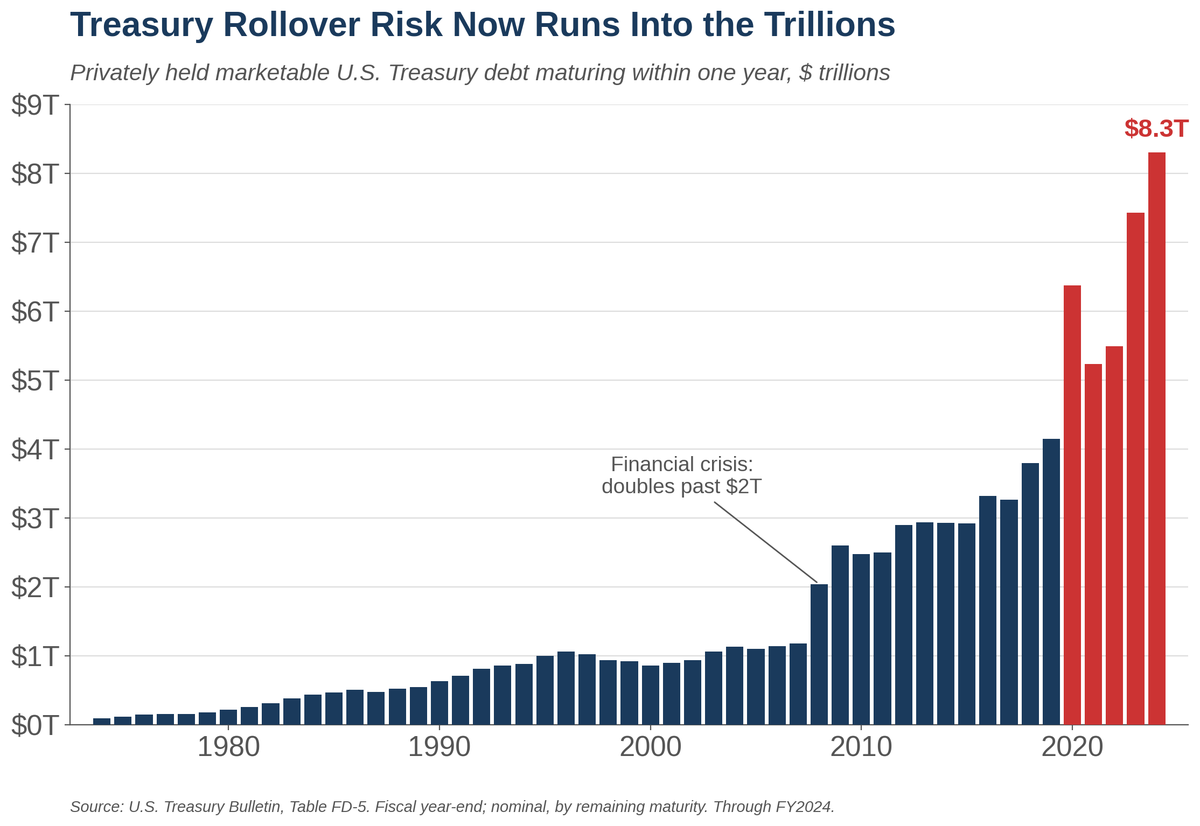
Debt payments are rising not just because the debt is growing under Trump, but because the government has leaned on too much short-term borrowing.
As it comes due, Washington must now lock in the higher rates the inflationary Iran War has created.
My @Morning_Joe Chart
Customers are not an abstraction for us: we exist to help enterprises, public institutions, and industries build their own intelligence, so the value created from their data, workflows, feedback, and models accrues to them rather than to model providers.
Build apps from https://t.co/f3u3RwhHjk, iOS, and Android. With one prompt, turn an idea into a published product with its own domain.
Now available for SuperGrok Heavy users.
Introducing Runway Media Router.
The first preference-optimized router for generative media. Instead of hand-picking a model for every request, you define what "best" means once, for cost, quality, or latency, and the router selects the right video, image, or audio model automatically.
Live now in Runway Dev.
Looking at usage behaviors over the past few months. In June, people generated the most content on Tuesdays and Wednesdays, on average. Saturday saw the least.