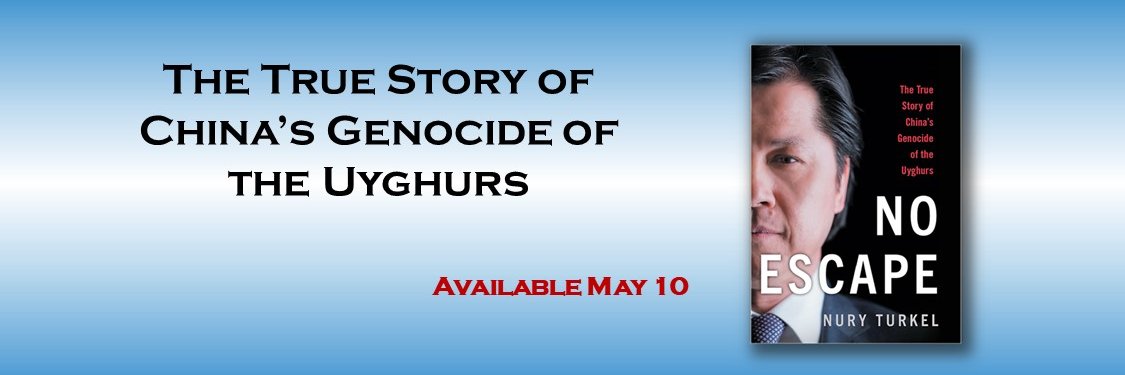
Humbled to announce my book, “No Escape” is available for pre-order w/ @HarperCollins https://t.co/JOvykDaRST.
Never expected to write a memoir this early in life & it has not been a solitary effort. Hope readers will no longer feel separate from/ indifferent to #UyghurGenocide.
I think part of it, at least vis a vis US/China competition, is that US and western chattering classes find it hard to believe that the market-driven outcome of frontier AI could possibly be right. They basically believe, in their hearts, that the Chinese system, with its “industrial strategy,” has eclipsed capitalism. So they harbor the same inferiority complex toward the Chinese system that many Americans once harbored toward the EU’s system. Their heuristic is that the industrial strategists of China have grasped the whole picture of the technological competition in a way that US industrialists, with their “profit maximizing incentives,” could not possibly have matched. And so any outcome in the economy that is not the result of “strategy” is therefore prima facie worse than what the “strategists” have concocted. They also believe the Chinese strategists possess awesome powers of foresight and the ability to evade all tendencies of financial and economic gravity, due of course to “strategy,” really it’s almost a kind of orientalism.
Meanwhile the U.S. industrialists are making new advances in math and science, and the fastest-growing businesses in history, by spending hundreds of billions of dollars on high-margin chips whose legacy is in rendering video games, cramming them underneath tents if need be, and investing generational capital into new energy generation technologies as they do it, and perhaps even colonizing space as an instrumentally convergent result. But none of that is “strategy,” you see.
This is an interesting question. My take: I do not quite accept the notion that China did not seek to "weaponize" rare earths and instead stumbled into a position of advantage. For at least 16 years, and likely more, the purpose has been an economic weapon. This is not like, say, solar or EVs, where excess capacity is sort of an accident.
Here, for example, is a semi-authoritative book cited by @JohnF_Sullivan on rare earth strategy written in 2011 for the state China Economic Publishing House the year after the Japan situation:
"What magical quality do rare earths possess that makes the usually arrogant and domineering Americans so furious? What magical quality do rare earths posses that leaves the usually wealthy and arrogant Japanese grief-stricken? China is the only country in the world capable of supplying all 17 rare earth elements, particularly holding a larger share of heavy rare earths that have prominent uses in military applications. To change China’s international position in the rare earth industry, since 2009, the Chinese government has launched a vigorous rare earth defense war, adopting a series of rectification measures including suspending approval of mining rights, controlling total mining volume, reducing export quotas, raising export tariffs and and severely cracking down on rare earth smuggling."
A key purpose of these post-2009 steps, which PRECEDE China's weaponization against Japan in 2010, was to hone a better coercive instrument.
Then there is some empirical evidence suggesting PRC action in this sector was about leverage.
First, most obviously, China used this as a coercive instrument in 2010. That shows, for at least 16 years, they have understood it as a critical leverage point.
Second, China's government has for decades manipulated the price of rare earths to prevent anyone else from achieving scale - dropping the price to kill foreign investment. Why did they do this when they already had 90% market dominance? The logic is toward control, not profit, and it is not the result of disaggregated independent Chinese market actors (which do not exist in this sector).
Third, related to that point, if this industry operated on economic logic, we would probably see more fragmentation. Indeed, for a brief time, we did see that before 2010. But then the PRC sharply consolidated the rare earths industry into state-backed companies. They shut down, arrested, harassed, and outright expropriated private actors. This was partly to ensure greater state control over external flows - the better to maintain leverage. The quote above refers to that effort.
Fourth, I do not think China's controls on rare earth minerals were modeled off U.S. controls. For example, the October controls went far beyond any U.S. controls. China's idea was any product, anywhere in the world, with .1% value coming from Chinese produced rare earths, required a license to be sold to anyone else in the world. The closest analogy -- and Chinese scholars have said this directly -- is to U.S. financial sanctions, not export controls.
Fifth, this is not a case where "there are many different actors, and they often overperform in search of particular targets." The industry has for a long time just been a few actors, tied to the state, acting at the state's direction. China's cultivation of leadership in this sector dates back to the 1960s, accelerating in the 1980s, with direct involvement of Deng's family in the 1990s and Premier Wen in the 2000s.
The empirical evidence seems to indicate a conscious desire to dominate this sector. One can debate whether or not such an intention was justifiable given U.S. control over chokepoints like finance.
But I think it is hard to advance the claim this was just the independent action of market participants that happened to accidentally create a position of extreme concentration and dominance.
Wow. This EO is almost exactly similar to the leaked text from the EO POTUS chose not to sign because it was too regulatory. The only major difference is that the “voluntary” pre-deployment review process is now 30 days rather than 90. That is a concession, but a very small one compared to what I would have expected based on the President’s remarks about the earlier draft.
This is fairly major win for the safety contingent within the Admin, and a significant loss for the Sacks/accelerationist wing, and is surprising to me.
I continue to think this EO is a mistake. This is clearly teeing up the infrastructure for a model licensing regime, and the fact that the administration is classifying the details of how this “voluntary” system will work is egregious. The public and the employees of the labs have a right to know how this works. Most lab staff don’t have clearances, but if the literal regulatory thresholds that trigger pre-deployment review are classified, researchers themselves won’t know whether what they are training is regulated by this EO. All for a benefit that is barely articulable; what, exactly, is the intelligence community going to do in 30 days to make the models safer?
It’s not a huge mistake, but a small-medium sized one. But I am fairly confident this is a mistake nonetheless.
John Costello, the Wirescreen analyst who wrote the report, said the data showed “directly and irrefutably” that U.S. technology was equipping the Chinese military.
“What number of advanced Nvidia chips in P.L.A. hands does the company consider acceptable?” he asked.
https://t.co/Ba25uSnp2R
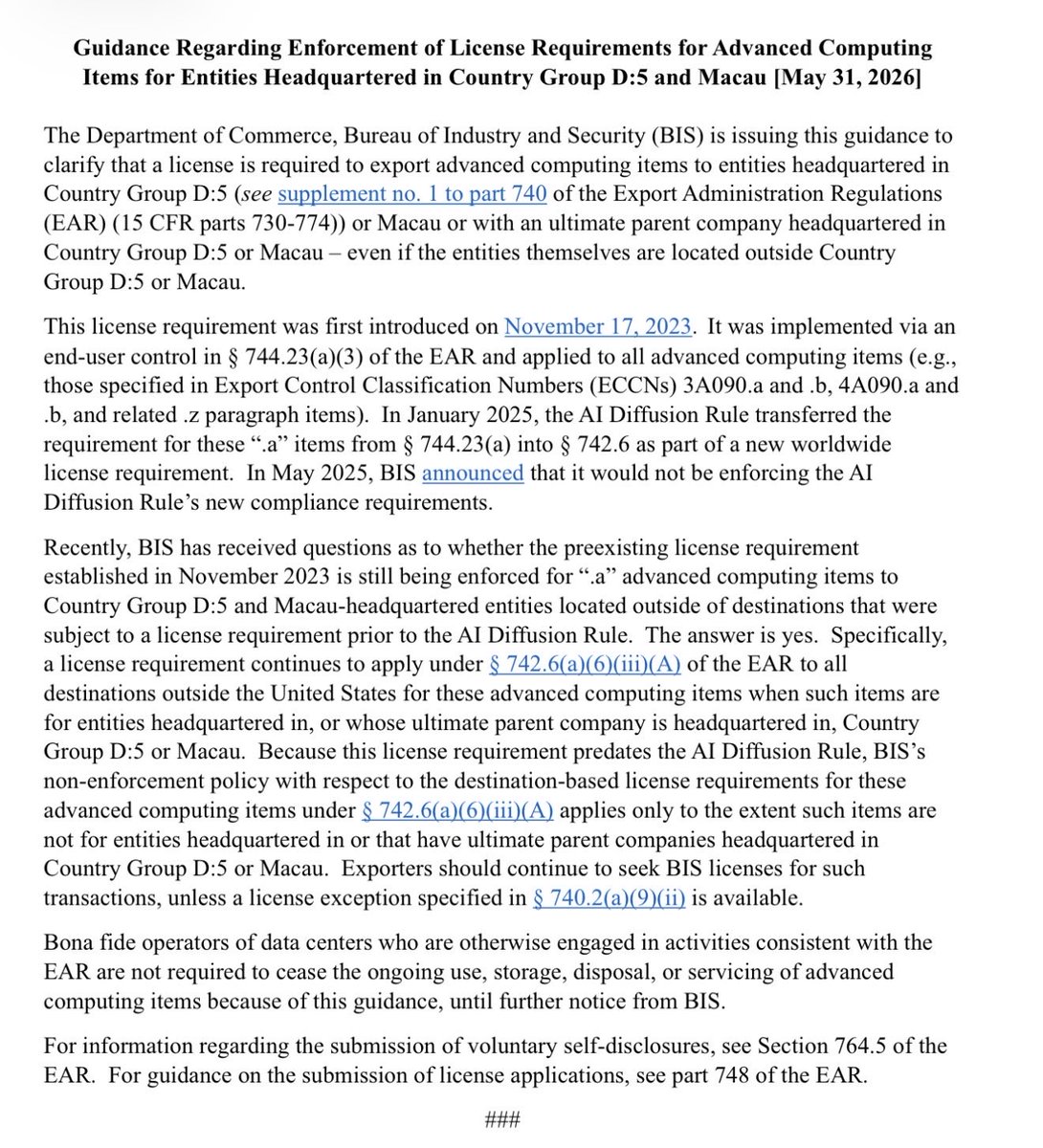
NEW: BIS just issued guidance stating that licenses are required for advanced AI chip exports to China-headquartered firms located outside of China (e.g. a Tencent subsidy in Malaysia). The reason they had to issue this statement is BIS’ non-enforcement of certain export controls have (potentially inadvertently) have allowed Chinese companies to both buy Nvidia Blackwell chips and make AI chips at TSMC, all legally and without a license. This is a HUGE problem.
Since May 2025, BIS has publicly stated that it is not enforcing certain license requirements related to AI chip shipments, and as a result, apparently Chinese companies’ overseas subsidiaries (e.g., Tencent Malaysia) have been able to legally buy Nvidia Blackwell chips without an export license - even though this had been restricted since 2023. Chinese companies have been buying these chips, very likely at scale. And because BIS has not updated export control regulations to clearly state what it IS enforcing, all of this was legal.
It actually gets worse. BIS’ non-enforcement announcement in May 2025 extends to existing US restrictions that prevent TSMC from making AI chips for Chinese companies. US export control regulations require TSMC to do enhanced due diligence on any orders that could be an AI chip, to make sure it isn’t illegally being made for a Chinese company (directly or indirectly). But these regulations require a license requirement to be in effect to work. And those license requirements largely were not being enforced.
This clarification does make clear that Blackwell shipments to China-headquartered companies outside of China are now illegal again—which is good, although obviously we have to see how many shipments have already gone to assess how much damage was done. BIS’ statement acknowledges these shipments have been happening when it says companies who bought chips under this loophole don’t have to stop using them.
HOWEVER, this statement does NOT say that BIS will enforce the parts of US regulations requiring TSMC to do enhanced due diligence on AI chip orders. This is a massive loophole that still needs to be closed. If Chinese companies can make chips at TSMC (including by using third-country cutouts to receive the chips), there is no point to restricting China’s access to AI chips or advanced chip-making tools.
Ultimately, BIS desperately needs to issue a regulation that clarifies what US export control policy for AI chips is. The reason this happened is because BIS said it is not enforcing existing regulations, but didn’t make clear what specific provisions its non-enforcement applied to, and didn’t update regulations to align with what it IS enforcing - which created massive loopholes, some of which still persist.
NEW: Xinjiang has the highest detention capacity in the world, according to FT analysis - enough space for almost 1 in 40 people in the region - more than five years after the Chinese govt announced the camps had closed.
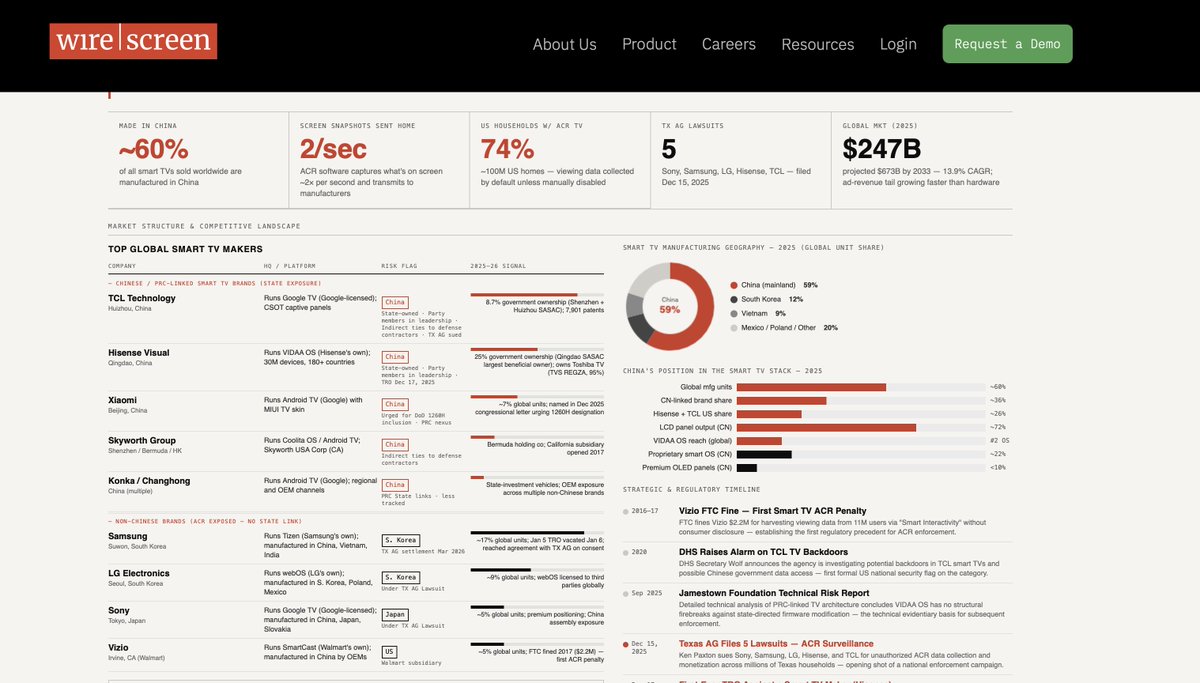
Washington is now treating the smart TV as a national security problem.
60% of the world's TVs are made in China. Hisense + TCL — both state-owned — hold ~25% of the US market. And your set captures what's on screen 2x/sec, then sends it home.
New WireScreen briefing 🧵👇 https://t.co/XDnhZRqSoV
Study finds Chinese state-media content embedded in major AI chatbots, shaping answers in ways that favor authoritarian governments. Read more in this week’s WSJ China newsletter: https://t.co/86HEZapsBK via @WSJ
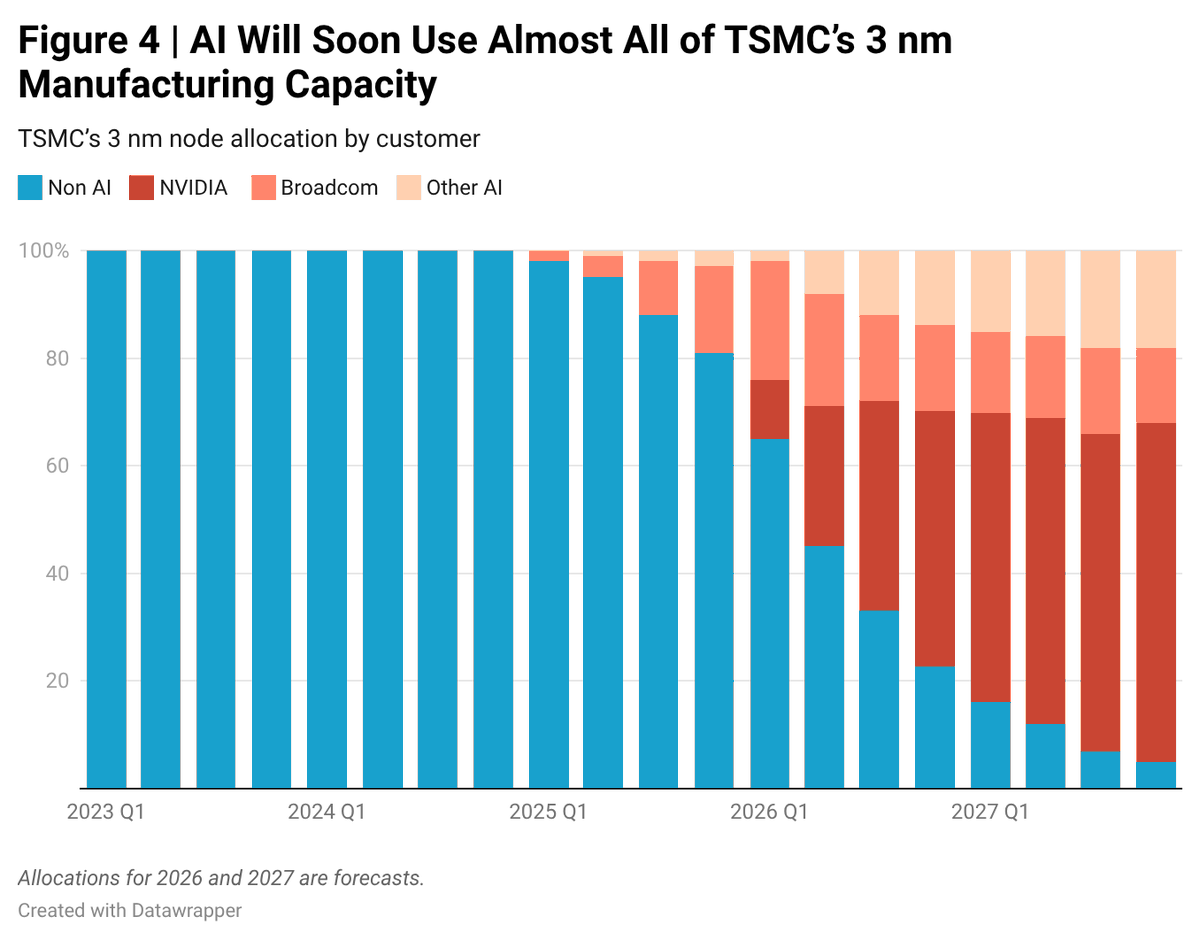
AI companies are pushing TSMC’s current production capacity to its limit—and planned capacity is fully reserved before it has even broken ground.
@james_s48, @janet_e_egan, and Rory Madigan demonstrate what this means for U.S. policy.
My latest in @PostOpinions for @FDD
President Trump is right to want to avoid war over #Taiwan. But treating Taiwan’s weapons as a bargaining chip with Beijing risks weakening the #deterrence needed to prevent one.
Taiwan’s weapons are not a favor to Taipei. They are a warning to Beijing.
https://t.co/B69V4nmX6F
Hostage diplomacy and exit bans have become key tools of CCP coercion.
As President Trump meets with Xi Jinping today in Beijing, securing the release of unjustly detained Americans and U.S.-linked individuals should be a top priority.
My latest in @FoxNewsOpinion: https://t.co/Ln79WMraNQ
NYT: A representative from a Chinese think tank approached officials from Anthropic at a meeting in Singapore last month to insist that the company change its stance and give Beijing access to its powerful new artificial intelligence model, according to people briefed on the discussions. Anthropic refused.
https://t.co/KJLEte5mOq
Most people I know in AI think the median person is screwed, and they have no idea what to do about it.
I spent the last 3 months talking to dozens of researchers, economists, and policy experts about AI's impact on work; including reps from every frontier lab and several Congressional offices. Unfortunately, I was not reassured.
The AI industry is raising the alarm, but can't change course. These companies' core business model relies on the disruption they are warning about: their faith in full automation only makes them go faster.
Policymakers are waking up, but still paralyzed by data and debates. Econ wonks disagree on plenty, but even the limited scenario looks like a "painful transition" that will disempower millions of workers.
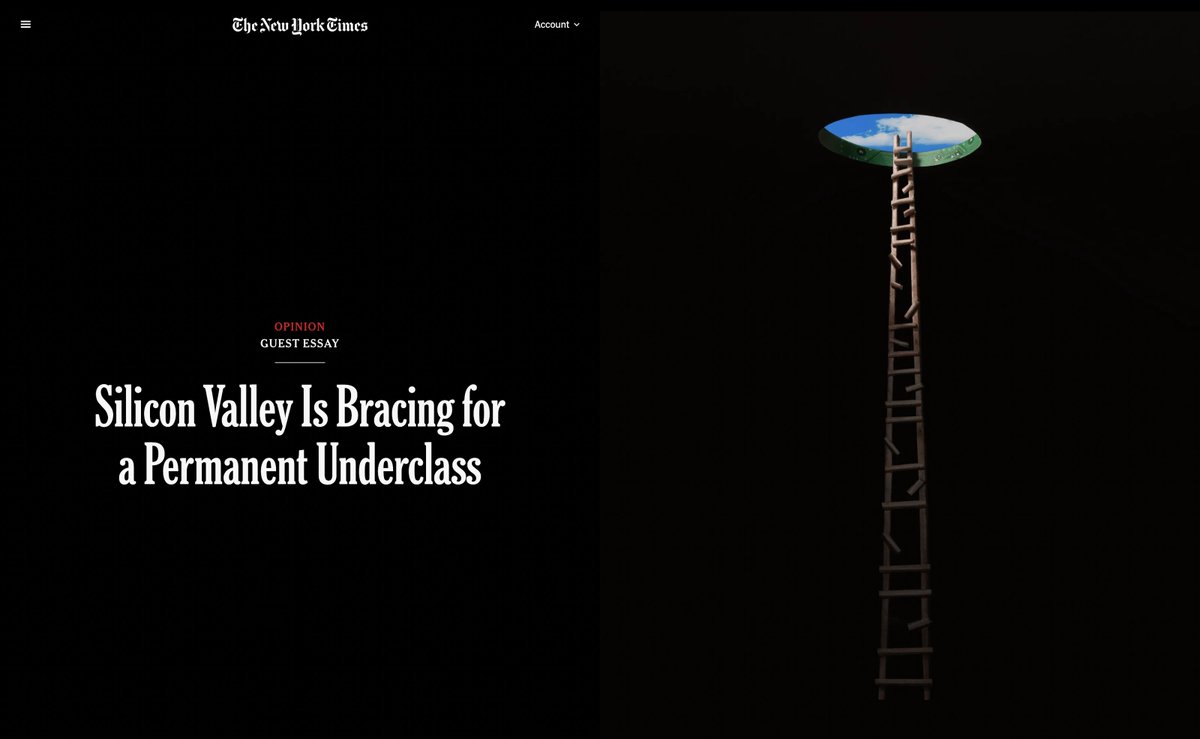
But an "underclass" is not inevitable, but rather a societal choice — and one we can and should stop. Instead of waiting for impact, we should start planning now to support workers through AI disruption. Whether policymakers can assuage concerns about economic security may determine if we get to reap AI's gains at all.
New from me for @NYTOpinion. I put a ton into researching what I think may be the biggest topic of the year, so hope you read it (gift link here!) https://t.co/NiGJpjyjzH
(🧵1/11) For the past year and a half, I've been investigating OpenAI and Sam Altman for @NewYorker. With my coauthor @andrewmarantz, I reviewed never-before-disclosed internal memos, obtained 200+ pages of documents related to a close colleague, including extensive private notes, and interviewed more than 100 people.
OpenAI was founded on the premise that A.I. could be the most dangerous invention in human history—and that its C.E.O. would need to be a person of uncommon integrity. We lay out the most detailed account yet of why Altman was ousted out by board members and executives who came to believe he lacked that integrity, and ask: were they right to allege that he couldn't be trusted?
A thread on some of of our findings:
@USTradeRep Greer interview worth a listen in full, esp. on China:
1. Strategic goal is a managed trade relationship where US and China agree on what we buy and sell each other and in which trade is predictable. (FWIW, I agree with Greer that a highly managed trading relationship is the best near/mid-term outcome for U.S.-China trade).
2. Under this approach, the U.S. will buy "low tech consumer goods," potentially some "commodities" that the U.S. doesn't have, etc. China will buy Boeings, medical devices, pharma, ag commodities. (I assume energy as well, though Greer did not mention it specifically).
3. Trade will be managed by a Board of Trade, the launch of which will be a Trump-Xi summit deliverable.
4. Greer cannot "pre-judge" whether the forthcoming Section 301 investigation will fully restore the 20% tariff rate on China that existed prior to the Feb. SCOTUS decision. (Legally, this is true, Greer can't pre-judge a 301 investigation outcome).
5. That said, both the U.S. and China are seeking "stability" and "continuity" and the U.S. wants to reduce the trade deficit and is committed to protecting its domestic economy.
6. Probably no more ministerial-level meetings prior to the Trump-Xi summit, with negotiations being handled by Deputies and staff. Greer said that he has not heard any discussion of pushing the summit back further beyond mid-May.
NEW: As Canadian lawmaker casts doubt on forced labor in Xinjiang, goods made by a sanctioned Xinjiang paramilitary group with alleged forced labor ties are widely sold in Canadian supermarkets.
Full article, paywall removed:
https://t.co/YMlZK2xMa3
Meet @ElsaJohnson, an American undergraduate junior at Stanford University who faced transnational repression (as well as her family!) from the Chinese Communist Party including online and physical surveillance on campus.
Our universities have become soft targets for foreign espionage and gateways for our adversaries, and they need a serious wake-up call to address these significant national security threats.