The largest-ever lifespan analysis of 601 mTOR modulators is now completed! This project has been driven by Rapamycin Longevity Lab (@omipalRLL) in partnership with @OraBiomedical (CEO @benblueAK, CSO Yan Ting Zhao, AI Engineer Ishan Ranasinghe, Co-founders @mkaeberlein , @BKennedy_aging, @mitchellblee33, @jangruber467 & Jason Pitt). Our mission has been to identify compounds even more potent than Rapamycin in extending lifespan in roundworms.
I am deeply grateful for the community’s support for this historic project and big thanks to all our sponsors who made this possible!
Our Gold Sponsors:
✅ Melissa Burdick & Brian Burdick: Great tech leaders and e-commerce pioneers. Connect with Brian and Melissa on LinkedIn to follow their work.
✅ Antoine Dusséaux: A London-based entrepreneur. Connect with him on X via @adssx
✅ Dmitry Sadovnikov: Connect with him on LinkedIn or X via @ksajxai
✅ Ciarán Murray: A longevity enthusiast and tech founder of @OlasProtocol. Connect with him on X via @C1aranMurray
✅ Anonymous: Two anonymous contributions to the project and one by Anonymouse.
Other Sponsors of the Project:
✅ @agelessrx_ : A cutting-edge telemedicine platform specializing in making various longevity interventions accessible, actively involved in research and clinical trials.
✅ Winslow Strong: Dedicated to advancing human health and wellbeing. Follow him on X @winslow_strong.
✅ Dr. Grant Fraser: Specializes in longevity medicine, integrating lifestyle interventions with personalized medical treatments.
✅ @OpenCuresOrg: A unique online platform empowering individuals, health professionals, labs, and researchers to accelerate longevity interventions.
✅ Revi Health (@johanhedevag): Modern clinic in Sweden combining regenerative medicine, performance health, and longevity protocols for measurable results.
✅ @healthspanmed: The first-ever digital medical clinic helping patients fight cellular senescence and regain control over the levers of aging.
✅ Rapamycin Longevity Lab (@omipalRLL): Our mission is to become the leading expert around mTOR inhibitor-based combinational therapies for longevity.
✅ People in the longevity community: Thank you for every donation, like, and share. Your support has fueled this project!
PS 1: Big thanks also to Victor Björk for the help with the fundraising!
PS 2: All lifespan data is now available on the Rapamycin Longevity Lab’s LID database (link in the comment section). You can find the top 20 and bottom 20 lists right here in the social media image! Big thanks to Andrew Steele (@statto) for the great suggestion to create a bottom list as well!
PS 3: The next step is to collaborate with different parties to analyze the data and also see if the data translates to other species. Reach out if you want to collaborate!
The wait is almost over. Next week the complete dataset from the largest mTOR modulator screening project will go live in the Longevity Intervention Database (LID). In partnership with @OraBiomedical and our great sponsors we have completed a rapid lifespan analysis of 601 mTOR modulators in roundworms.
Our goal in open-sourcing this foundational data is to allow AI, labs, researchers and companies to accelerate progress and move the longevity field forward. Many more screening projects will be launched by the Rapamycin Longevity Lab (@omipalRLL) in collaboration with Ora Biomedical and others.
But today I wanted to give you a sneak peek at the updated leaderboard. Here are my three key takeaways from this new phase of data:
1⃣ We have more than doubled the number of compounds beating Rapamycin. In our first phase, we identified 5 compounds that outperformed the best recorded Rapamycin baseline (27% median lifespan extension). With this second release we now have 11 compounds sitting above the red line.
2⃣ 24 new compounds qualified for the top list. It is fantastic to see these new entries. It will be incredibly interesting to dig deeper into the data to understand how they target the mTOR pathway in different ways. More to come on this. So stay tuned!
3⃣ Omipalisib continues to be a standout compound. The Rapamycin Longevity Lab was the first to discover its lifespan-extending properties in worms. We have conducted and are currently conducting experiments across multiple species to see if we can translate these results beyond worms. We are also evaluating combination therapies to see if we can enhance the longevity effects even further.
If you are a researcher or organization interested in collaborating either to support upcoming screening projects or to validate any of these top-performing compounds in other strains then please reach out. Let’s collaborate and move the field forward together! And big thanks to all who have helped out with all the work so far!
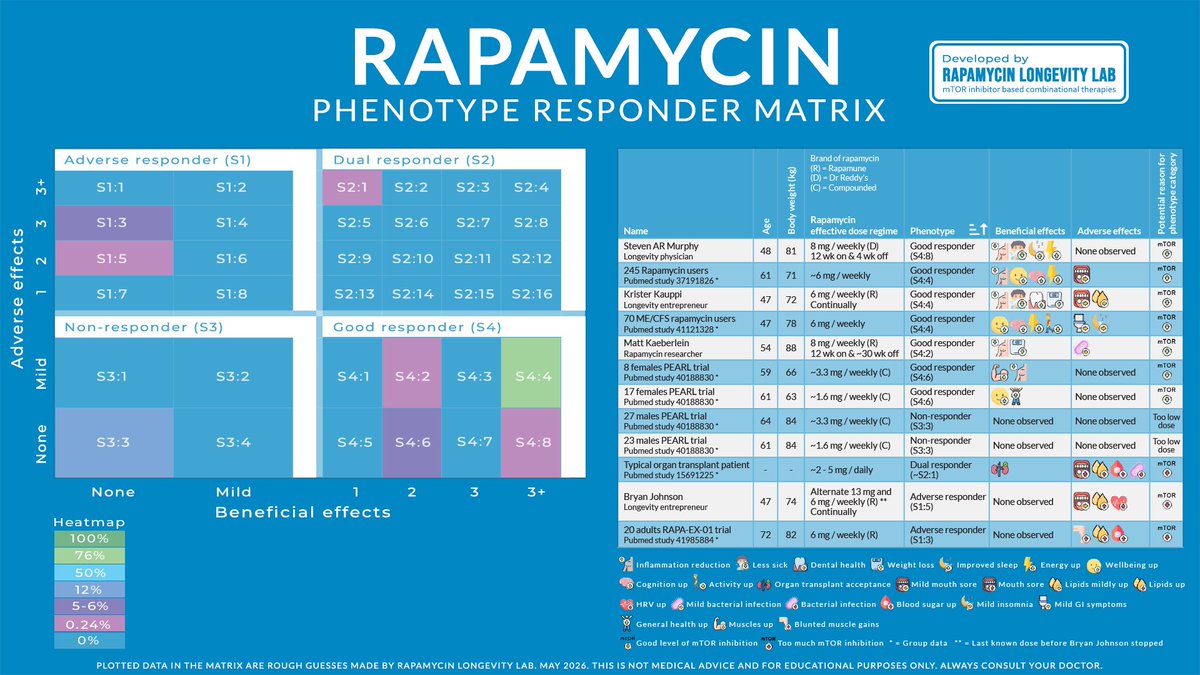
I’ve just added two landmark human clinical trials led by Joan Mannick (pubmed 25540326 & 29997249) to the Rapamycin Phenotype Responder Matrix. These trials explored how low-dose Everolimus, a rapamycin analog, can improve immune function in older adults.
The first study showed an improved response to the influenza vaccine at lower doses but not at the highest dose. The subsequent phase 2 trial demonstrated a similar trend toward improved vaccine response alongside a reduction in the rate of respiratory tract infections. The most common side effects trended toward mild mouth sores and elevated lipid levels but overall the different dosing protocols were well tolerated.
I interviewed Joan Mannick a few years ago and highly recommend checking it out. She walks through these different trials and shares other interesting insights around mTOR. I've left the link to the interview in the comments section.
It’s time for another update to the Rapamycin Phenotype Responder Matrix. I’ve just added an interesting new study from the University of Oxford and the University of Nottingham (pubmed 41524558). This small pilot study in older adults using low-dose Rapamycin (1 mg daily) showed:
1️⃣ Reduced DNA damage: It physically lowered the burden of DNA lesions in T-cells.
2️⃣ Lowered senescence markers: There was a significant drop in p21, a marker of cellular aging.
3️⃣ Boosted immune resilience: It reduced "exhaustion" markers on immune cells without causing immunosuppression.
4️⃣ A new mechanism: Interestingly these effects appeared to be independent of autophagy or slowing protein synthesis. Suggesting instead a direct protective effect on the genome.
While this was a small study, it offers interesting data points that are well worth adding to the Matrix. The reason I created this matrix was to move past the oversimplified "black and white" debate of whether a drug simply works or doesn't work. Instead the Matrix encourages us to ask questions like:
1️⃣ Who is the responder?
2️⃣ Can responders be grouped into specific phenotypes?
3️⃣ Do different dosing protocols have different effects on different phenotype responders?
This highlights the importance of personalized medicine and that there truly is no “one size fits all.”
As always, I’m open to feedback and suggestions for improvement. More studies will be added to the Matrix. If you know of some other interesting study I should include please reach out!
The ticker is $OMIDOCS
Y2XSdRRh1Dv3rzDeUs9n6tbbDyi6D3u7nzBPcqodrug
@OMIPALRLL is building around real radical life extension research on Solana, followed by Bio Protocol founder @paulkhls.
The founder @KristerKauppi is still actively sharing research updates and developments, even @aubreydegrey quoted tweet his post.
https://t.co/n8NDQPhoBG
Their flagship compound, $OMIDOCS (Omipalisib + Doxycycline), is one of the most interesting longevity experiments
Why?
• Omipalisib = a potent mTOR inhibitor tied to anti-aging research
• Doxycycline = an FDA-approved antibiotic with dose-dependent anti-inflammatory effects
• Combined together, worm studies reportedly showed an unprecedented 109% median lifespan extension, more than doubling lifespan
The project was launched by Rapamycin Longevity Lab in collaboration with the Center for Healthy Longevity at the National University of Singapore
Worth paying attention to.
It’s time for an update of the Rapamycin Phenotype Responder Matrix. Two weeks ago @BradStanfieldMD published the result from his clinical trial around Rapamycin (pubmed 41985884). The aim was to see if Rapamycin in older adults in combination with exercise could increase its effects. The reason why this is interesting to test is because mTOR activation tends to increase by age and this may result in less muscle gains. The results from the study point towards that Rapamycin is most likely not a physical performance enhancer. This is not something unique to just rapamycin. The same thing can apply to other interventions such as fasting, calorie restriction, protein restriction, metformin, aspirin, GLP-1 agonists, NAC, antioxidants, cold showers etc. Possible reasons why these interventions blunt the effects of exercise are 1) Too big inhibition of anabolic processes, 2) Too big neutralizing effect on acute muscle stress when it comes to building new muscle, 3) Too little energy to be able to challenge the muscles in an efficient way and/or 4) Insufficient amino acids and calories to build muscle. I would argue that many of the “longevity” interventions out there touch on one or several of these reasons. It’s a trade-off dependent on dosing protocol and highlights the importance of a personalized approach aligned with personal goals and pre-conditions.
The reason why I created the Phenotype Responder Matrix last year was to structure and combine both clinical trial data and self experimentation N=1 data in one view around a specific longevity intervention. The pilot intervention for this matrix is Rapamycin and the long term goal is to build this type of matrix for many different longevity interventions. If you have suggestions for improvements or any other feedback just reach out. All feedback is welcome, even the tough ones.
What I really like with this phenotype responder matrix is that if a group or individual does not get an effect or gets a negative effect it does not mean the intervention will not work for others. The matrix points towards the fact that personalized longevity medicine is the right way forward. There is no one shoe that fits all. Things are often more nuanced than just black and white.
A new lifespan study in mice was published this month regarding a combination therapy where Urolithin A, Quercetin, NR, Alpha-lipoic acid and SRN-820 were combined. It showed a 33% increase in median lifespan. They also tested Rapamycin alone and it showed a 21% increase.
While these aren't any big values they point once again toward that combination therapies are the way forward. Very few resources are currently put into researching combinations and my guess is that when we start to see really big lifespan effects then it will become much easier to forecast whether an intervention really works in humans through various metrics in much early stages.
One very interesting thing regarding the study would have been to explore each intervention individually because I believe there is potential to improve the cocktail recipe. Perhaps some compounds could be removed due to having little to no effect and others could be added.
But step by step we are moving ahead! I have also added the four data points from this study to Rapamycin Longevity Lab's (@omipallRLL) Longevity Intervention Database (LID). So now we have more than 2800 data points there!
Last week Dr. @BradStanfieldMD the results from his Rapamycin + Exercise clinical trial and they showed that Rapamycin is not a physical performance enhancer. To some this felt like a "failure". To me, this highlights the essential interplay between anabolic (building up) and catabolic (cleaning and breaking down) processes. Most “longevity” interventions such as calorie restriction, fasting, Rapamycin etc activate catabolic processes. To optimize physical performance then activation of anabolic processes is needed to a certain level. We can’t floor the gas (anabolism) and the brake (catabolism) at the same time and expect a world-record in physical performance. Different interplays between anabolic and catabolic processes serve different life goals and biological states, each with its own benefits and trade-offs.
I’ve been sketching on a X model around this to try to make things a bit clear. So here are some potential goals to optimize for.
1️⃣ Reproduction: Optimizing for reproduction and fertility but the trade-off is not optimal performance or lifespan.
2️⃣ Performance: The elite athlete who tries to push the limits. The trade-off is not optimal reproduction or lifespan.
3️⃣ Survival: Optimizing for a longer life. The trade-off is not optimal reproduction or performance.
4️⃣ The Middle Way: The trade-off is that nothing is optimal but not bad either.
5️⃣ & 6️⃣ Radical Life Extension: Aiming for a radically long life. We don’t yet know if it's possible or what benefits or trade-offs will be.
The value of this model is clarity. If you want Performance (2), Rapamycin might get in your way. If you want Survival (3), Rapamycin is a logical ally. Personally, I am targeting Radical Life Extension (5). Since we don't have a proven roadmap for State 5 I try therefore to align my current lifestyle with Survival (3) as a potential bridge to the future. Only time will tell if this is the correct path forward for me.
So before we pick up our next “longevity” intervention I think it’s good to ask ourselves: Which longevity state is this intervention aligned with and is that what I’m really aiming for?
PS. Please keep in mind that this is an unvalidated and early-stage model. All feedback is welcome as always! Even the really tough one.
We have added over 170 new data points to the Longevity Intervention Database (LID). This database is developed by the Rapamycin Longevity Lab (@omipalRLL) and it’s a public-access resource and the goal is to soon start to generate massive amounts of data to it. The purpose with this is to empower AI, companies, labs, researchers and other people to accelerate the research so that we move closer to a world without age-related diseases.
Most of the new data points that have been added are focused on the IIS pathway, which alongside the mTOR pathway is a primary focus of our lab. This dual interest also led to our discovery of Omipalisib (GSK2126458) which showed very promising lifespan data in roundworms. We are now working to translate these findings to other species such as flies and mice. We have three months of data for our mouse study but because of a lack of funding we may need to cancel the experiment this month. If anyone is interested in helping with $10k in funding the study then we could at least obtain important data on median lifespan and health metrics (such as grip strength, activity, body weight and body temperature) for Omipalisib. Reach out if you want to help and if you cannot help out financially please help by spreading the word!
On April 8th there will be rallies in 15 cities to raise support for the longevity mission. I'm planning to be at the one in Paris. See https://t.co/XY4ByEsKFk for details!
This is a monthly update of the Rapamycin Longevity Lab (@omipalRLL) Pipeline on @pumpdotscience. Our core portfolio is built around the highly evolutionary conserved mTOR pathway which is widely viewed as the gold standard in the longevity field. Our mission at Rapamycin Longevity Lab is to explore opportunities to leverage this pathway and push the boundaries of human lifespan in order to take steps closer to radical life extension.
Here’s the latest update on our premium portfolio:
1⃣ Doxycycline ($DOCS): An FDA-approved antibiotic with a strong safety profile. We took a “King of the Pill” position as the best-performing lifespan compound in worms on Pump Science, with more than 80% median lifespan extension.
2⃣ Chemical Partial Reprogramming ($TREX): In partnership with Reprogramming Lab (@reprogLab) we launched this token. It’s a cutting-edge longevity intervention with big potential if it works to reverse aging. Worm data showed 13% life extension but another lab has seen 42%. We are together with Metformin Ventures exploring the combination with Metformin + TCP ($BADDIE) in worms.
3⃣ Omipalisib ($OMIPAL): Two years ago we discovered that the dual PI3K/mTOR inhibitor Omipalisib extended worm lifespan with a maximum median increase of 63%. That is more than double Rapamycin’s lifespan effects in the literature. Fly experiments showed 6% life span extension. We are now trying a different dose protocol to see if we can increase the lifespan even more.
4⃣ Omipalisib + Doxycycline ($OMIDOCS): This combination has shown a remarkable 109% median lifespan increase in worms by another lab. In our own experiments we observed a 56% extension which secured its place as the next best-performing intervention on Pump Science. Fly experiments are set to begin once the ongoing Omipalisib fly experiments are completed.
5⃣ Rapamycin ($RAP): This is a well-known mTOR inhibitor with robust longevity data across species. Rapamycin Longevity Lab took full developer ownership of the token after Eterna Labs closed. The latest fly data from our experiments showed around 18% median lifespan extension.
6⃣ Metformin ($BADDIE): We partnered up with Metformin Ventures to explore different combinations with the FDA approved glucose regulator Metformin. Lifespan data in worms showed 21% extension.
7⃣Hair health track ($DOCS, $RAP, $RAPADOCS, $BADDIE): We are currently exploring hair rejuvenation collaboration around these interventions.
For more lab updates follow Rapamycin Longevity Lab (@omipalRLL).
Note: This is not medical or financial advice. It is for educational purposes only. Always consult professionals in relevant areas.
No one wants to die from infectious diseases. This is why much research and effort has been put into preventing them from happening at the same rates as in the past. But today we instead die mainly of other causes which are age-related diseases. The four most common are heart disease, cancer, Alzheimer’s and type 2 diabetes. I have seen how these diseases have made my parents, relatives and friends suffer and die against their own will. It has never been a pleasant thing and in some diseases it’s a brutal way of dying that no one truly wants.
This is why Rapamycin Longevity Lab (@omipallRLL), together with others, is working to make a difference. We aren't just targeting one disease at a time such as cancer. We are trying to target the root of age-related diseases at once by different longevity interventions. This year my lab is going to launch an initiative to generate massive amounts of longevity data across multiple species. This data will be publicly open for AI, labs, researchers and others to use. The purpose of this is to accelerate the discoveries of big breakthroughs in the longevity field and by that increase the odds so that we end the era of age-related diseases! If you want to support this initiative in any way then just reach out to me!