The drone explosion in the port of Constanța shows that Russia’s war is increasingly spilling over into EU territory.
I spoke with Foreign Minister @oana_toiu about today's developments and expressed the EU’s full solidarity with Romania.
The ultimate responsibility for what happened rests squarely with Russia. As President Zelenskyy told Putin in an open letter yesterday: Moscow can stop this war any day.
Next week, EU Defence Ministers will discuss how to further ramp up our support for Ukraine and increase the EU’s own defence readiness.
Illustration of divergence of a vector field.
Divergence represents the volume density of the outward flux of a vector field F = (P, Q, R). It is given by the formula:
div F = ∇ · F = ∂P/∂x + ∂Q/∂y + ∂R/∂z
- Source (left): Field lines emanate outward from a point; divergence is positive (∇ · F > 0).
- Sink (center): Field lines converge inward to a point; divergence is negative (∇ · F < 0).
- Zero divergence (right): Parallel field lines with constant spacing indicate no net expansion or contraction (∇ · F = 0).
Georg Ohm, the German physicist behind Ohm’s Law, gave us one of the simplest and most important rules in electricity: how voltage, current, and resistance are connected.
His work became a foundation of modern electrical engineering, and electrical resistance is now measured in ohms, named in his honor.
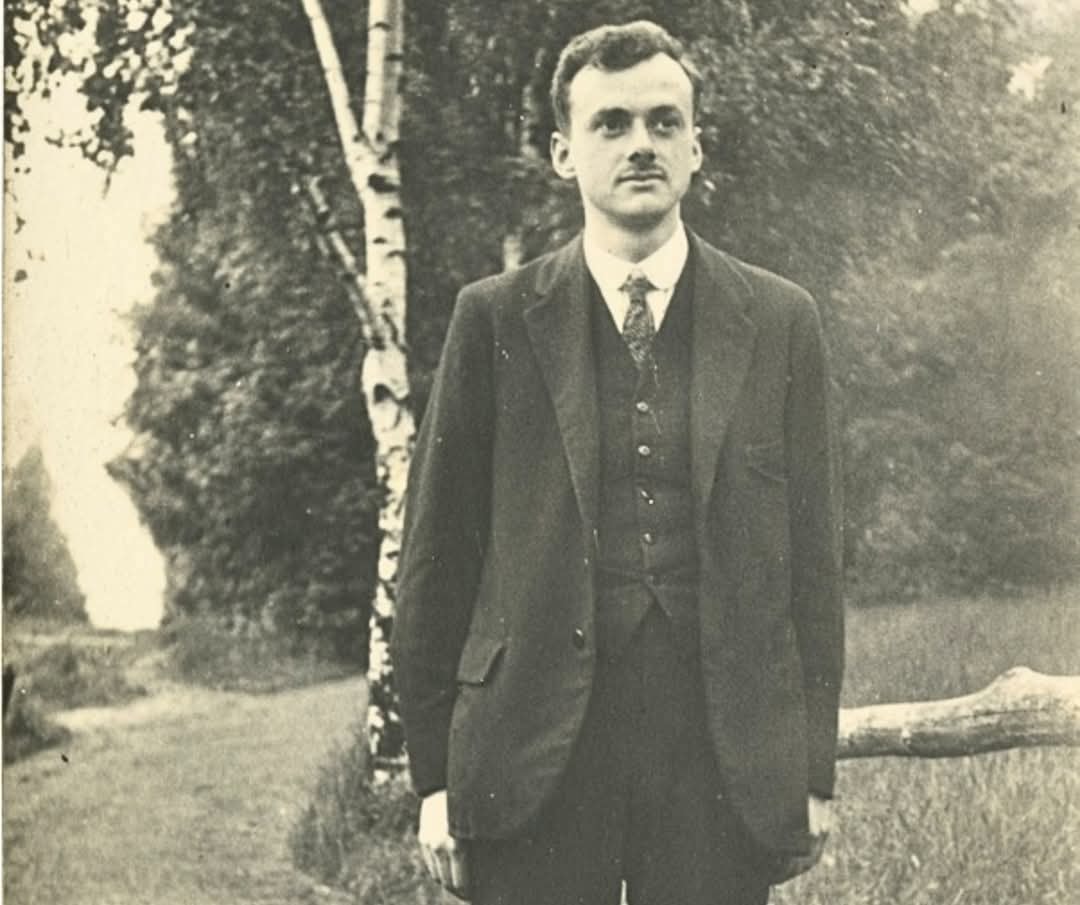
"In the winter of 1926... I was so desperate that I was ready to give up physics altogether. I felt that I was a completely untalented person who had chosen the wrong profession."
- Paul Dirac, reflecting on his early struggles with quantum mechanics
“Quantum theory does not trouble me at all. It is just the way the world works. What eats me, gets me, drives me, pushes me, is to understand how it got that way. What is the deeper foundation underneath it? Where does it come from?"
- John Wheeler
Tom Trotter on Mathematician Paul Erdös:
Paul Erdös was one of those very special geniuses, the kind who comes along only once in a very long while yet he chose, quite consciously I am sure, to share mathematics with mere mortals — like me. And for this, I will always be grateful to him. I will miss the times he prowled my hallways at 4:00 A.M. and came to my bed to ask whether my “brain is open.” I will miss the problems and conjectures and the stimulating conversations about anything and everything. But most of all, I will just miss Paul, the human. I loved him dearly.
I unequivocally support the Leiden Declaration. As a former AMS VP, current Editor-in-Chief, and someone bridging academia and industry, I see its message as urgent. AI will shape mathematics. We must uphold rigor, transparency, attribution, and culture. https://t.co/owK1HAOHrf
Five years ago, I read a preprint that alleged an error in a classic study of the "secretary problem". That preprint itself contained a subtle flaw, which was pointed out here on Twitter. Now, partly with the help of AI, the story continues here --> https://t.co/lMGLQt8QAG
In 1742, Christian Goldbach wrote to Leonhard Euler proposing a simple conjecture: every even number greater than 2 is the sum of two primes (e.g., 18 = 13 + 5, 74 = 43 + 31).
In 1938, Nils Pipping verified this up to 100,000 by hand. Since then, computers have checked it for vast ranges—millions, billions, even trillions—without a single counterexample.
Yet, no general proof exists. The statement remains one of mathematics’ most famous unsolved problems known as Goldbach conjecture.
Terence Tao: "We lived in a world with cognitive friction until very recently, where every task required us to use our brain.
So we didn't really think about it, we just thought this was the cost of doing something intellectual. But now we have AI and the other technologies that can bring these frictions down to zero."
Most research time is not spent having cinematic insights.
It is spent checking cases, chasing references, translating intuition into computation, testing a path, finding it false, and deciding whether the failure taught you anything.
AI changes the cost of that loop.
Terence Tao says that now he can try “crazier things,” and that makes so much difference. Because unconventional ideas are often not rejected by proof, but by inconvenience.
A mathematician may avoid a strange direction not because it is foolish, but because the bookkeeping, coding, or literature search needed to test it is too expensive for a hunch.
This is where cognitive friction becomes scientific friction.
Lowering it does not make taste, judgment, or proof disappear; it makes more weak signals cheap enough to inspect before they are abandoned.
AI is making hesitation less expensive, and that is often where discovery begins.
Terence Tao summarized how AI is massively accelerating math career and math research.
"In math, you previously had to basically go through years and years of education to be a math PhD before you could contribute to the frontier of math research. But now it's quite possible at the high school level or whatever, that you could get involved in a math project and actually make a real contribution because of all these AI tools and lean and everything else."
From @dwarkesh_sp podcast (link to full video in comment)
James Maynard: The Prime Number Genius Who Conquered the Fields Medal
James Maynard (b. 1987) is an English mathematician and Professor at Oxford University, renowned for his groundbreaking work in analytic number theory.
In 2013, he revolutionized the study of prime gaps by developing a powerful new multidimensional sieve, proving that there are infinitely many prime pairs differing by at most 600 (later improved to 246). This was a major leap toward the Twin Prime Conjecture.
His further breakthroughs include results on large gaps between primes, bounded intervals containing prime clusters of any fixed length, and solving the Duffin-Schaeffer conjecture. These achievements earned him the Fields Medal in 2022.
Avi Wigderson is the only person in history to have won both a Turing Award (computer science) and Abel Prize (math). I interviewed him all about his field. We discussed:
• His intuition on a proof of P vs NP
• Why we use SAT solvers for most NP problems
• Zero knowledge proofs and their impact
• Quantum computation and implications
• Math and computer science's relationship
Where to watch:
• YouTube: https://t.co/zViqAulFCo
• Spotify: https://t.co/iat08Xob17
• Apple Podcasts: https://t.co/jOYDGtGVnt
• Transcript: https://t.co/k4zS7yOhnw
Thank you to this episode's sponsors for supporting my work:
• WorkOS: makes your app Enterprise Ready with easy to use APIs to add SSO, SCIM, RBAC, and more in just a few lines of code, check them out at https://t.co/y8noBzFEem
Timestamps:
00:00 - Intro
01:08 - P vs NP
14:51 - What if you relaxed correctness
25:38 - Why NP complete problems are equivalent
30:33 - Space vs time complexity
43:06 - Why people use SAT solvers
45:53 - Randomness is a resource
55:48 - Randomness depends on computational power
01:21:20 - Zero knowledge proofs and their significance
01:38:30 - Quantum computation and why it matters
01:56:24 - Math vs computer science
02:08:16 - Major breakthroughs and his experience
02:12:31 - Advice for his younger self
02:14:48 - Outro