Two systems can start with the same model.
Only one keeps receiving verified outcomes from the real world.
That gap does not close with the next release.
It closes with the learning loop.
Decisions. Actions. Outcomes. Feedback.
If the action cannot be verified, the feedback is just another story.
Real-world feedback. Continuous learning. Hybrid intelligence.
Proof of Human Action is what keeps the loop honest.
.@Actum_system is an intelligent digital O&M layer that records equipment work as facts.
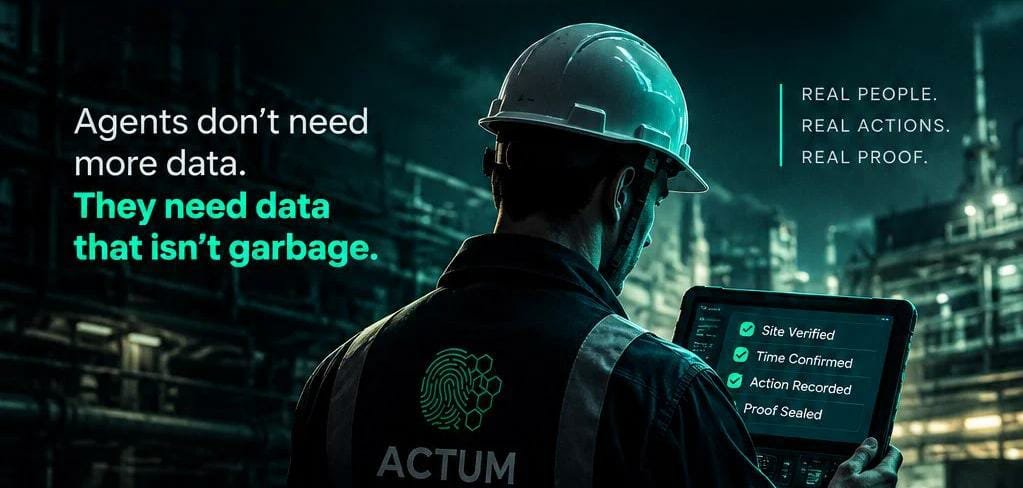
One scan runs Triple Verification across space, time, and action, then stores a tamper-proof digest.
Proof of Human Action starts with what was done.
We only record,we don't judge. #ACTUM
When a scheduled maintenance task is not submitted, @Actum_system does not leave a blank.
Missing Value Recording timestamps the non-action and attributes it to the asset, so gaps in the 30-year lifecycle become evidence rather than a management blind spot.
#ACTUM
A learning loop is only as strong as the truth entering it.
A system can make decisions, watch outcomes, and improve over time.
But there’s a problem:
What if the action behind that feedback was never actually verified?
In the real world, things happen outside the screen.
A technician performs maintenance.
An inspection is completed.
A component gets replaced.
An operational task is carried out.
The digital system needs more than a record saying “done.”
It needs confidence that the action actually happened.
That is where Actum caught my attention.
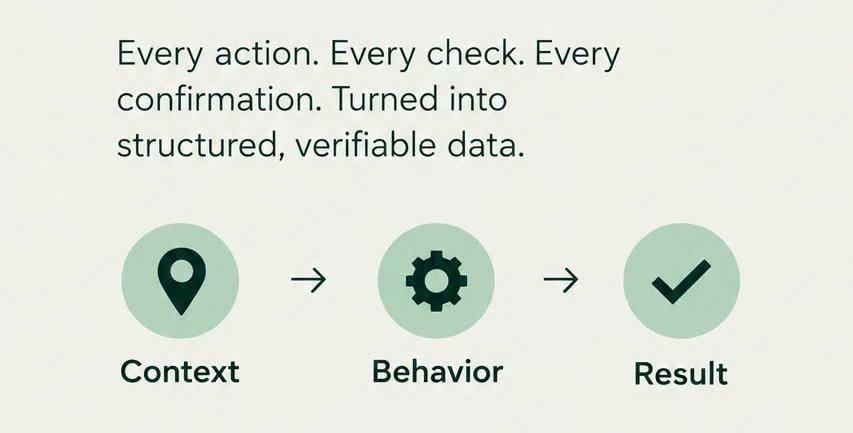
Its approach connects Context → Behavior → Result, creating a verifiable record of what happened in the physical world.
And with Proof of Human Action, the learning loop gets a stronger source of truth.
Because continuous learning only works when the feedback is trustworthy.
Bad input can create better models of the wrong reality.
@Actum_system is working on making sure the real world leaves a reliable digital memory.
#actum
Trust is built when actions can be verified.
@ACTUM_SYSTEM turns real-world actions into verifiable proof, making it possible to understand what happened, when it happened, where it happened, and who was responsible.
Less uncertainty. More accountability. #ACTUM
For ESG, CBAM, and DPP reviews, overseas partners can verify encrypted behavioral digests without raw operational data leaving the enterprise.
@Actum_system keeps tamper-proof 30-year lifecycle records that support data assetization.
We only record, we don't judge.
#ACTUM
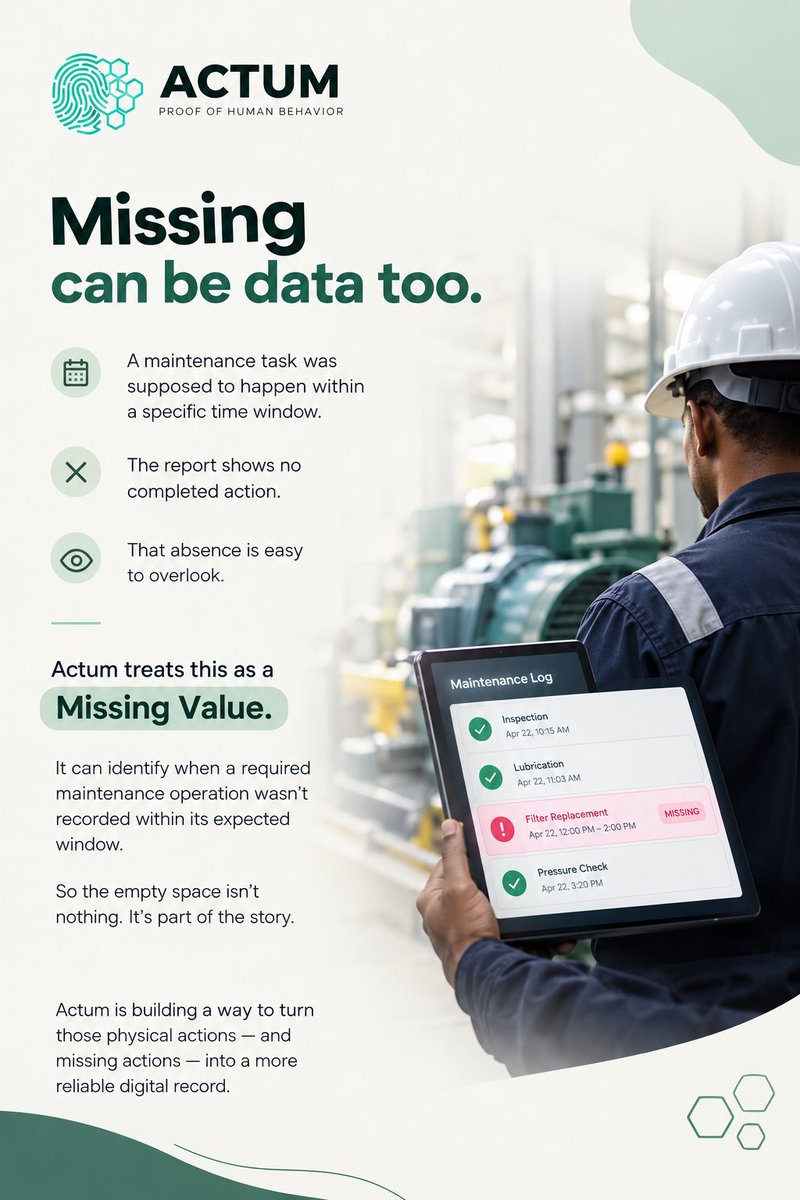
Missing can be data too.
Think about a maintenance task that was supposed to happen within a specific time window.
The report shows no completed action.
That absence is easy to overlook. But for a system responsible for keeping an asset running, it can be important information.
@Actum_system treats this as a Missing Value.
Instead of only recording what happened, it can also identify when a required maintenance operation was not recorded within its expected window.
That changes how you look at maintenance records.
The empty space isn't necessarily nothing.
Sometimes, what wasn't recorded tells part of the story too.
Actum is building a way to turn those physical actions and missing actions into a more reliable digital record.
#actum
The next AI advantage may not be a bigger model.
It may be a better way to learn from reality.
Two models can have similar reasoning capabilities.
But if one continuously receives feedback from millions of real-world interactions while the other only sees static datasets, they won't stay equal for long.
The difference is the learning loop.
Human decisions create actions.
Actions create outcomes.
Outcomes create feedback.
Feedback improves the system.
The companies that can close this loop may have an advantage that can't simply be downloaded from a model release.
The future of AI isn't just about training smarter models.
It's about building systems that can keep learning from reality.
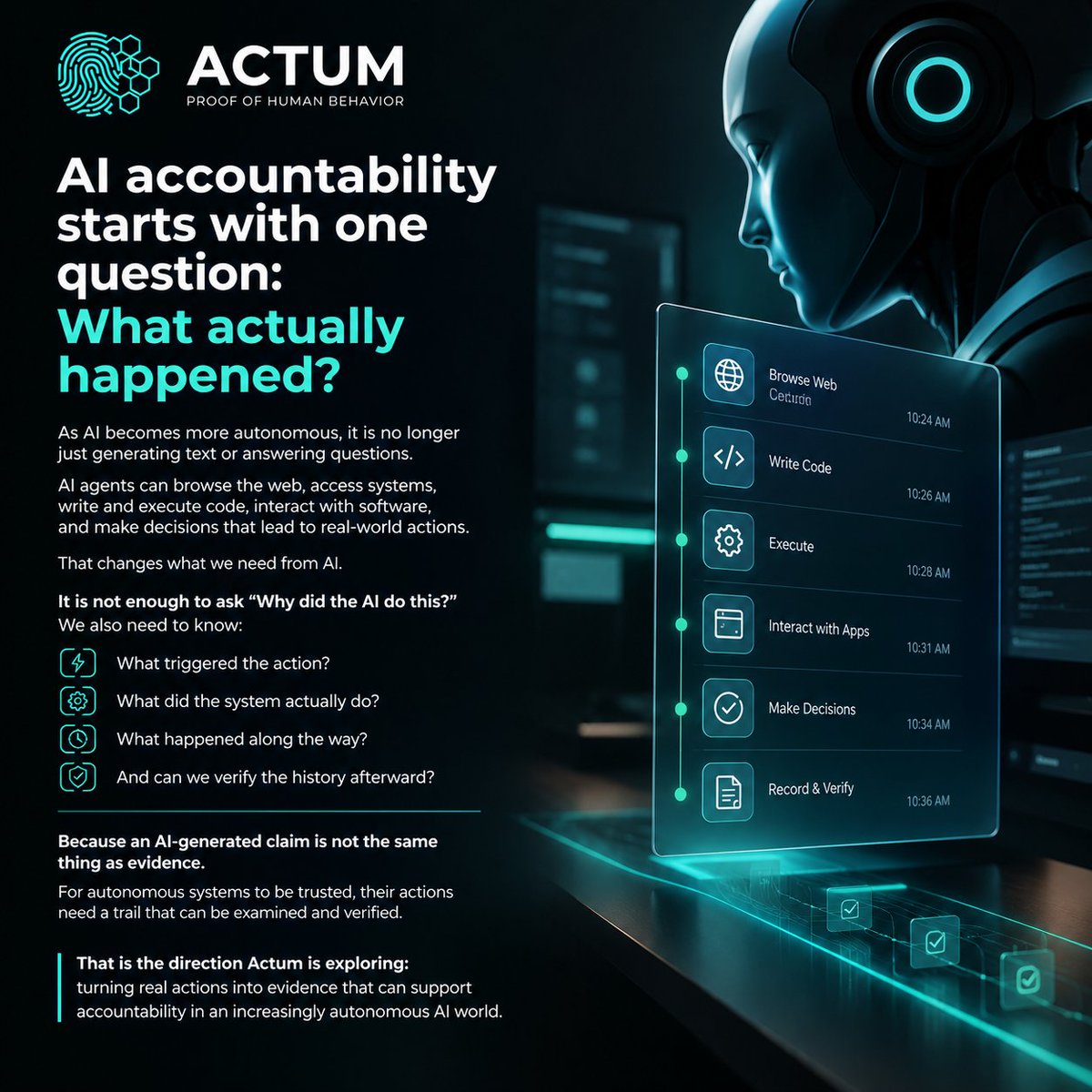
AI accountability starts with one question What actually happened?
As AI becomes more autonomous, it is no longer just generating text or answering questions.
AI agents can browse the web, access systems, write and execute code, interact with software, and make decisions that lead to real-world actions.
That changes what we need from AI.
It is not enough to ask Why did the AI do this?
We also need to know:
What triggered the action?
What did the system actually do?
What happened along the way?
And can we verify the history afterward?
Because an AI generated claim is not the same thing as evidence.
For autonomous systems to be trusted, their actions need a trail that can be examined and verified.
That is the direction @Actum_system is exploring turning real actions into evidence that can support accountability in an increasingly autonomous AI world.
#actum