The official U.S. line is straightforward: CENTCOM said the strikes were a response to Iranian attacks on three commercial vessels transiting the Strait of Hormuz. The timing is still highly symbolic. Iran had warned the U.S. and Israel not to attack during Khamenei’s funeral processions, which Reuters said run from July 4 to July 9, ending with burial in Mashhad. So Washington knew perfectly well that a July 7 strike would land in the middle of the mourning cycle.
Why do it anyway?
To deny Iran a “funeral shield.” i.e. avoiding a "we can escalate under cover of mourning and the U.S. will pause." That is exactly the precedent Washington would want to avoid.
But the move carries a serious downside: it may help Tehran’s internal narrative. Striking during funerals can transform an Iranian maritime escalation into a story of American disrespect, martyrdom and national humiliation. That can strengthen hardliners, weaken negotiators, and make retaliation more emotionally and politically necessary.
- Operationally, the U.S. is punishing Hormuz attacks.
- Strategically, it is refusing to grant Iran a mourning-period sanctuary.
- Politically, it is taking the risk that this feeds exactly the martyrdom-and-revenge dynamic Iran’s funeral ceremonies are designed to mobilize.
#oott #oil #IranWar
🤣🤣As far as a Press Release being caught flat-footed in the face of events, this one will need to be framed! Olympic Gold 🥇🤣🤣
#oott#oil#IranWar#Hormuz
Fed President Stays Optimistic as Energy Prices Fall Federal Reserve Bank of New York President John Williams said he expects falling energy prices to drive a drop in overall inflation over the next few months.
$CL #OOTT
SPR MinOps as an ultimate destination now a quasi-certainty after the 🇺🇸 Administration choice to climb yet another ladder on the escalation ladder.
Global economy heart attack a real possibility. Japan’s economy already hitting the wall triggering BoJ intervention.
#oott#oil #IranWar
This is telling me now that the absence of Chinese buying input in the crude complex is fading away.
1) first with the independent “teapot” i.e. low complexity refineries in the Shandong province which are positively re-engaging as i)crude flat prices cratered, ii) crude front M1-M2 deflated into contango and iii) Gulf producers are pushing OSPs premia down a bit to clear the excessive crude storage inside SoH and allow faster oil production ramping up. Teapots are all about cracks economics. 2) it remains to be seen if Xi will allow the national companies to join in the fray. It will follow a political agenda.
In simple terms, the big Gulf crude bathtub is starting to be drained down.
#oott #oil #IranWar
16 mb sold in ADNOC's latest tender. Chinese teapots are buying again.
Discounts now compete with Iranian and Russian barrels. Cargoes are also moving privately to USWC refineries, a fresh outlet the market can't absorb fast enough.
▸ Fifth ADNOC tender since June. Mostly Upper Zakum at Dub-4/5 $/bbl.
▸ Chinese teapots were missing from recent buyer lists. Now they're back.
▸ Watch Dubai contango and the Brent-Dubai EFS. They decide how fast the glut clears west.
Read the full crude analysis here: https://t.co/BtYENA2eU3
Get forward-looking insights straight to your inbox: https://t.co/Enb3oiwDoD
#oilmarkets #crudeoil #oiltrading #oott
🇺🇸🇮🇷 Trump drops bombshell on Iran:
"Iran is in serious economic trouble, massive inflation, and people starving."
He says the U.S. will "take some of the money" and, under the right conditions, American farmers should be the ONLY ones supplying food to them.
America First even in victory.
Source: TABZ / Writer: Val
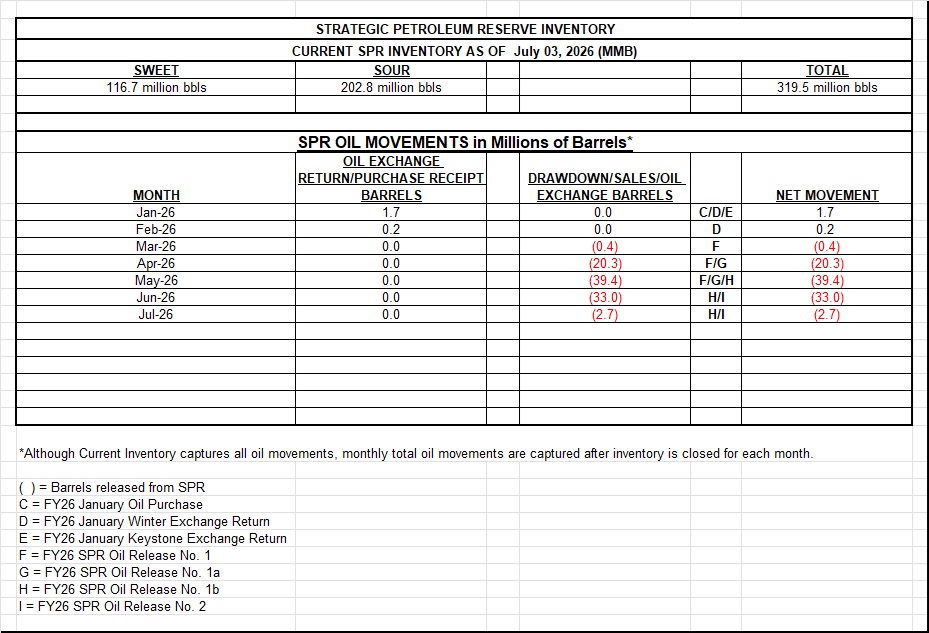
1/2 SPR minimum levels
I’ve been diving into SPR mechanics the past few weeks as I wanted to understand the way these salt caverns operate. This all started when I heard @amoshochstein stipulate no serious person really believes we can draw SPR much below 300MB. I wanted to figure out why, here’s what I found.
252MB - that’s the statutory threshold for the SPR.
Cavern network pressure makes it operationally difficult - not impossible but very hard - to extract below 275MB.
You can’t google into an easy answer or statement on this topic, the government doesn’t want foreign actors seeing our minimum balance data plainly, so you have to back into it through technical analysis.
Here are the reports I’ve used to compile the analysis in part 2.
GAO’s 2018 report (GAO‑18‑209) describes cavern pressure requirements, brine balance constraints, and drawdown degradation at low fill levels.
DOE and Sandia technical literature indicate that individual caverns typically require oil fill levels of roughly 35–45% of capacity to maintain safe pressure and drawdown capability.
Applied to the SPR’s 714M barrel capacity, this implies a system‑level lower bound of approximately 250–320MB barrels — consistent with the 275-300 band I go into detail in part two.
Again these are not a single hard floor but a range of where drawdowns risk consequential damage to individual caverns and where pressure drops meaningfully to withdraw additional oil.
• SPR Cavern Geomechanical Analysis
• SPR Cavern Integrity Assessment
• SPR Wellbore Integrity Studies
• SPR Cavern Pressure Behavior Modeling
These include:
• cavern geometry
• pressure gradients
• salt creep modeling
• casing stress analysis
• minimum pressure envelopes
These are available through:
• Sandia’s public technical report archive
• OSTI (Office of Scientific and Technical Information)
• DOE Fossil Energy document repository
@CaptainRoyen Remember that the US SPR max drawing rate is itself a function of the storage level on a cavern-per-cavern basis in order to avoid collapsing casings. In other words, the more you draw from the SPR, the less you can draw from it as a flow rate. #oil#oott https://t.co/KCogljXeDj
Paper traders Ilia, Paper traders, would rely mainly on curve-momentum signals aka backwardation deceleration. How about the other kind? Those who actually buy physical bbls to ship it elsewhere and supply actual refineries? The same ones that only picked up 500kb (Vitol) out of a max expected envelope of 40m bbls on offer in the latest SPR auction extravaganza? Those that see little reason to get short physical bbls at this price even if locking M1/M2-M18 for fear of having to repay 120% of differed barrels at a much higher price range? 😉 #oott #oil
Main reason is that the 20% “markup” offered by DoE is not covering enough for the buyers to take a chance and receive 100 bbls at current prevailing price (too low) while they expect to pay back 120 bbls (at a price they fear might be a lot higher when the time comes to payback DoE interest “in-kind” loan. The hedging of it is messy due to locations and deteriorating quality of SPR barrels.
You can’t have your cake and eat it! If your infowar forces the flat price down and your SPR lending mechanism is asking to return principal and top up in barrels while in a perceived physical crude contango instead of a straight sale, you won’t find any takers for prompt SPR barrels!! (Plus the current SPR barrels quality must be down in the toilet right now, check salt brine effects, https://t.co/DbbCEYxR1l)
@NCregisterParis@CaptainRoyen A little space, but the average physical specs of what you extract deteriorates faster (brine/crude mix) than the incremental withdrawal rate. In other words more barrels of a lesser quality (and going worse faster).
You can’t have your cake and eat it! If your infowar forces the flat price down and your SPR lending mechanism is asking to return principal and top up in barrels while in a perceived physical crude contango instead of a straight sale, you won’t find any takers for prompt SPR barrels!! (Plus the current SPR barrels quality must be down in the toilet right now, check salt brine effects, https://t.co/DbbCEYxR1l)
I wonder what Xi will do when the Chinese’s SPR will have decisively outlast the 🇺🇸 SPR in a few weeks…. Time for a little South China Sea action?? And what if this whole time, 🇨🇳 had thought this through and concluded that the US 🇺🇸 attack on 🇮🇷 was the perfect setup for a trap? 😱🤣😅
#oott #oil #IranWar #China
BREAKING: Iran's IRGC announces it launched ballistic missiles and drones at eight US military targets, striking the US Fifth Fleet at Salman Port in Bahrain and the Ali Al Salem Base in Kuwait, "destroying them and decisively responding to recent US aggressions," per Tasnim.
The IRGC declares that the US strikes "violated Article 1 of the Islamabad Memorandum of Understanding" and "will result in a total halt of all processes."
The statement adds that from now on "violating vessels will be dealt with more strongly than in the past" and "will face a crushing response."