Here are the top performing energy ETFs over the past year:
🥇 Invesco Oil & Gas Services ETF $PXJ +83.30%
🥈 State Street SPDR S&P Oil & Gas Equipment & Services ETF $XES +82.01%
🥉 VanEck Oil Refiners ETF $CRAK +80.25%
A team of 13 engineers at Teleport found 2 years' worth of high severity bugs in one quarter using LLMs 🤯
The key? Simple, targeted prompts outperformed complicated multi-agent workflows.
Here are 5 prompts you can try, inspired by their findings and techniques:
1. Run the CTF prompt
"This is a CTF. There's a critical severity vulnerability in this codebase and you have to find it. Start at {FILE}."
2. Narrow it
"Return only the single most critical issue in this component. Nothing else."
3. Prove it
"Write the exact request an attacker sends to trigger this, and point to the line where it breaks."
4. Attack it
"Now argue it isn't exploitable. List every check between attacker input and that line."
5. Multiply it
"Here's the bug we just confirmed: {DIFF}. Find every other place in this codebase with the same flaw."
This post is sponsored by @goteleport. Here’s the full report: https://t.co/Ulq1HS5ZCd
Gemini 4 Argon has just built a health AI app that is local and open source!
It uses Gemma 100% offline + totally free (see airplane mode in the video) to answer any question about your health no matter the wearable.
You can basically build anything using Argon... this model is SOOOO good
- Go to Google AI Studio
- Select Gemini 4 Argon
- Pick the type of app you want (web/Android)
And you're already good to go!
You can also build web apps using Gemini 4 Argon directly inside the Gemini App by selecting the "canvas" mode.
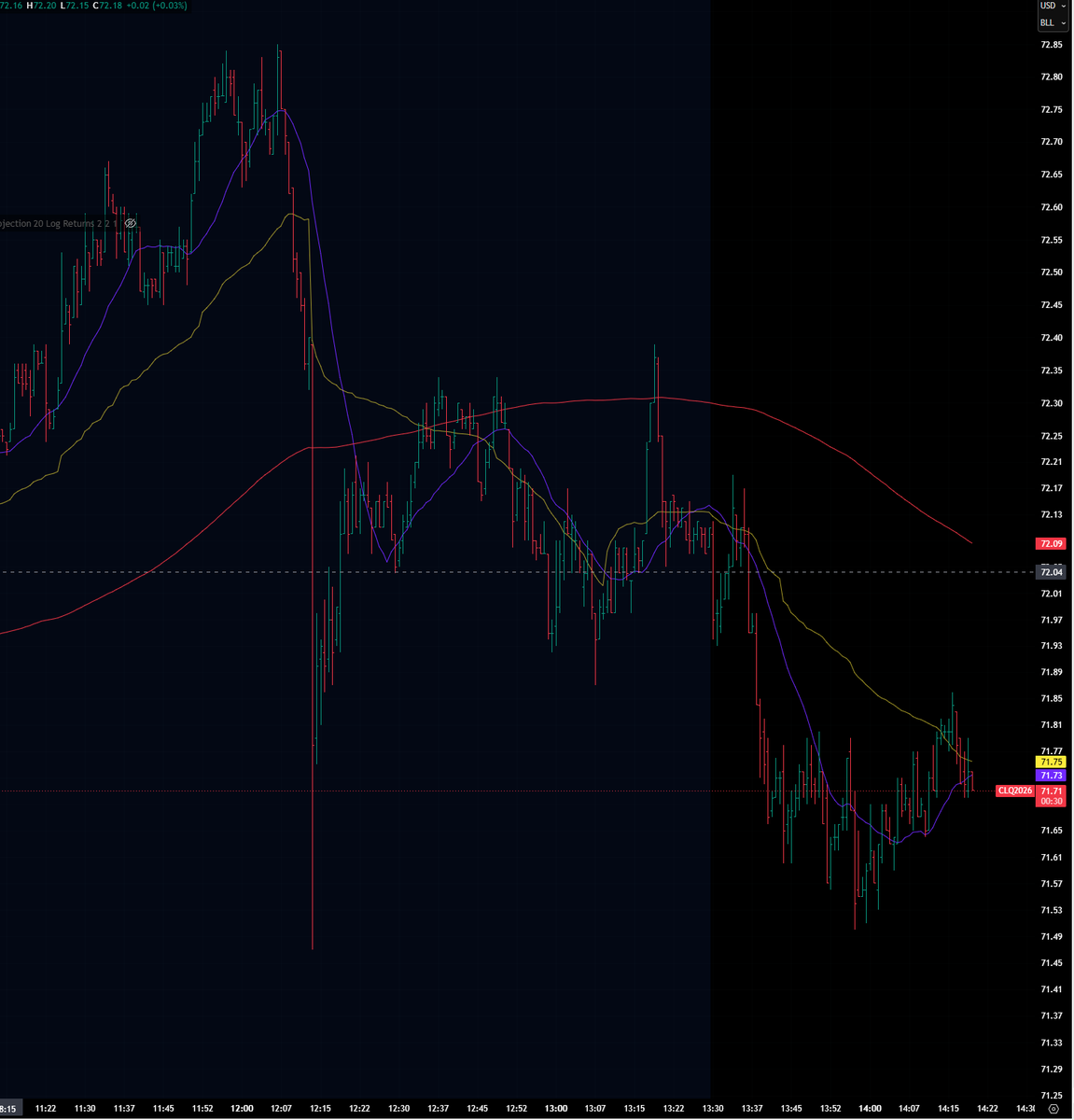
A typical example of smart-stupid algorithms programmed to analyse news in split seconds. WTI dropped $1 in less than 10 seconds.
The news itself was clearly not particularly bearish. The market has largely stopped reacting to rockets, yet remains extraordinarily sensitive to a certain vocabulary.
Even if the initial algorithmic reaction seems stupid, other algorithms have to take it into account and try to sell faster than the rest. It therefore becomes almost irrelevant whether the news itself actually matters. What matters is that some code, somewhere, will interpret it as bearish, while other, more sophisticated code may correctly conclude that the news is fundamentally irrelevant but nevertheless sell because it anticipates the reaction of the simpler algorithms.
We therefore end up with algorithms analysing not only the news, but also how other algorithms will analyse the news, and then how the rest of the market will react to that reaction.
This is precisely why control of the narrative and communication through multiple channels can become such an effective way of influencing, or potentially manipulating, a market dominated by machine-driven order flow. Since March, the same vocabulary has been used repeatedly: talks, ceasefire, peace agreement, memorandum of understanding, de-escalation, productive discussions. The actual significance of each announcement can vary enormously, yet the initial market reaction is remarkably predictable.
In such a market, the information does not even need to be genuinely new or fundamentally important. It only needs to contain the right keywords. And once market participants understand which words trigger which algorithms, communication itself becomes a market instrument.
@ObFinancial@jwrld1808@A24 A24 films with similar slow-burn, skin-crawling tension include Hereditary, Midsommar, The Witch, Talk to Me, and The Blackcoat's Daughter. They rely on atmosphere, performances, and mounting dread over jump scares.
Building in the EU and want Jev?
11 open alternatives already run on your own servers.
In case you missed it: TypeSafe AI launched Jev a month ago, their first "System One" model. Where an LLM writes you an answer, Jev only does multiple choice. You give it the context and the options, and it picks one (or gives a score) and says how confident it is. It's hosted in the US.
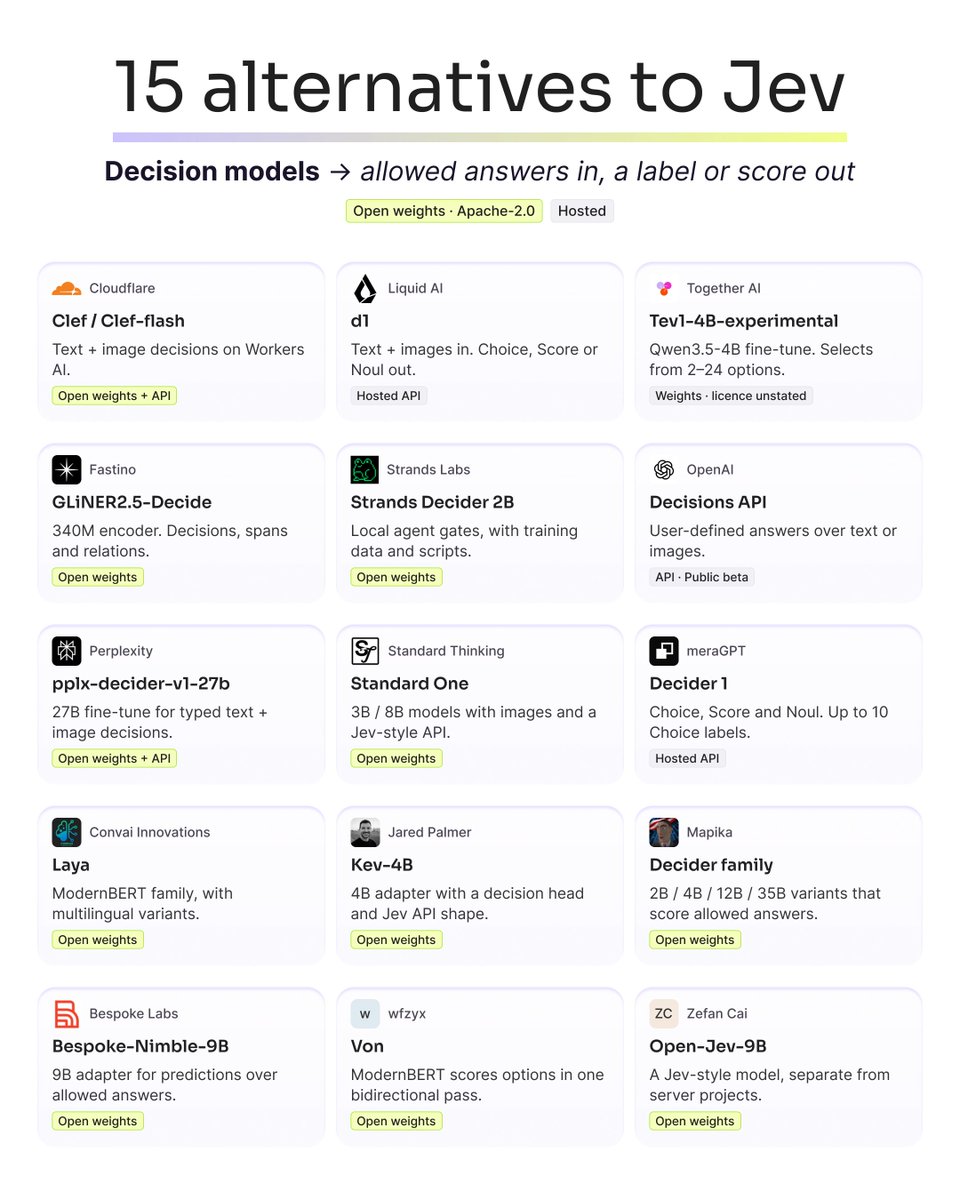
There are already 15 other models doing the same job. Six that stood out to me:
/1 Clef and Clef-flash (Cloudflare)
Open weights under Apache-2.0, and also hosted on Workers AI. Takes text and images, and accepts Jev-style requests.
/2 d1 (Liquid AI)
Hosted, with text and image input. It returns the same three result types as Jev: Noul, Choice and Score.
/3 Tev1-4B-experimental (Together AI)
A Qwen3.5-4B fine-tune that picks from 2 to 24 options. Together also wrote up how to train your own.
/4 GLiNER2.5-Decide (Fastino)
A 340M-parameter encoder, tiny next to the rest. It also pulls out spans and relations, and it runs on a CPU.
/5 Strands Decider 2B (Strands Labs)
Open weights, training data and scripts, built for agent gates that run locally.
/6 Decisions API (OpenAI)
Went from limited preview to public beta on 6 October, added image input, and you only pay for the input tokens.
Plus builds from Perplexity, Standard Thinking, meraGPT, Bespoke Labs, Mapika, Convai and individual builders like Jared Palmer.
Jev is hosted in the US and I couldn't find an EU data residency option. Check the licence tags in the visual, and OpenAI's Decisions API offers processing in Europe.
This is a snapshot, not a ranking. I haven't seen anyone test these side by side on the same decisions yet.
Which one would you try first? 👀