I have just received the terrible news of the challenges faced by President Tinubu. The lack of running water in Aso Rock is sad news to us all . I will encourage him to vote for Peter Obi in 2027 so that we can create a Nigeria that works.
The polling unit I referenced in my last tweet is 16-08-10-021 in Ikeduru, Imo State. It went from 1,382 registered voters in 2023 to 3,117. That’s 1,735 new voters.
Now look closely at the 2023 presidential and House of Representatives result sheets from this polling unit. How do you explain the difference in the number of accredited voters?
This is one of many polling units where our forensic analysis showed that result sheets were filled out and photographed for IReV before voting began.
The House of Reps result sheet was captured around 5am on election day.
Omo! The scale of electoral malpractice in Nigeria is frightening!
This goes beyond one state or INEC’s top officials.
We just uncovered a polling unit voters’ register riddled with glaring irregularities, apparently to add about 2,000 voters. The brazenness is shocking. They barely bother to hide it anymore!
Is our democracy a joke?
We MUST fix our elections and hold those responsible CRIMINALS accountable.
Enough is enough!
17 voters. 17 different names. One photo.
The beauty of AI and machine learning: you don't need to stare at thousands of voter records. You run a script, and the duplicate and suspicious registrations surface on their own, across a polling unit, a ward, or a whole state.
This took a pixel check on one polling unit: Comm. Sch. Ochicha (16-08-11-003), Ikeduru LGA, Imo. Every photo matched, pixel for pixel.
If you are planning to rig elections in 2027, there is no hiding place.
#Mundx #NigeriaDecides2027 #VotersRegister
SmartBallot : Towards credible and Transparent Ballot
I have consistently believed that technology, combined with the creativity and resourcefulness of young Nigerians, can help reinforce our democracy and advance free, fair, and credible elections.
I am pleased to endorse SmartBallot (https://t.co/YgbAq2cLxE), a platform developed to facilitate grassroots mobilization, civic engagement, and election monitoring.
I urge our supporters and NDC candidates to register on SmartBallot and examine how its tools can assist them in organizing their communities, coordinating voters and polling unit agents, expanding grassroots engagement, and supporting transparent election monitoring.
Through the effective use of technology and collective action, we can reinforce our democratic institutions and help ensure that every vote is counted.
Credible elections require preparation, active participation, and peaceful vigilance. Let us make full use of every available resource to create a more organized, engaged, and empowered electorate.
A New Nigeria is Possible. -PO
NIGERIANS, GO AND VERIFY (7)
LIFTING THE VULNERABLE : ANAMBRA’S BLUEPRINT FOR POVERTY ALLEVIATION AND SUSTAINABLE EMPOWERMENT (2006–2014)
Economic growth that does not translate into improved living conditions for ordinary citizens is incomplete. This is one of our fundamental concerns with President Bola Ahmed Tinubu's government. Development must ultimately be measured by its impact on human lives, particularly those of the poor and vulnerable. This was underpinned by the Anambra Integrated Development Strategy (ANIDS). We believed that infrastructure, education, healthcare, agriculture, and social protection must reinforce one another. Poverty was not merely a shortage of money; it was also a lack of access to opportunities, productive resources, and the basic conditions necessary for a decent life.
Our poverty alleviation strategy, therefore, went beyond temporary handouts. It focused on restoring dignity, creating economic opportunities, and equipping vulnerable citizens with the means to become self-reliant.
Our approach attracted recognition beyond Anambra. In May 2010, Magnus Kpakol, then National Coordinator of the National Poverty Eradication Programme (NAPEP), commended our commitment to poverty reduction, declaring: “We are prepared to support you in the excellent work you are doing in Anambra State.”
1. POVERTY MAPPING: KNOWING WHERE POVERTY LIVES
We recognised that poverty could not be effectively addressed without knowing where it was concentrated and what caused it. We, therefore, undertook a poverty-mapping exercise to identify the most deprived local government areas and communities.
The exercise revealed that some of our poorest communities were also important food-producing areas. Their challenges included poor access to markets, agricultural inputs, electricity, water, and other economic opportunities.
Areas including Anambra West, Orumba South, Awka North, and Ogbaru required particular attention. The findings informed our development priorities, enabling us to direct roads, agricultural support, and social interventions toward neglected communities.
2. EMPOWERING WOMEN, WIDOWS, AND COOPERATIVES
We recognised that rural women, widows, and indigent households bore a disproportionate burden of poverty. Across the 21 local government areas, we provided financial assistance and productive support to thousands of beneficiaries.
Our administration provided financial assistance to support the establishment and expansion of small businesses and farming activities. We also introduced revolving loan schemes to promote enterprise development, economic self-reliance, and improved livelihoods.
We distributed productive equipment, including sewing machines, generators, ovens, cookers, hair dryers, shoe-making machines, and welding equipment. The objective was to help beneficiaries establish sustainable livelihoods rather than remain dependent on government assistance.
We also promoted access to microcredit and cooperative financing to enable small entrepreneurs to expand their businesses, improve their incomes, and create employment.
Our philosophy was simple: rather than merely giving people money to survive today, the government should help them acquire the means to earn a living tomorrow.
3. AGRICULTURE AND FADAMA: MAKING RURAL COMMUNITIES PRODUCTIVE
Agriculture was central to our poverty-reduction strategy because many rural households depended on farming.
Through partnerships with the Federal Government, the World Bank, and other development partners, particularly under the FADAMA programme, we supported farmers with finance and productive assets.
In November 2009, our administration disbursed millions to FADAMA Community Associations across the state. By October 2010, the National FADAMA office was commending Anambra’s commitment. Its National Project Coordinator, Buka Tijjani, represented by Charles Ugwuona, described Anambra as the leading state in the programme.
A young artist who supported APC was rejected by 8 hospitals and eventually died. His fellow APC supporters still don't think there's a problem that needs attention in the health sector.
Olubadan is now going to wait for tinubu at the airport? 😂😂
Even akiolu won't go to the airport to wait for him.
By the time this person of no origin is done with yoruba culture eh, you people will see blue and call it red.
Omo! This is crazy sha. Somebody close to me once told me: Klinton just collect your own lockup, this country no fit change, a former Nigerian player that i know had to join cityBoy movement cos he was also offered a cut too, may God not make me Nigerian in my next life, Iseh! 🙏🏾
Graphic Warning ⚠️
British colonialism killed about 165 million Indians in just 40 years (1880–1920)—far more than Adolf Hitler’s Holocaust.
The British portrayed Hitler as the greater villain to hide their own far larger crimes.
My dear big bro, @ruffydfire ,
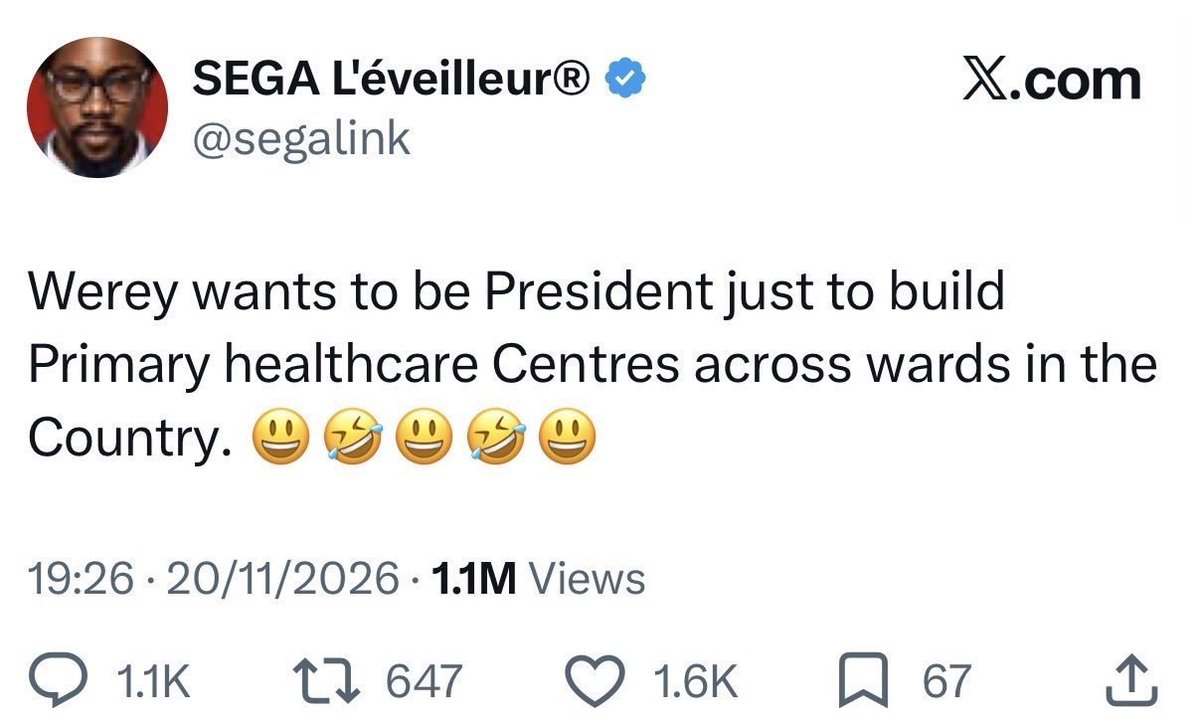
It costs approximately ₦100 million to build and equip a functional Primary Healthcare Centre (PHC) in Nigeria today.
That means 10,000 functional PHCs would cost:
₦100,000,000 × 10,000 = ₦1 trillion.
The Tinubu/APC administration claims to have saved ₦15.8 trillion from fuel subsidy removal, in addition to accumulating close to $100 billion in loans.
Yet, just ₦1 trillion would be enough to provide 10,000 functional PHCs across Nigeria, bringing essential healthcare closer to millions of Nigerians.
Under a Peter Obi administration, resources recovered from subsidy removal and our national wealth will not disappear into the pockets of those occupying Aso Rock. They will be deployed for the public good.
Beyond the 10,000 PHCs, HE Mr Peter Obi has also committed to building 40,000 new classrooms to address our out-of-school children crisis, alongside establishing cancer treatment and dialysis centres.
These are achievable priorities if we cut government waste, block leakages and end the theft of public resources.
The issue is not that Nigeria lacks resources; it is how those resources are managed and deployed.
Be assured of my highest regards always.
Idris Zekeri Junior