My #interventionalcardiology Toolkit 🧰⚙️🪛:
What if percutaneous mitral valvuloplasty could be performed using tools already familiar from structural intervention?
🔗https://t.co/zd1SkdxXJA
@BURZOTTA_F et al. present a practical approach using TEE, #3D echo sizing, steerable access and rapid LV pacing, with the option to reassess and redilate without re-crossing the mitral valve.
#TMVR #CardioEd
ICARUS: torrential TR, annulus exceeds sizing for EVOQUE, annular downsizing via TEER, CT re-evaluation confirmed feasibility; implantation of a 52 mm EVOQUE valve
Explore advanced management of complex structural scenarios at TACIT Germany January 2027
https://t.co/yr8Kd4N8TG
From imaging, physiology to bifurcations, calcified lesions, protected PCI and complication management: a course for experienced operators and advanced fellows, limited to 16 participants and direct interaction with international faculty
Regustration: https://t.co/YrWD5nAV9t
Cut To Size, or Why I Don’t Stress About Nailing the Distal Bifurcation Anymore
This was a complex CTO: heavily calcified with a blunt cap, an occluded SVG, and a failed PCI attempt by another CTO operator. Oh, the pt is also a physician. 😅
#HDR didn’t work, so we performed rCART. (Easier typed than done!)
The near-final angio showed a distal RCA stenosis. We treated it with a 1:1 CBA (3 cuts at 8, 10, and 12 atm) followed by DCB PTCA.
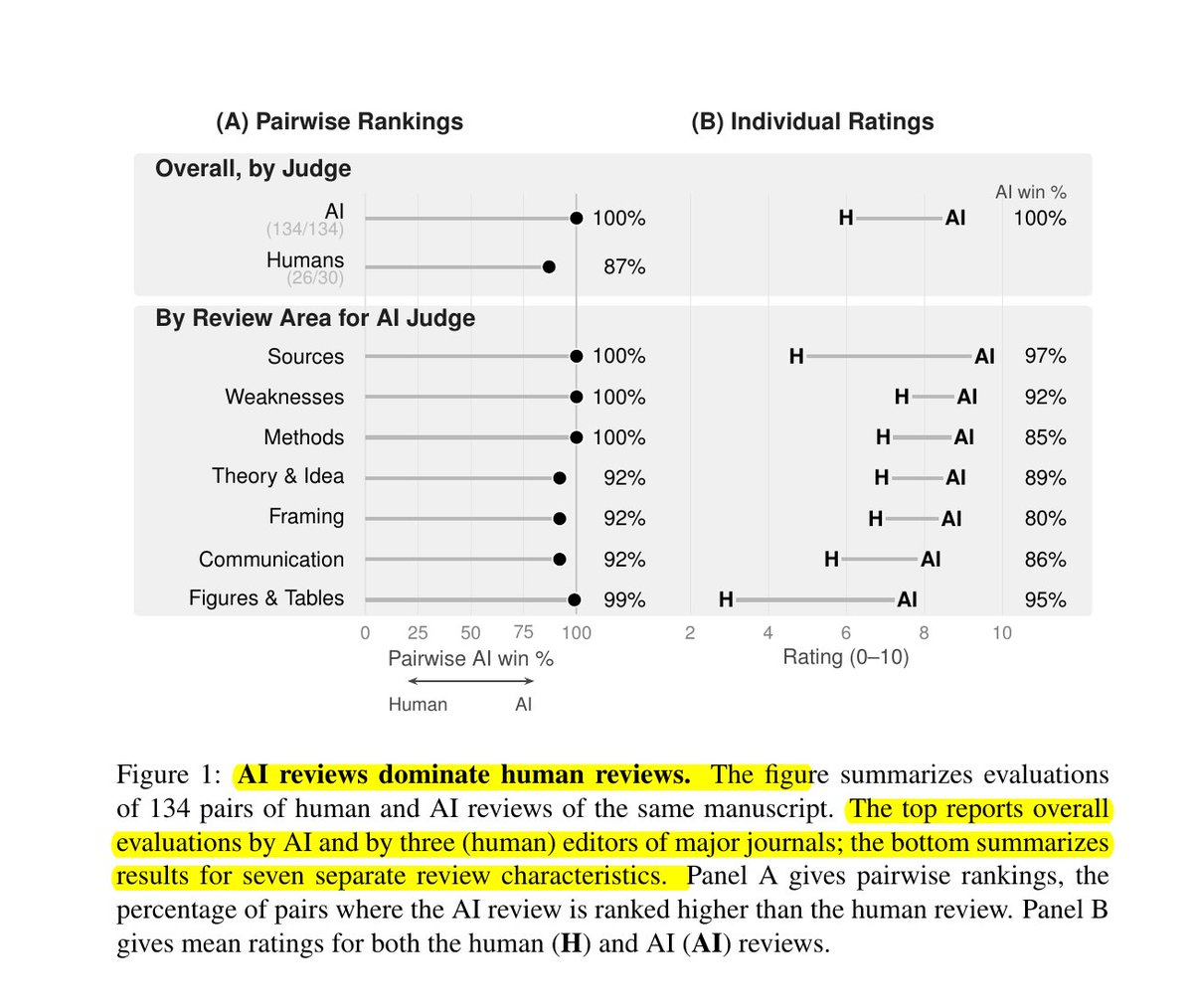
Massive. New Harvard study finds that AI-written paper reviews now beat the best human peer reviews on every measure the authors tested.
Peer review is slow and often misses errors. Earlier studies concluded AI should only assist human reviewers, not replace them.
They used 134 reviews from rapidPeer, a Harvard service that pays expert reviewers well. Claude Opus 4.8 reviewed the same 1124 papers, and GPT-5.5 plus 3 former journal editors judged the pairs blind.
GPT-5.5 picked the AI review in all 132 decided pairs, and the editors picked it 87% of the time. Only 5.5% of the AI's claims about the paper were wrong, versus 15.9% for the human reviews.
Teams that depend on expert critique can now let AI do the first full review pass, and keep a human for the final decision.
@Menshovic I have seen a case of ruptured sinus of valsalva that was not detected by Echo and the patient had a very loud murmur and I resent him to TEE which revealed the diagnosis
In the SPIRARE II trial, mechanical aspiration thrombectomy with the Vertex Pulmonary Embolectomy System met its prespecified safety and effectiveness endpoints in intermediate-risk pulmonary embolism, with improved right ventricular function and a low rate of major adverse events.
Read more here: https://t.co/48xmYGuCas
#PulmonaryEmbolism #MechanicalThrombectomy
@CatalinPToma@FelixMahfoud@wissamj123
For interventional cardiologists intrested in deep dive in complex structural scenarios, electic surgery techniques with hands-on simulators, several Live-cases and Live-in-a-Box, join us on the 28th and 29th of January 2027 in Essen