Focused on the economy, politics, financial markets, and the implosion of the AI bubble.
Tip: If you don't know where the bubble is, look in your portfolio!
Drove through Boise yesterday and saw an example of the AI bubble firsthand. Micron spending $50B on 2 new chip fabs, power & water, and an expansion of its headquarters. I'd bet this gets scaled back before it's completed, and they'll have a big write-off after the bubble pops.
APOLLO CEO ROWAN: IF NVIDIA'S BANKING FUNCTION GETS TAKEN AWAY, ACCESS TO CAPITAL FOR A LARGE NUMBER OF NEO CLOUDS IS GOING TO DISAPPEAR .- CNBC INTERVIEW
This is hubris and borderline delusional. He's already going to testify in front of committee chairs, and little doubt he'll be back in January in front of a much less friendly audience. This could evolve into a corporate scandal, with NVDA facing lawsuits and fines. No responsible board would bring him back.
Over the past several years, the success of AI labs ($ANT, @OpenAI) has been positively correlated with the semis/memory/neocloud trade.
With the wave of supply coming online through 2030, I think that correlation breaks down.
The success of the AI labs will be dependent on solving the diffusion problem, which involves bending the cost curve on compute.
History tells us the probability of oversupply or a supply gut by 2030 is much higher than most think.
And the fact that the models themselves are getting better at designing chips and making compute more efficient only increases those odds (which is ironic).
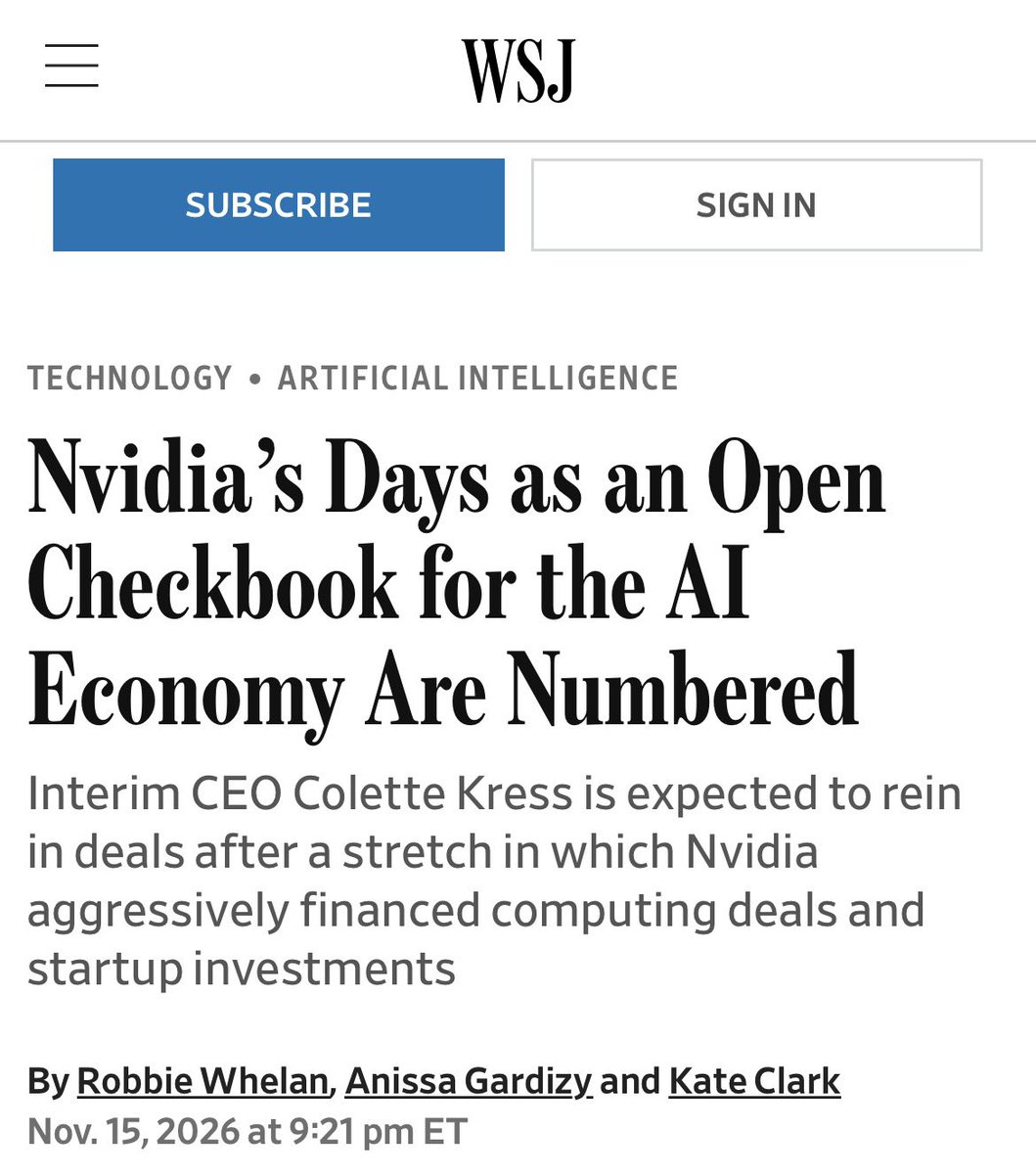
@simon_ree Kress has been pushing back against aggressive circular financing. Will she use the call to signal a shift? Unlikely, but the shift will happen regardless. Huang's departure signals fewer circular financing deals and illegal shipments to China. Major growth slowdown ahead.
U.S. HOMEBUILDER CONFIDENCE HITS LOWEST LEVEL SINCE APRIL 2012
U.S. homebuilder sentiment plunged to 25 in November, missing the 29 consensus and falling from 29 in October, according to the NAHB.
🔸 Current sales: 28 vs. 34 previously
🔸 Future sales: 30 vs. 32
🔸 Buyer traffic: 16 vs. 18
🔸 46% of builders cut prices, a post-pandemic high.
🔸 68% offered sales incentives.
Elevated mortgage rates, labor shortages and rising construction costs continue to pressure the U.S. housing market.
“Huang told his finance team in August that the company was under pressure, The Wall Street Journal previously reported. Major cloud providers were making plans to use alternative chips and lessen their reliance on the firm, and Nvidia was staring at a glut of chip wafers and memory it had committed to buying, he told them.” 👇🏼
https://t.co/WfXXTiD3uu