An interdisciplinary community of scholars at Duke University working at the intersections of science, governance, and business toward ocean sustainability
🐟 Small-scale fisheries are the backbone of coastal communities, offering livelihoods, food security, and cultural preservation. 🌊Explore a new course by @DukeEnvironment and @WorldFishCenter and partners, which helps organisations measure their impact:
https://t.co/LX3vJUHBYo
Undergrad Natalie Lewis recently shared insights into why she chose to major in Environmental Sciences and advice for students considering the major or the Scholars in Marine Medicine program https://t.co/SAd9xUT0AZ
As part of @NSF-funded study, @Dukeenvironment and @UNCWilmington have developed a model to understand why U.S. coastal property values do not fully reflect climate risks and adaptation costs to sea-level rise. https://t.co/ndd0VcmJmK
Doug Nowacek was interviewed on @scifri's "The State of Science" segment about whether rumors of offshore wind farms hurting and killing right whales have any merit behind them. https://t.co/0IyBOd1Q8N
A team of researchers, led by @Duke_MGEL and @NOAAFish_NEFSC, mapped the population density of North Atlantic right whales worldwide to predict and help avoid harmful, even fatal, exposure to commercial fishing and vessel strikes. https://t.co/fPq5WyzESL
Writing for @ScienceMagazine, Liz Losos (@NichInstitute), Alex Pfaff (@DukeSanford) and Stuart Pimm (@DukeEnvironment) propose reforms to debt-for-nature swaps to help developing countries tackle debt, biodiversity loss, and climate change.
Read a Q&A: https://t.co/YArgMi7r8p.
A Duke-led team of 23 scientists, working across six countries, has created a research framework to incorporate ecological theory into ecosystem management and planning to more effectively scale restoration efforts.
https://t.co/2XDzvZ5Fma
Offshore wind turbines often get blamed for killing whales, but the science doesn't support the claim. @DukeMarineLab's Andrew Read and Douglas Nowacek help @sciam explain the actual causes and how to effectively mitigate them. https://t.co/VeFTqhhZvq
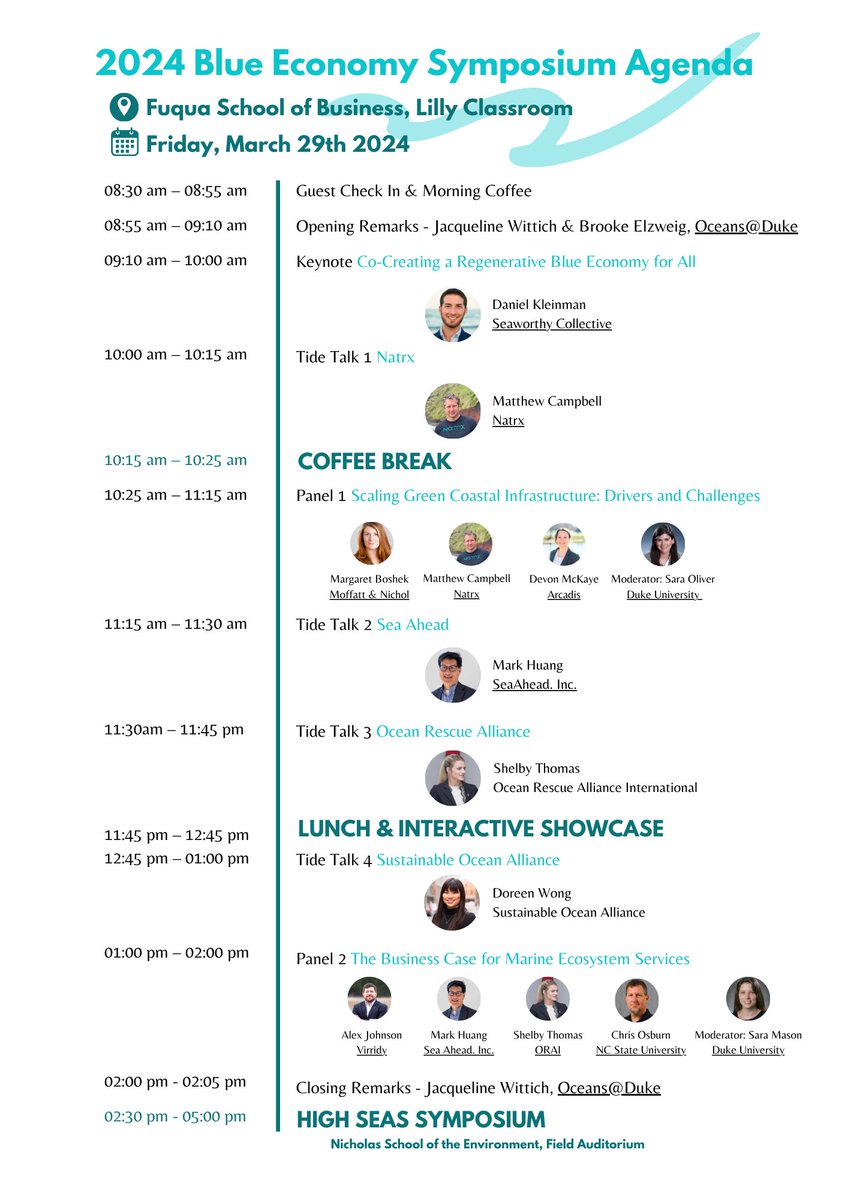
A day filled with insightful discussions with innovators and investors in the blue economy. Together, we're designing a blueprint for better coastal resilience. 🌊💙 #blueeconomy
In a gathering of nine leaders in the field, the Blue Economy Symposium brought together novel ideas and discussions over climate change solutions:
https://t.co/4sYyuJMFSY
We are so excited for our amazing speakers and panelists joining us this Friday, March 29th, at our Blue Economy Symposium. Registration for this event is now full, but keep an eye on the waitlist for potential openings!
Michael Connor, Assistant Secretary of the Army (Civil Works), will join us for a discussion on water in the U.S. at 6:30 p.m. on Tuesday at Field Auditorium. https://t.co/fXjFPWx4eg
Registration is live!
Sign up for the Blue Economy Symposium here: https://t.co/yEqiC9pKuG
Sign up for High Seas Symposium here: https://t.co/izLvjHMJJX
A new Duke Immerse course will allow undergrads to spend the fall semester at DUML and travel to Europe as they examine how people, countries and societies are growing ocean-based tools to address the most pressing problems facing our world. Learn more https://t.co/cdZFVLyCjA
Jason Somarelli and alumna Zoie Diana PhD'23 quoted about a new study that found an average of around 240,000 nanoplastic particles in a liter of bottled water. https://t.co/Btw5wuJvte