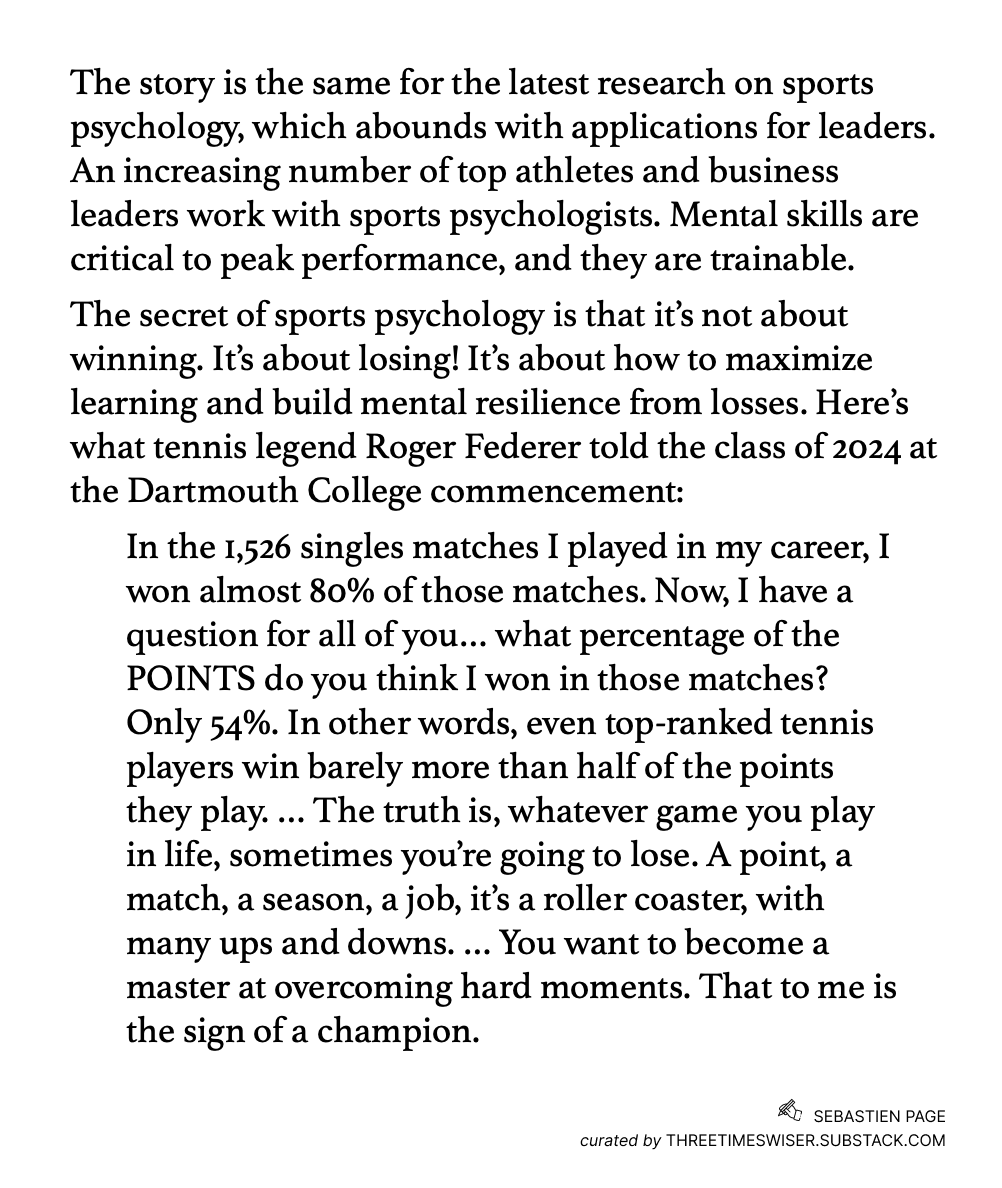
This is what an EXCEPTIONAL mindset thinks like and sounds like.
So impressive from a 22 years old.
Not only you CAN control what you think, and how you think it and why, but you SHOULD.
See your mind as a skill and practice it as such.
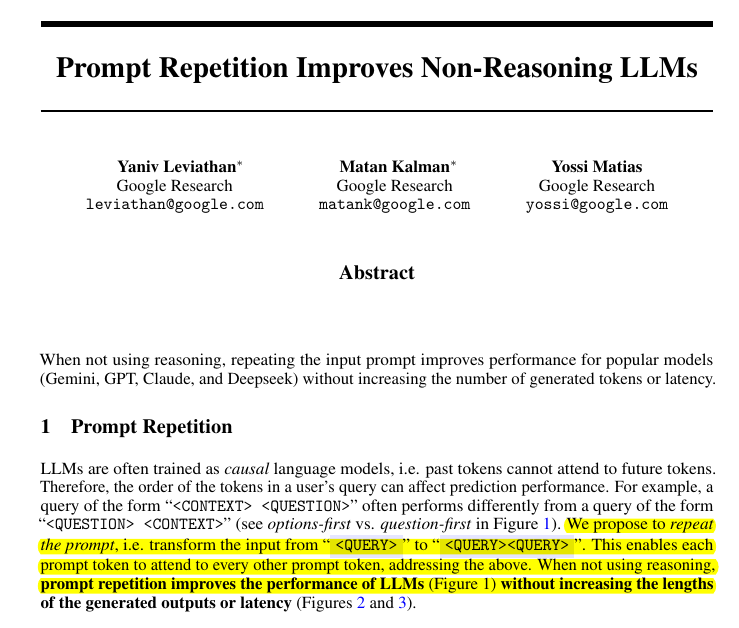
Fascinating Google paper: just repeating your prompt 2 times can seriously boost LLM performance, sometimes pushing accuracy from 21% to 97% on certain search tasks.
An LLM reads your prompt left to right, so early words get processed before the model has seen the later words that might change what they mean.
If you paste the same prompt again, the model reaches the 2nd copy already knowing the full prompt from the 1st copy, so it can interpret the 2nd copy with the full context.
That means the model gets a cleaner “what am I supposed to do” picture right before it answers, instead of guessing too early and sticking with a bad setup.
This helps most when the task needs details that appear late, like when answer choices show up before the actual question, because the 2nd pass sees both together in the right order.
In the Google tests, this simple trick took one hard search-style task from 21.33% correct to 97.33% correct for a model setting with no step-by-step reasoning.
Across 7 models and 7 benchmarks, repeating the prompt beat the normal prompt in 47 out of 70 cases, and it never did worse in a statistically meaningful way.
The big deal is that it is almost free to try, it often boosts accuracy a lot, and it shows many LLM mistakes are “reading order” problems rather than pure lack of knowledge.
----
Paper Link – arxiv. org/abs/2512.14982
Paper Title: "Prompt Repetition Improves Non-Reasoning LLMs"
Vi vill inte leva i en värld där USA, Kina och Ryssland samarbetar som motparter till Europa.
Det gäller att ha minst en på vår sida. USA med dess historia och förmåga är given etta.
Inget tyder på att Kina eller Ryssland kommer att bli ”nyktert” i vår livstid, men USA kan bli.
ℹ️ Många tror att Area 51 handlar om utomjordingar. Det är i verkligheten ett testområde för CIA och flygvapnet, som utvecklar nya (spion)plan och vapen. Ogrundade spekulationer om utomjordingar är till fördel för försvaret som vill hålla riktiga projekt hemliga. U-2, A-12, m.m.
Trump kommer inte sitta kvar för alltid som president.
Om det kommer en i dubbel bemärkelse mer demokratiskt sinnad president så kommer USA återigen att bli Europas nära partner i kampen mot de diktatoriska stormakterna. Kina är största hotet för Ryssland nedmonterar sig självt.
In 2013, Nassim Taleb gave a 1-hour masterclass on Antifragile and how the world really works.
He broke down how:
• Small failures save systems
• Big success hides fragility
• Forecasting is dangerous
• Time exposes lies
12 lessons from Taleb on surviving uncertainty:
Skidalpinism är en intressant OS-debuterande gren. 👏
Dock stort minus för att avslutningen är helt odramatisk utförskörning. Det måste spetsas till så att det är realistiskt möjligt att gå förbi i utförsåkningen.
Kärnan i idrott är att det ska kunna bli mer spännande i slutet.
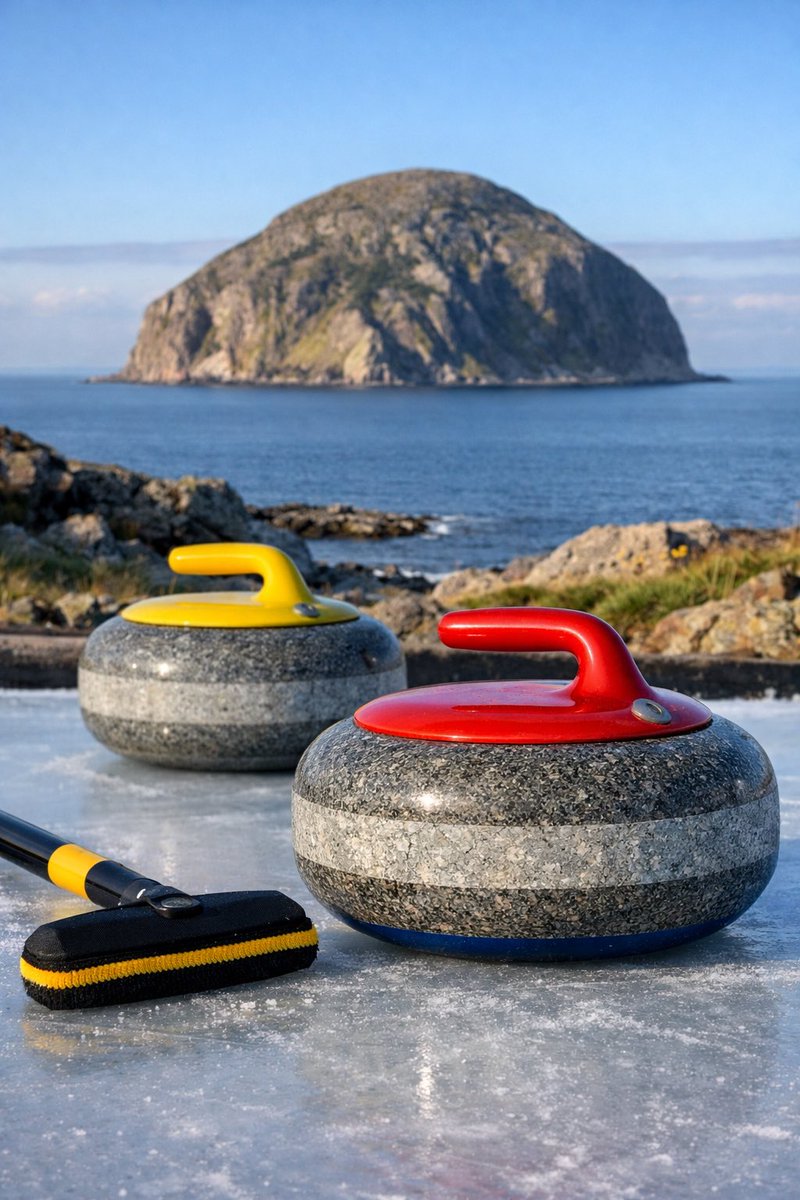
The Rock Behind Olympic Curling
There is something most casual viewers never realize about Olympic curling. At the highest level, every stone used in competition comes from the same small, uninhabited island off the coast of Scotland.
Not just similar rock. The exact same source.
Each curling stone begins as granite taken from Ailsa Craig, an ancient volcanic formation. The granite found there is exceptionally dense and highly resistant to water absorption. This is crucial because curling stones experience repeated heavy impacts and constant exposure to melting and refreezing ice. If water penetrates the stone and later freezes, it can create microscopic fractures that alter performance. At elite levels, even the smallest variation can influence the outcome.
Manufacturers use two specific types of granite from the island. A tougher variety forms the main body of the stone to withstand collisions. A rarer, finer grained granite known as Blue Hone is used for the narrow running band that makes contact with the ice. That surface determines how the stone moves and curls. Any variation in material would affect how the sport is played.
The island itself is rarely mentioned during broadcasts, yet it remains a constant presence in every Olympic match. Every precise shot and every narrow miss begins with stone shaped from the same remote source.
Stay connected,
Follow Gandalv @Microinteracti1
Michael Phelps won 23 Olympic gold medals using a mental technique most athletes ignore:
"The biggest thing that really separated me through my career was my mental game. Everything that was in between my ears."
Michael explains how he used visualization:
"When I would visualize, I'd visualize every single thing getting up to a meet, probably a month or so in advance. What could happen. What I want to happen. And what I don't want to happen. Because when it happened, I was prepared for it."
He describes the goal:
"When I got to a swim meet, there's nothing I can control at that point except what I do. I can't control what anybody else does. So I want to know how the race could go, how I don't want the race to go, and in a perfect world, how the race should go. So I could get behind the block and not have to think about anything."
His coach Bob Bowman reveals how they trained this skill:
"When Michael was young, I gave his mom a book of progressive relaxation. Before he'd go to bed at night, she would read this progression of things: clench your fists, work through your whole body. He got so good she'd just open the book, say two things, and he'd be asleep."
Bowman explains why visualization works:
"The brain cannot distinguish between something that's vividly visualized and something that's real. By the time Michael steps up on the block at the Olympics, he's swum that race hundreds of times in his mind. All he has to do is shut everything down and it goes on autopilot."
Michael adds the key detail most miss:
"When I would visualize, it would be what you want it to be, what you don't want it to be, what it could be. So you're always ready for anything. If I have a suit rip, fine, I need another suit, put it on. Any small thing that could go wrong, I'm ready for."
Det är för många som hamnar i en VD-position som absolut inte borde hamnat där. Jag tror man gravt underskattar mängden semi-inkompetenta människor i höga positioner.
OpenAI and Anthropic engineers leaked a prompting technique that separates beginners from experts.
It's called "Socratic prompting" and it's insanely simple.
Instead of telling the AI what to do, you ask it questions.
My output quality: 6.2/10 → 9.1/10
Here's how it works:
Bitcoin (som jag inte ägt i modern tid) slaktas och rasar. Det verkar bero på att något är fuffens med välkända Binance.
Bitcoins ras drar ner många teknologiaktier på USA-börsen. De där sympatilikande ”sekundär-rasen” ska man vara vaksam på. Kan lätt överdrivas och ge fyndpris.
Jensen Huang: "People with really high expectations have very low resilience."
"I think one of my great advantages is that I have very low expectations. And I mean that.
Most of the Stanford graduates have very high expectations. And you deserve to have high expectations because you came from a great school.
You were very successful. You're top of your class.
Obviously, you were able to pay for tuition. And then you're graduating from one of the finest institutions on the planet.
You're surrounded by other kids that are just incredible. You naturally have very high expectations.
People with very high expectations have very low resilience. And unfortunately, resilience matters in success.
I don't know how to teach it to you except for I hope suffering happens to you. And I was fortunate that I grew up with my parents providing a condition for us to be successful on the one hand, but there were plenty of opportunities for setbacks and suffering.
And to this day, I use the phrase pain and suffering inside our company with great glee. And I mean that. Boy, this is going to cause a lot of pain and suffering.
And I mean that in a happy way, because you want to train, you want to refine the character of your company.
You want greatness out of them. And greatness is not intelligence.
Greatness comes from character, and character isn't formed out of smart people.
It's formed out of people who suffered.
And so if I could wish upon you, I don't know how to do it. For all of you Stanford students, I wish upon you ample doses of pain and suffering."