BREAKING:
Iran has successfully developed a laboratory-scale artificial brain made from living human neurons that can form learning neural networks.
Iranian officials claim this biological technology can process information far faster than silicon chips while using up to 1 million times less energy.
🚨 BREAKING: Keir Starmer gets emotional as he resigns as Prime Minister
"I shall spend more time on the most important job. Being the best husband I can to my fantastic wife Vic... and being best dad I can to my beautiful children, who have been my pride and joy"
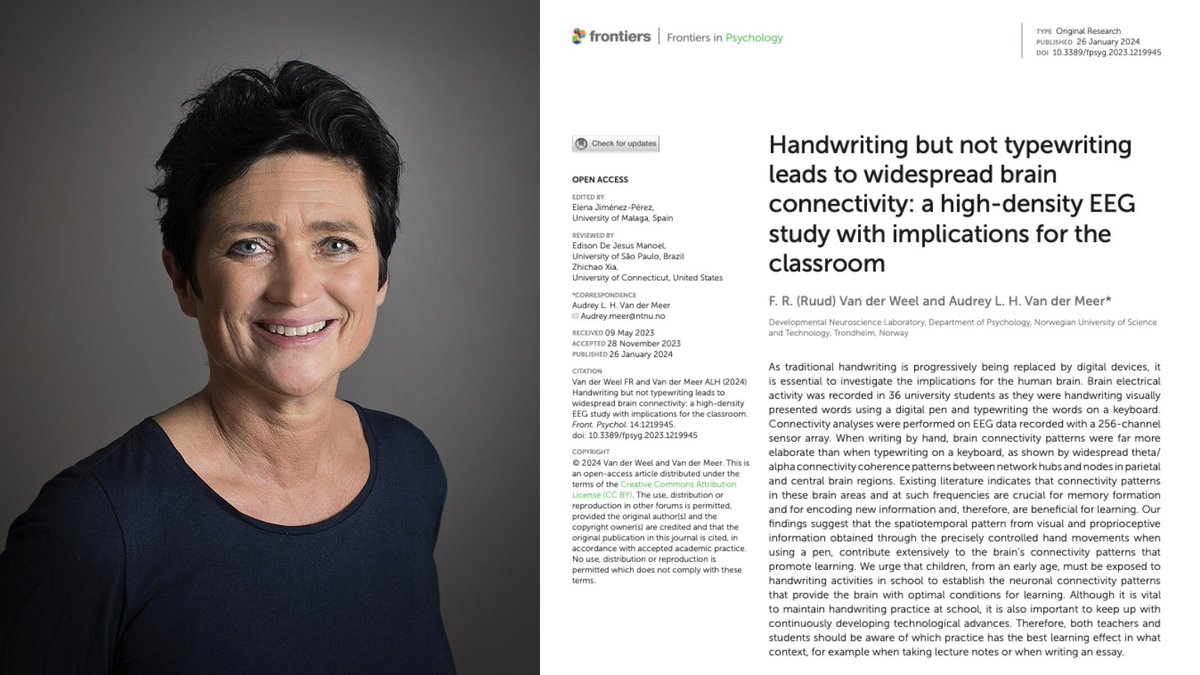
A Norwegian neuroscientist spent 20 years proving that the act of writing by hand changes the human brain in ways typing physically cannot, and almost nobody outside her field has read the paper.
Her name is Audrey van der Meer.
She runs a brain research lab in Trondheim, and the paper that closed the argument was published in 2024 in a journal called Frontiers in Psychology. The finding is brutal enough that it should have changed every classroom on Earth.
The experiment was simple. She recruited 36 university students and put each one in a cap with 256 sensors pressed against their scalp to record brain activity. Words flashed on a screen one at a time.
Sometimes the students wrote the word by hand on a touchscreen using a digital pen, and sometimes they typed the same word on a keyboard. Every neural response was recorded for the full five seconds the word stayed on screen.
Then her team looked at the part of the data most researchers had ignored for years, which is how different parts of the brain were communicating with each other during the task.
When the students wrote by hand, the brain lit up everywhere at once.
The regions responsible for memory, sensory integration, and the encoding of new information were all firing together in a coordinated pattern that spread across the entire cortex. The whole network was awake and connected.
When the same students typed the same word, that pattern collapsed almost completely.
Most of the brain went quiet, and the connections between regions that had been alive seconds earlier were nowhere to be found on the EEG.
Same word, same brain, same person, and two completely different neurological events.
The reason turned out to be something nobody had really paid attention to before her work. Writing by hand is not one motion but a sequence of thousands of tiny micro-movements coordinated with your eyes in real time, where each letter is a different shape that requires the brain to solve a slightly different spatial problem.
Your fingers, wrist, vision, and the parts of your brain that track position in space are all working together to produce one letter, then the next, then the next.
Typing throws all of that away. Every key on a keyboard requires the exact same finger motion regardless of which letter you are pressing, which means the brain has almost nothing to integrate and almost no problem to solve.
Van der Meer said it plainly in her interviews.
Pressing the same key with the same finger over and over does not stimulate the brain in any meaningful way, and she pointed out something that should scare every parent who handed their kid an iPad.
Children who learn to read and write on tablets often cannot tell letters like b and d apart, because they have never physically felt with their bodies what it takes to actually produce those letters on a page.
A decade before her, two researchers at Princeton ran the same fight using a completely different method and ended up at the same answer. Pam Mueller and Daniel Oppenheimer tested 327 students across three experiments, where half took notes on laptops with the internet disabled and half took notes by hand, before testing everyone on what they actually understood from the lectures they had watched.
The handwriting group won by a wide margin on every question that required real understanding rather than surface recall.
The reason was hiding in the transcripts of what the two groups had actually written down.
The laptop students typed almost word for word, capturing more total content but processing almost none of it as they went, while the handwriting students physically could not write fast enough to transcribe a lecture in real time, which forced them to listen carefully, decide what actually mattered, and put it in their own words on the page.
That single act of choosing what to keep was the learning itself, and the keyboard had quietly skipped the choosing and skipped the learning along with it.
Two studies. Two countries. Same answer.
Handwriting makes the brain work. Typing lets it coast.
Every note you have ever typed instead of written went into your brain through a thinner pipe. Every meeting, every book highlight, every idea you captured on your phone instead of on paper was processed at half depth.
You did not forget those things because your memory is bad. You forgot them because typing never woke the part of the brain that would have made them stick.
The fix is the thing your grandmother already knew.
Pick up a pen. Write the thing down. The slower road is the faster one.
Dangote Cement plans London Stock Exchange listing, taking advantage of revised requirements by UK regulators who are pursuing more initial public offers by African companies.
https://t.co/svzt1xUepH
Growing tension in parts of South Africa where anti-migrant groups are targeting foreign nationals in demonstrations. Thousands of people have protested in Johannesburg demanding undocumented foreigners to leave.
Al Jazeera’s Fahmida Miller reports.
This is insane 🤯
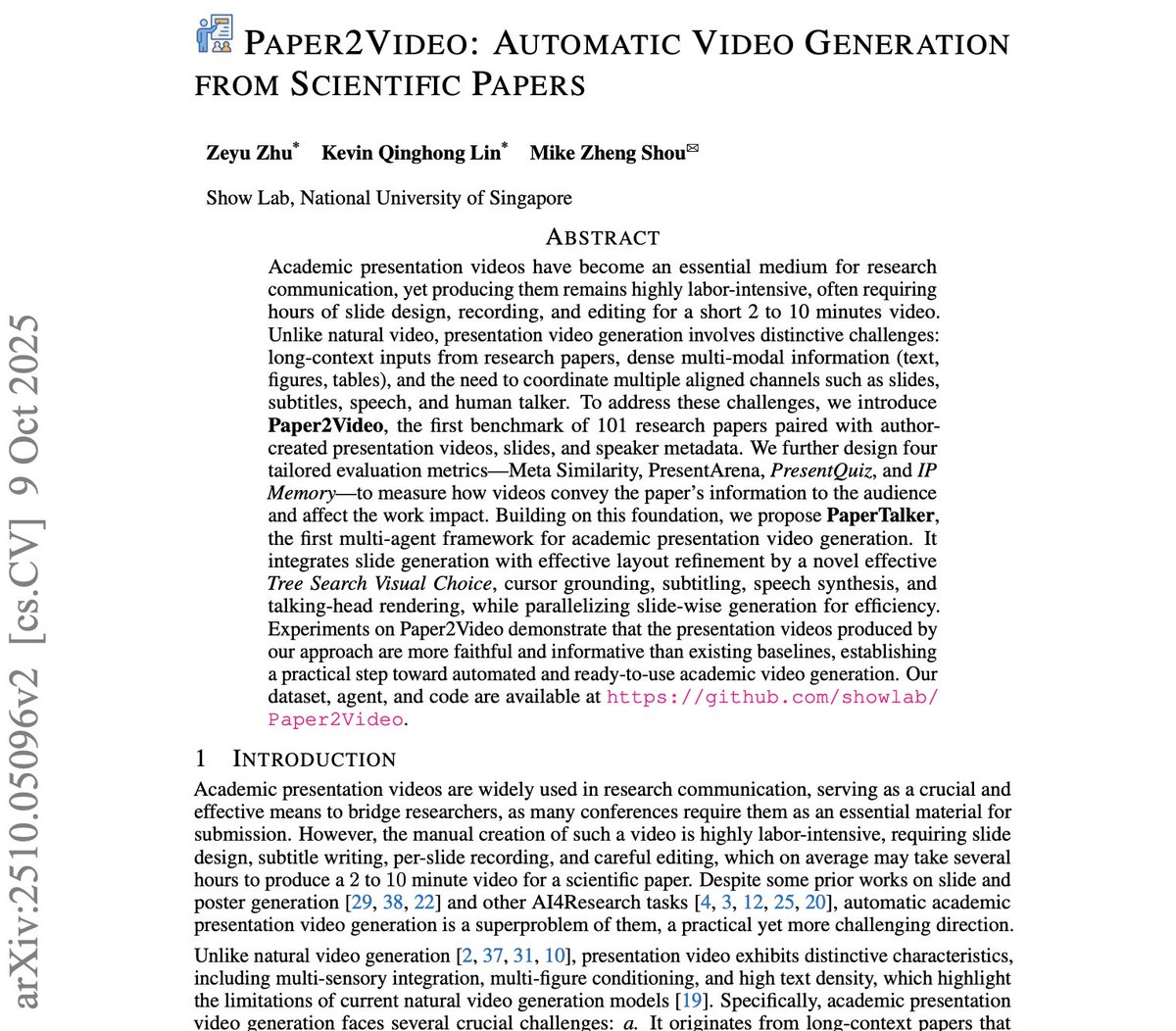
A new system called Paper2Video can read a scientific paper and automatically create a full presentation video slides, narration, subtitles, even a talking head of the author.
It’s called PaperTalker, and it beat human-made videos in comprehension tests.
Hours of academic video editing... gone.
AI now explains your research better than you do.
👉 github. com/showlab/Paper2Video
This is why we needed Raila in that office. He would have called out this nonsense.
African Union is a joke.
Chains that hold Africa to a past it wants to shed.
@MariaSTsehai
How the brain talks to the immune system
This diagram shows the inflammatory reflex - a neural circuit where the brain regulates inflammation through the vagus nerve. It’s how psychological stress, inflammation, and immune activity stay linked.
1️⃣ The signal starts in the brain
The vagus nerve carries electrical impulses from the brainstem to the spleen, the body’s blood-filtering and immune-coordinating organ.
🟢 Example: Deep breathing and meditation can activate the vagus nerve, lowering heart rate and reducing circulating inflammatory markers like CRP and IL-6.
2️⃣ The spleen acts as a relay
When the vagus nerve is stimulated, it triggers the splenic nerve to release noradrenaline, which activates immune T cells to release acetylcholine.
🟢 Example: In animal models, vagus nerve stimulation increased noradrenaline in the spleen within minutes, showing how fast the nervous system can modulate immunity.
3️⃣ Acetylcholine calms inflammation
This neurotransmitter binds to receptors on macrophages, reducing the release of tumor necrosis factor-α (TNF-α), an inflammatory cytokine involved in chronic disease.
🟢 Example: Clinical studies using implanted vagus nerve stimulators in rheumatoid arthritis patients lowered TNF-α levels and improved joint pain without immunosuppressive drugs.
The inflammatory reflex shows that inflammation isn’t just chemical, it’s electrical. The brain can literally tell the immune system when to stand down.
Chemistry writes the story of life.
Every cell, every second, it tells it again - powered by molecular design.
At the core of this process lies the citric acid cycle, the central hub of metabolism.
Here, acetyl-CoA derived from carbohydrates, fats, or proteins enters a precise series of reactions that convert fuel into energy.
Each step transfers electrons, drives ATP synthesis, and sustains the continuous renewal of life at the cellular level.
What may seem invisible is, in fact, the most constant motion in existence; the quiet rhythm of biochemistry that powers everything we do.