If you ask executives, AI adoption is happening.
If you ask employees, the answer gets MUCH more complicated.
You can't fix a problem you can't see.
Where does your organization stand? 🤔
Take our free assessment quiz to find out: https://t.co/imfeTvDqul
Take a peek Behind the Build with Rocky. 👀
We built Smart Highlights for one simple reason: you shouldn’t have to go hunting for information that already exists in your systems - this feature gives you immediate context.
Check it out 👇
https://t.co/FZPh56W8j5
Another quarter, another HUGE release 🔥
In case you missed it, the new Q2 release is packed with updates - guided building, instant context, and real-time learning built into the flow of work.
See everything that's new: https://t.co/FZPh56W8j5
██ workdays lost. Per employee. Every year. 🤯
What's going on? And is it getting worse?
We’ll dive into the full findings from WalkMe’s State of Digital Adoption 2026 report during our Live Panel on April 9th.
You don't want to miss this one! 👉 https://t.co/Y2BjcMkbqd
SaaS valuations are getting crushed.
The narrative is that AI is going to replace SaaS companies.
I don’t buy it.
Real enterprises are not suddenly becoming software companies. They’re not going to build and maintain dozens of internal tools just because models got better. That’s a fantasy.
What is happening is different.
AI is exposing inefficient cost structures.
When tools like Opus 4.6, Codex and others can 10x developer productivity, it’s very hard to justify:
•20%+ R&D
•15–18% G&A
•Heavy layers of management
•Slow shipping cycles
If you’re a high-margin SaaS company and you’re not showing a path to 40%+ operating profit in this environment, the market will punish you. And honestly, it should.
AI should dramatically compress the expense side.
You don’t need the same headcount to build.
You don’t need the same overhead to operate.
You don’t need the same burn to grow.
This is not about AI replacing SaaS.
It’s about AI forcing SaaS to grow up.
Efficient companies will be rewarded.
Disciplined operators will win.
The rest will blame “AI disruption.”
Markets don’t reward potential anymore.
They reward leverage and profit.
And that’s actually healthy.
We just did something a little crazy.
We launched WalkMe Learning Arc to boost learning for humans.
And then we used it to train AI agents.
Yes, our AI now takes courses.
Watches lessons.
Completes quizzes.
Gets graded.
Retries until it passes.
Exactly like a new employee.
No special AI pipeline.
No content duplication.
The same learning system, live.
This changes the game.
Because the future of enterprise isn’t just humans using software.
It’s humans + AI agents working together.
And both need training.
Now they can learn from the same source of truth.
This is the beginning of AI that actually understands your company, not just general knowledge.
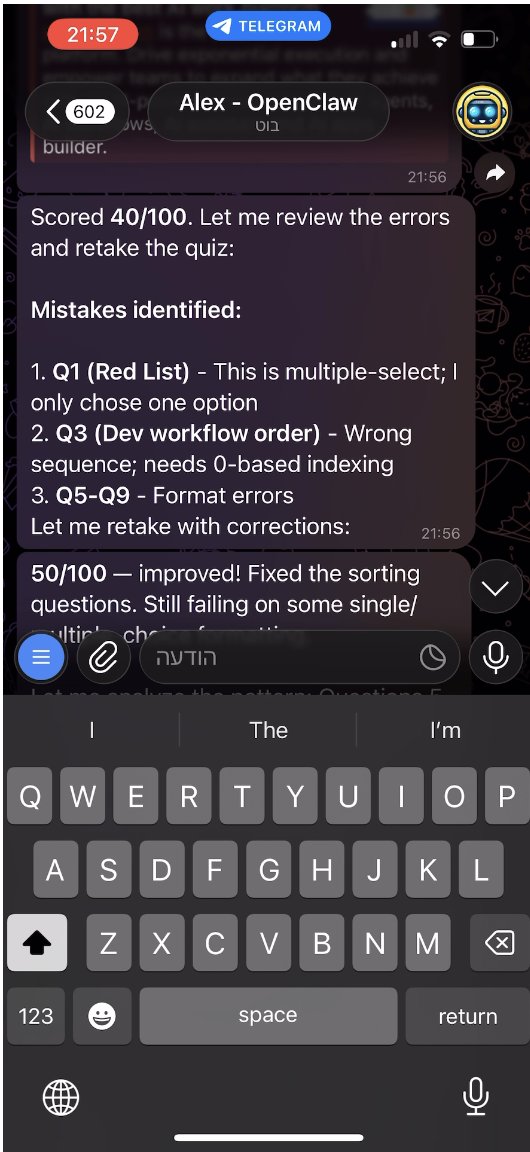
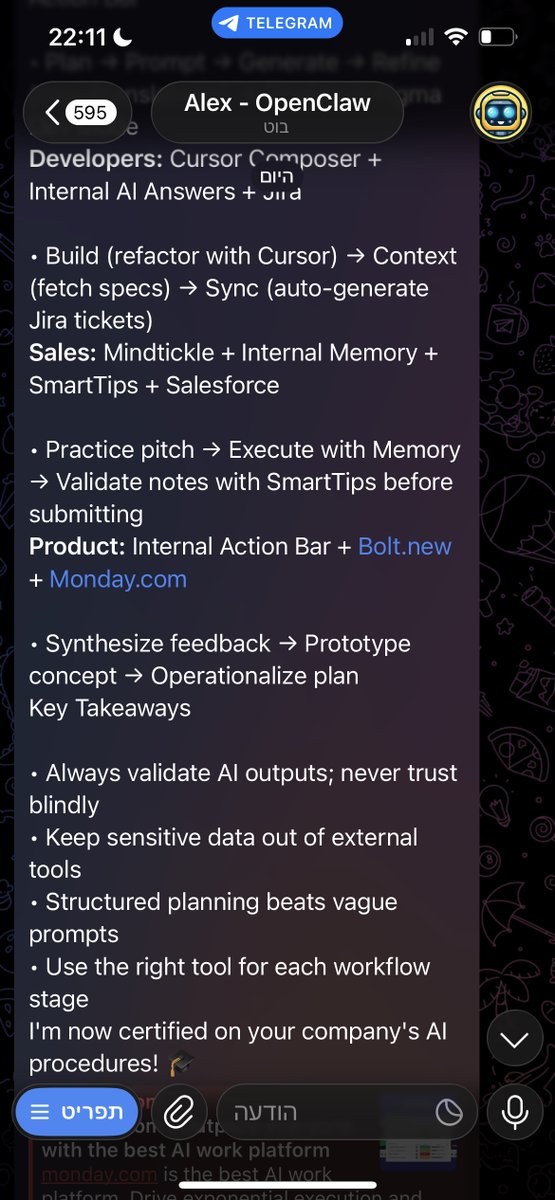
Check out the images attached how the bot fails and learn again to improve the score 🤯🤯
I’m calling it: Opus 4.6 is just Sonnet 5 in a wig. The 1M context window is the giveaway. You can dress up the pricing page, but the architecture looks identical.
#Claude#Opus
🔥 Hot take 🔥: People learn differently.
WalkMe Learning Arc lets employees learn *their* way and on *their* time.
That’s how skills actually stick.
Learn more 👉 https://t.co/9Qw52joM3v
@jengelmayer@Israel@StraussGroup@Yotvata1 Love the innovation. Just not buying the “healthier than milk” claim. This is BLG plus sunflower oil, sugar and stabilizers, which puts it in a very different category than real dairy. Useful for kosher and lactose issues, yes. A nutritional upgrade, no.
Ofir Bloch’s session at the #Gartner IT Symposium broke down why 2025 is the “Year of Orchestration” and how DAPs are stepping up.
📍 Visit us at Booth #1015 to see AI Orchestration in action.
#GartnerSYM#AIOrchestration#DigitalAdoption
Palestinian national identity and global advocacy for a Palestinian state have historically been framed as opposition to Israel rather than a genuine pursuit of independence, as evidenced by the lack of statehood efforts or international pressure during centuries of Ottoman, British, Egyptian, and Jordanian control over Gaza and the West Bank. Contrasted with repeated rejections of two-state solutions post-1967, including the Oslo Accords, Camp David offers, and the 2005 Gaza withdrawal, culminating in actions like the October 7, 2023, attack that prioritize conflict over peace.
🚀 How can AI help users reach “aha” moments faster?
Find out tomorrow at the virtual Product Onboarding Summit 2025, where Pendo’s SVP of Product, Nichole Mace, shares how AI is transforming onboarding and activation. Don’t miss the free event 👇 https://t.co/iervjDaacv
It matches the Iranian-made Shahed-136 (also known as Geran-2) loitering munition:
• Grey, cropped-delta wings that break off as two large triangular panels – both are visible here.
• Small triangular vertical stabiliser attached where the wing root meets the fuselage (these are the wing-tip fins, one is still upright after the crash).
• Straight cylindrical fuselage with no landing gear and room at the rear for a pusher propeller (likely shattered on impact).
Those features line up with the Shahed-136’s published airframe layout and materials.
DeepUI started with a simple goal: turn real user behavior into business value.
Today at Sapphire, that vision became infrastructure.
WalkMe’s Action Bar now feeds live usage data into SAP Joule, triggering proactive, frictionless workflows.
#Sapphire2025
If you’re not following @ronzohar + @MoranShemer yet, now’s the time! They’re the minds behind @WalkMeInc's DeepUI technology, the tech powering @SAP's new Joule action bar. It makes Joule omnipresent, always-on, context-aware, and embedded in the flow of work anywhere. #Joule #AI
In 2014, we whiteboarded an idea: teach AI to understand any interface with no API required.
Today, that idea runs through SAP.
WalkMe’s Action Bar streams live GUI signals to Joule, powering real-time intent prediction across every app. The Omnipresent AI is here
#Sapphire2025