They will build the stack so you dont have to manage it.
For some this is okay, for developers, look back to the 12 factors of agents.
You must own it all to derive value.
https://t.co/fak5RJr3cv
@uzairansar Massive L! What a great browser. All because they need to keep up with the ai hype. I don’t want my browser using AI. What’s hard to understand about that?
I spent 48 hours in SF hanging out with billionaires, data labs and AI founders and execs running $1B to $100B companies.
My observations:
1. Sooo MANY stories of data brokers making like $2M a WEEK selling company data to labs. I can't tell if it's the beginning or a bubble, and I kept wondering which niches are left. Digging into it actively.
2. At dinner, someone asked the table, "If a new model drops next month, does your company get better or worse?" HALF the table went quiet! I think that's the best question to ask about any AI startup right now.
3. The bar people talk about now is hitting $1B in revenue in 12 months (I guess that's the new unicorn?). What I didn't hear much about is retention. AI revenue can come in fast and leave fast, and I think we're going to see a lot of stories of AI companies with huge revenue and terrible retention.
4. It's pretty clear we're living through the reinvention of the computer. The model is the CPU, the harness is the operating system, and skills and plugins are the apps. Thinking about it that way makes it easier to see where the whitespace is.
5. We're maybe 12 months from an agent that can watch you work for a week and then do your job without any instructions. The screen recording plus agent memory plus local model combination makes this possible right now.
6. Agent harnesses feel like the new GPT wrappers, in a good way, especially vertical ones. The best teams I talked to treat the model as swappable. One founder walked me through routing different models to different jobs: one for taste and visuals, a cheaper one for the everyday stuff, another for text.
They use prompts they can move across models over fine-tuning, and A/B test the output on what users actually do with it: do they edit it, export it, share it? A vertical harness is basically four things: the connectors for that industry's data, evals written by people who know the work, rules for what the agent can and can't touch, and a clean screen for a human to review. The model is maybe 20% of it.
7. There's a lot of reverse engineering going on/cloning going on more than I've ever seen. People are decompiling software and rebuilding it with agents, and someone showed a suite of like 10 apps that are worth $5B+ each all that he cloned open source. Me and everyone are still thinking through what it means when software gets this easy to copy.
8. My guess is the value moves to data. If the software can be rebuilt quickly, what's worth paying for in a legacy SaaS company is the years of customer data and workflows inside it. Some SaaS companies are secretly data companies.
Gets me thinking about how do you truly value data for this saas companies? Like if we were buying these dying saas companies at 2x ARR before (as example), maybe there is a better metric. Idk, just thinking out loud here.
9. It feels like a good chunk of legacy software won't make it to the agentic era, especially anything built around people clicking through a lot of screens.
10. Every company I talked to wants to pipe its internal data into one place and expose it to agents through MCP. Then they look at the data and realize it's a mess: five versions of the same customer, old Slack channels, PDFs nobody can search. Cleaning that up feels like a big consulting opportunity!
11. A lot of founders are building the basic building blocks for agents: APIs, data layers and tools. Some of the companies I saw barely have a UI because the main user is an agent. I really believe the startups that build primitives to this agentic era will do extremely well. Building blocks is the best way to think about it.
12. Labs can get plenty of training data, but it's harder to get real examples of agents failing inside companies. Whoever has those logs has something valuable.
13. Someone running a big consumer company told me the next fight is over memory. The model that remembers the most about you wins, and the smartest model matters less than people think.
14. Physical AI came up a lot. Astra I think was the first model that got people into AI can actually do CAD, and I think a lot of people are thinking what does vibe manufacturing really look like. The line I keep thinking about came from a robotics founder: the hardest problems in AI are deployment problems now, not research problems. Their robots work on their own, call a human when they get stuck, and every one of those calls becomes training data.
15. Cybersecurity companies are having a moment and are actually cool companies to build now, especially the ones that clean up after a breach. Every agent with access to your systems is a new door into your company, and a lot of those doors were left open.
16. Some startups are worth more dead than alive now. A shutdown company with 5 years of Slack, email and code can get paid for licensing all of it. I wouldn't be surprised if founders start factoring that into when they shut down.
17. People are starting to talk about monetizing the agent web. It feels really early, but when the most popular user of the internet is an agent, what startups should you be building?
18. I think agent insurance is coming. Once an agent makes an expensive mistake, insurers will want audits before they cover anyone.
19. Several people said the hire they want most is someone with taste who can write evals. The models are getting good at generating ideas, so the hard part is judging which ones are good.
20. New trend I observed: startup raises VC, uses venture dollars to become a creator, startup fails, founder falls back on being a full-time creator and incubates other products bootstrapped.
21. Getting SIGNIFICANT distribution is HARD right now. Founders are sponsoring buses, buying billboards like crazy and throwing parties with famous DJs to get noticed. Kinda feels dotcom era in that sense.
Attention is what's scarce! The growth guy going viral sharing his UGC strategy from Wispr Flow is a good example. It's the sauce everyone wants, and I truly believe there are probably only 50 people on the planet who know how to scale these types of businesses efficiently in this era.
Always good to get that dose of SF. I felt sooo lucky to have such an incredible trip during such an incredible time in building businesses. Surreal in so many ways.
Happy to be home and locked in.
Until next time!
Every market has a lifecycle.
Every human has a learning rate.
For all of history, markets were slower.
AI flipped that.
The edge is no longer knowing the market. It's seeing it accurately while it's still moving.
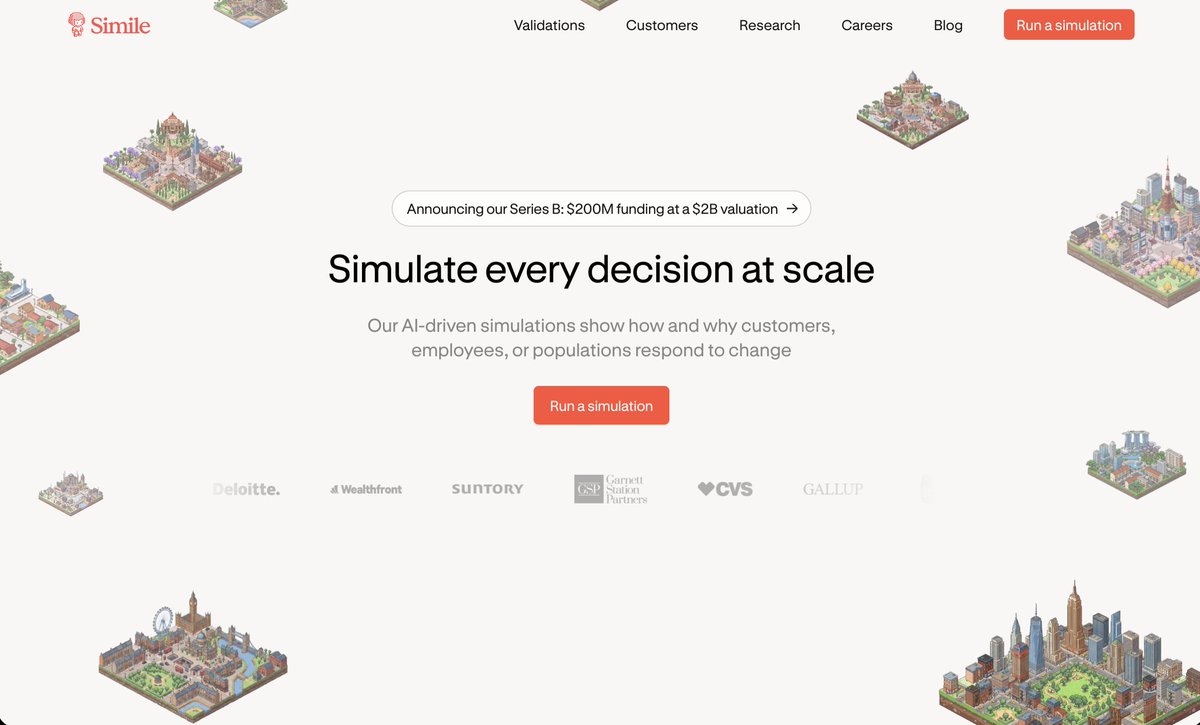
Trend I'm following: Teams using AI "simulations" to quickly test product ideas and flow tweaks.
Products like @simile_ai, @primitivelabsai, @syntheticusers, https://t.co/ob9IJxlKT9, https://t.co/9j08COCw4J, and others.
If you've tried something like this, how'd it go?
As an AI Engineer, you must build these projects.
Systems that prove you can retrieve, reason & ship.
1.) Production RAG Pipeline
Build: Ingestion → chunking → hybrid search → reranking → cited answers over 1000+ docs.
Why: Retrieval quality decides if your LLM product lives or dies.
2.) Structured Output Engine
Build: Pydantic schema enforcement with retries, validation, graceful fallbacks on malformed JSON.
Why: Apps break on free text. Schemas make LLM output usable.
3.) Context Assembly Service
Build: Dynamic context builder that budgets tokens across memory, docs & tools per request.
Why: Context engineering beats prompt tweaking in production.
4.) LLM Evaluation Harness
Build: Golden dataset + LLM-as-a-judge + CI gate that blocks merges on quality regression.
Why: You cannot ship what you cannot measure.
5.) Semantic Cache Layer
Build: Embedding-based cache returning stored answers for similar queries, with hit-rate tracking.
Why: The cheapest token is the one you never generate.
6.) Model Routing Gateway
Build: Complexity-based router across 3 model tiers with fallbacks and per-request cost tracking.
Why: Unit economics decide if your AI product survives.
7.) Multi-Tenant LLM API
Build: Per-tenant keys, rate limits, token budgets, isolated data access.
Why: Enterprise customers demand isolation and spend control.
8.) Fine-Tuning Pipeline
Build: LoRA/QLoRA fine-tune of a small model on synthetic data, benchmarked vs prompt-only baseline.
Why: Know when adaptation beats prompting, and when it doesn't.
9.) Agent Memory System
Build: Working + episodic + semantic memory with compression and eviction policies.
Why: Agents without memory fail by turn five.
10.) Guardrails Middleware
Build: Input/output filtering, PII redaction, injection detection as a reusable service layer.
Why: One leak destroys trust. Safety must be infrastructure.
11.) Streaming Response Infrastructure
Build: SSE streaming with backpressure, reconnects, time-to-first-token tracking.
Why: Perceived latency is the UX of AI products.
12.) Prompt Versioning and A/B System
Build: Registry for prompts and configs with rollback, traffic splitting, outcome tracking.
Why: Prompts are production code. Treat them that way.
13.) LLM Observability Stack
Build: Tracing for prompts, tokens, latency, cost per request with alerting on anomalies.
Why: You cannot debug what you cannot see, especially non-determinism.
14.) Tool-Calling Framework
Build: Typed function schemas with discovery, retries, sandboxed execution.
Why: Tools turn chatbots into systems that actually do work.
15.) Self-Correcting RAG Agent
Build: Query rewriting, retrieval critique, confidence-based fallback to web search.
Why: Production retrieval must repair itself, not hallucinate.
Most people watch tutorials. Builders ship systems.
Bookmark & Repost.
@boardyai building prism flow, ai-native data aggregation that gives ecommerce teams decision-ready recs without building the pipeline. would love in on boardy pro
My TXDMV VIN tracker for autonomous vehicle fleet registrations is live! See link below and let me know what you think. Also, yes @wholemars beat me to market with this by 1 day.
Tracker Link: https://t.co/4adfrIvTsR