One thing I've mentioned to friends that I find amusing: to me, it feels like one clear UX for AI in the current form is essentially an email inbox.
The idea is that you basically work through the most critical tasks AI needs you for.
Of course, it's a little more than that: click an "email" (task) and have it open to a specific document or brief, with the UX designed to easily access additional context through progressive disclosure. Ie, click to open a side bar with more context or other docs.
It's what I've built internally at @RarelyDecaf, at least.
I can finally share what I’ve been working on at @Microsoft. I lead Today, the product you saw all over the Ignite conference this week.
Today is a new form factor for work. It’s not a chat box it’s a Feed. While you sleep, an AI agent works in the background on your email, your calendar, Teams and your documents. In the morning, the work is already prepared: replies drafted, conflicts spotted, the messages that matter pulled to the top, the documents waiting for your review.
You don’t have to prompt it. There’s nothing to configure. You open Today, check what it did, and in a few taps you send, accept or mark as done. Most of us start the day by digging through everything that came in overnight. With Today, you start by finishing work your agent did.
We think this is what AI at work should feel like: proactive, quiet and useful, without you having to ask.
Today lives in your existing apps starting with Outlook and Copilot meeting customers in the app they use the most.
I had so much fun building it with an incredible team: @JesseProvo, @donovanso, @telmen, @justinchando, Chris Parnin, Gideon Ojo, Alex Trzyna, Christopher Miller, Diana Slaba, Kirill Varshavskiy. Thank you for the craft, the late nights, and for caring about every detail.
And none of this would have happened without the incredible support of @sumit_c, @elbio_abib, @rroslansky, @clamanna, @jacobandreou and so many others across Microsoft. Thank you for believing in it.
This is just the beginning!
P.S. i made a little film to celebrate. It starts in 1997. Watch till the end.
I wanted to test Fable 5.2's quality with one-shot prompts without human feedback.
Everything in this game is from scratch: models, sounds, textures. ~$550 at API pricing, ~2.7M output and 445M input tokens, heavily cached. Took 8 hours!
Play it here: https://t.co/fazOCcyNIH
Polsia, the one-person startup reportedly at a $25M run rate, used to have a public API. It exposed internal metrics alongside the headline numbers. It has since been taken down.
For the curious and the skeptical, here’s what it showed and my take on the whole "one-person company" thing.
I also respect Ben. Building this solo is inspiring. But I haven’t seen evidence of successful customer businesses either.
In May, he said only 10% of companies had made at least a dollar, and called the experience “a game” that educates people about building. That’s a legitimate product, but it’s a different promise from AI running your business.
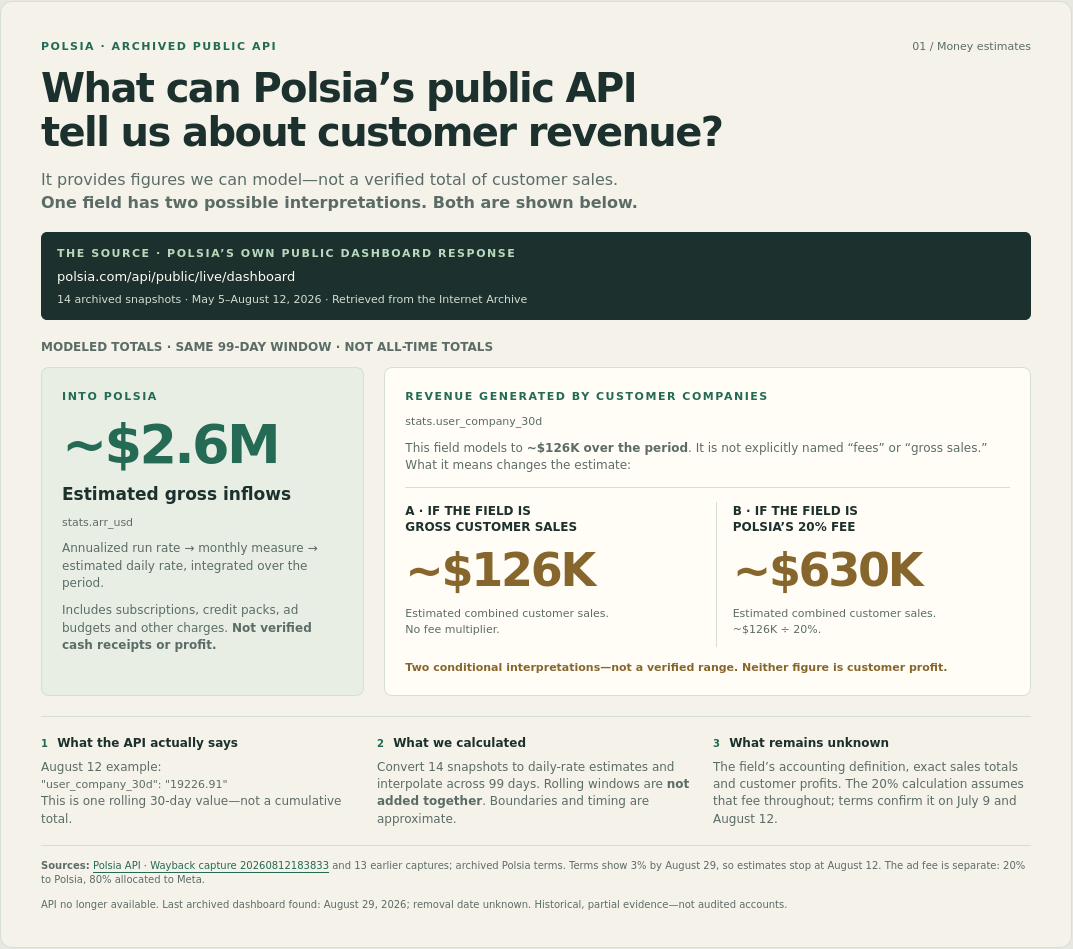
A few months ago, out of curiosity, I stumbled into more data behind Polsia’s public API, which has since been taken down. By late August, the API reported ~81% 30-day paid churn and ~8% trial-to-paid conversion.
My estimate from the same data: from May to mid-August, ~$2.6M went into Polsia, while customer companies generated ~$126K–$630K in sales. Sources and caveats attached.
I think this is a broader pattern in AI: slop before craft. We saw it with images and video, and now we’re seeing it with companies.
The capability is real. Turning it into something valuable takes tools that let people bring their expertise, judgment and taste into the work.
For context: I run a business consultancy (@RarelyDecaf ) who went from running a team to running the business myself with an AI platform.
What makes that possible is infrastructure I've built that lets my expertise scale through the AI. That’s what keeps the output my work, not more AI slop.
For the AI nerds out there...it's a combination of custom agent harnesses and control plane.
I also respect Ben. Building this solo is inspiring. But I haven’t seen evidence of successful customer businesses either.
In May, he said only 10% of companies had made at least a dollar, and called the experience “a game” that educates people about building. That’s a legitimate product, but it’s a different promise from AI running your business.
A few months ago, out of curiosity, I stumbled into more data behind Polsia’s public API, which has since been taken down. By late August, the API reported ~81% 30-day paid churn and ~8% trial-to-paid conversion.
My estimate from the same data: from May to mid-August, ~$2.6M went into Polsia, while customer companies generated ~$126K–$630K in sales. Sources and caveats attached.
I think this is a broader pattern in AI: slop before craft. We saw it with images and video, and now we’re seeing it with companies.
The capability is real. Turning it into something valuable takes tools that let people bring their expertise, judgment and taste into the work.
Definitely.
The way I see it, we hit the slop phase before the craft phase.
Same cycle with AI-generated media. Initial AI media was slop, now there's some great stuff where it's clear there was human craft, judgement, and taste baked into the final output—either systematically, or by doing things that don't scale.
Similarly, we're in that cycle with AI-generated companies or consulting.
But, behind the scenes, I'm sure there are loads of people building in processes and systems to build in their judgement to the output.
It's what I'm doing at @RarelyDecaf and I'm sure there are plenty others. Open source tools like @papercliping are making this easier for people.