ok... uh so I'm making a game... it's like if GTA & Apple Maps v1 had a baby
And that baby was a custom built engine that streams in OpenMapTiles (plus some other public domain mapping data) to render the entire earth as a playable open world game
Engine is all C++ with Metal (and Vulcan) renderer - which means this thing runs on ALL Apple platforms... yes even that one (ok not the watch... yet)
Right now it's just a sandbox world. No "game" - just layers and layers of systems. Earth scale procedural weather systems (rain, storms, clouds, wind, KpI, tornadoes, hurricanes, etc) which means you can see them coming from the distance and travel across the landscape in a timelapse. And every building has a procedurally generated interior.
There's also tons of vehicles, skateboarding (with skateparks), snowboarding (with ski resorts & lifts)
Also a photography mode with all sorts of fun goodies
The whole thing is a bit mad. Work's been insane right now and I wind down before bed by going through all of the work Claude has done that day, playtesting, writing up new project plans, and then kicking off the next day's projects across my 3 Macs in my house wirring on this all day with Opus 5.5 (maybe save that explainer for another crazy person Twitter screed)
Anyway, curious what you think. Now I can post my little updates here instead of blowing up all my group chats with the weird ideas I'm trying next.
My dear friends, I’d like to show you my latest toy project
Introducing Handwired: turn your regular JavaScript code into a neural net!
- no training
- exact outputs vs the JS program
- fully differentiable
All runnable in a browser, without GPU
interpretability might be the most important scientific problem in the world right now, as I don't think we can solve alignment if we don't know what we're building. I think I have good news about it. I co-authored early work in mechanistic interpretability at OpenAI and came away pessimistic, because neural networks appeared to fold into arbitrary tangled knots. years later, I started openai's first large-scale automated interpretability project, finding about 2% of neurons legible with the primitive tools we had
with modern agentic tools and a much closer look, the picture looks totally different. the vast majority in models up to trillions of parameters are legible, and their circuits beautiful. many famous examples of tangled neurons turned out to be misunderstood. The roadblocks I expected mostly aren't there. I now think ambitious interpretability will be solved by the time we need it most, and possibly quite soon, as automated scientists keep improving. it may be a bitter lesson for interpretability: the simple thing, at absurd scale, works
https://t.co/zHij5zwKGT
@lauriewired wireless display has macOS sidecar as a PoC, although prior config and proximity is required. easy to see how pairing could improve though.
power would be extremely cool, a surface with overlapping coils could work if ‘contact with surface’ is allowed criteria?
in related news... i'm building a new programming language called "ink".
https://t.co/2GN8jawf1w
the idea is that it has a small core that self optimises as you submit more proofs.
i'm launching https://t.co/O5ifyyg1bB
a way for people to use their excess tokens to push forward the frontier of science.
submit an open proof request and have others contribute to them.
it's agent first & has an api & cli.
failed attempts are just as valuable!
Introducing gdp-ts: Ghosts of Departed Proofs for TypeScript.
gdp-ts is a library, linter and AI skill for safer API design. Under this contract, sensitive functions require 'proofs' that the caller performed an authorization check.
The typechecker verifies these proofs at compile time, preventing your team and agents from shipping catastrophic security (and other kinds of) bugs.
While these patterns have existed for quite some time, especially in ecosystems like Haskell, ① human code review and ② cognitive and syntactic overhead made these solutions niche.
The situation is now inverted. Agents are writing more code than we can review, and they *thrive* in tight loops with hard constraints that would frustrate us. We see this with the rise of Rust, borrow checker, code aesthetics debate and all.
The README and examples model a real-world Vercel API product constraint: changing the password on a Project requires a proof of a certain role + a certain entitlement. Thanks to Matt Noonan and Ollie Charles for their research in this space.
https://t.co/eRWdiMvQ2V
As far as we know, YBaMnFeO₅ is a new design that was never made or proposed as this kind of magnet. Simulations predict a 2.35 eV band gap and magnetism above room temperature, but the Mn/Fe checkerboard it needs may scramble during synthesis.
KV[Cr(CN)₆] stays magnetic up to 376 K (measured, 1999). We predict a 2.1 eV gap with both band edges in one spin channel, sorted over 2.6 and 1.6 eV windows.
To verify, the agents ran hundreds of quantum-mechanical simulations (density functional theory, the standard way to compute how electrons behave in a crystal) on cloud computers.
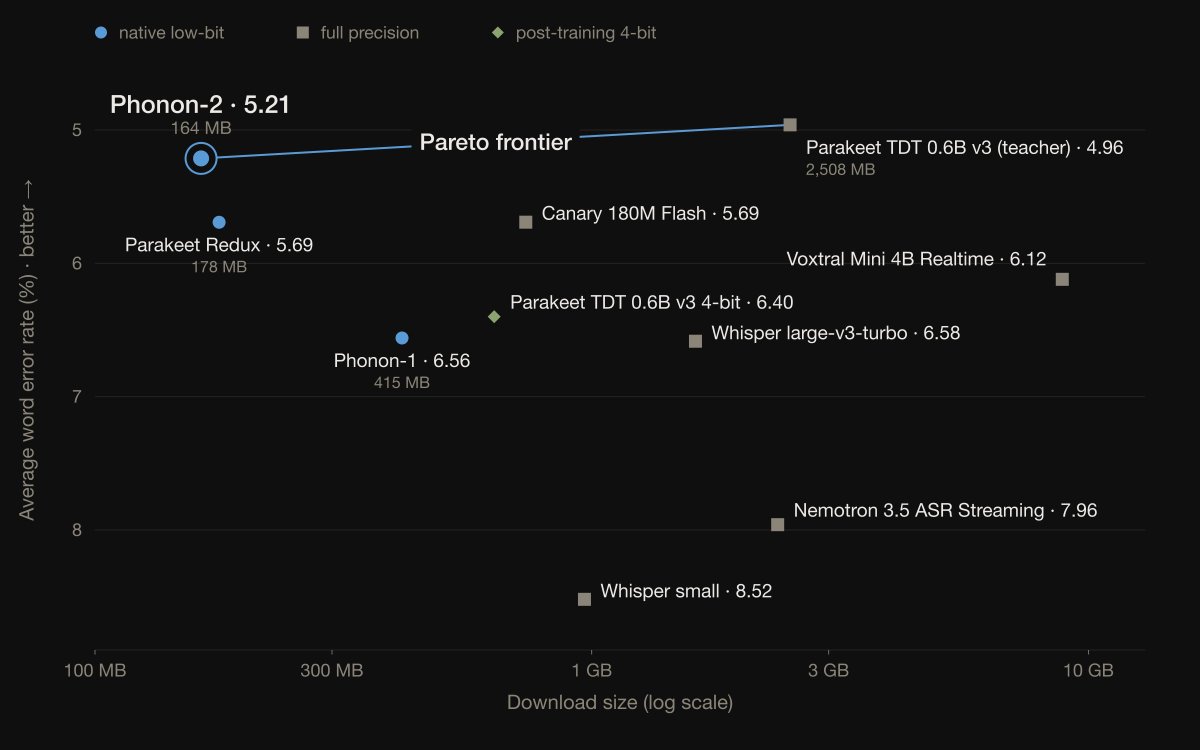
Introducing Phonon-2: a new standard in speech recognition per byte.
At just a tiny 164MB download, it is more accurate on average than OpenAI's Whisper large ( a model 10X its size)
Transcribe an hour of audio in just 20 seconds on a MacBook Air!
Open weights, CC-BY-4.0, today.
@fermion_ai