🎓 Dr. Kristen Lindquist
The Robert K. and Dale J. Weary Endowed Chair in Social Psychology at Ohio State Univ. Her work has advanced constructionist models of emotion, and shown how affect emerges from distributed brain networks interacting with cultural and social learning
A psychology professor at Ohio State just dismantled everything you thought you knew about willpower.
Dr. Kentaro Fujita has spent his career studying self-control. And his research doesn't say what most people want to hear.
Here's what actually works — and what doesn't.
The marshmallow test was never really about willpower.
You know the experiment. Kid sits alone with one marshmallow. If they wait, they get two. Kids who waited longer apparently became more successful adults.
But here's what everyone missed: Walter Mischel's real discovery wasn't that self-control predicts success. It was that self-control can be taught.
The kids who waited longer weren't the ones who stared hardest at the marshmallow willing themselves not to eat it. They were the ones who learned tricks — covering it up, closing their eyes, imagining it as a puffy white cloud.
"Three-year-olds believe staring at the marshmallow will motivate them. Five-year-olds have already learned that's not going to work."
The implication: self-control isn't a fixed trait you're born with. It's a skill set you build through trial and error. The children who figured out which tools worked became the ones who succeeded later. Not because they had more willpower — because they had better strategies.
Willpower training barely works. Strategy training does.
I spent years believing that willpower is like a muscle. Train it, and you get stronger. Do hard things, and doing hard things gets easier.
The data doesn't quite support this.
Multiple large-scale replication attempts have struggled to find reliable evidence for the so-called "depletion effect." When labs around the world try to reproduce the finding that doing one hard thing exhausts you for the next — the results are messy. Inconsistent. Often null.
What does replicate is this: your beliefs about willpower matter more than your willpower itself.
Psychologist Veronika Job created a simple questionnaire asking people whether they found hard tasks energizing or exhausting. The people who said energizing acted energized after hard tasks. The people who said exhausting showed depletion effects. Same tasks. Different beliefs. Completely different outcomes.
So the first thing I'd tell anyone trying to build discipline: stop treating willpower as a finite resource. That belief might literally be creating the limitation you're trying to overcome.
The real problem with self-control: it's distance-dependent.
Here's the insight from Fujita's own research that I keep coming back to.
When a goal is far away, it's easy to commit to it. You think about why you want it — the meaning, the purpose, the bigger picture. It feels clear. Obvious. Of course you're going to go to the gym. Of course you're going to write that book.
When the goal is right now, your brain shifts. Suddenly you're thinking about how — and the how is hard, uncomfortable, and miserable.
"The clarity I once had is gone. And later, when it's far away again, I look back completely perplexed as to why I didn't do the thing."
This isn't weakness. It's a feature of how the human mind processes time. But it explains almost every self-control failure I've ever had, and probably most of yours too.
The fix: when you're in the moment of temptation, force yourself back into the "why." Not "I'm on a diet." But "I want to be alive for my kids' wedding. I want to be the person I told myself I'd become." High-order reasons. Meaning. Not rules.
Fujita's lab ran experiments where they got people thinking about their why before presenting a self-control challenge. Better self-control — not because of discipline, but because they were simulating the mindset of someone looking from a distance.
The self-control toolkit: there's no single right answer.
One of the most honest things Fujita said in this entire conversation is that psychology has been looking for the self-control strategy. There isn't one.
What works for one person reliably fails for another. What works for you in the morning might not work at night. What carries you through the beginning of a hard workout might be useless at the end.
In Fujita's framework, there are multiple tools that work through completely different mechanisms:
Think about the why — zoom out to meaning and purpose (works well for abstract future goals)
Think about the immediate downside — the sugar crash, the shame, the feeling after the bad decision (works well in the moment, for short-term temptations)
Use third-person self-talk — "What would Ken do?" instead of "What do I want?" Creates psychological distance from impulse
Invoke a hero — ask what your most admired person would do; research suggests you literally start thinking like them
Strategic environment design — remove the temptation from physical proximity entirely rather than white-knuckling it
The key is exploration. You have to find out which tools work for you by actually trying them and failing. Failure isn't proof that you have bad self-control. It's data on which tool doesn't fit your wiring.
Abstinence vs. moderation — and why you're probably choosing wrong.
This is where Fujita's research surprised me most.
Most people default to abstinence when setting a goal. All or nothing. No sugar. No Netflix. No exceptions.
But moderation is actually harder than abstinence — it requires more self-control, not less, because you have to constantly evaluate whether this particular instance is the allowed exception or a failure.
Abstinence is computationally simple: the decision is already made. You just execute.
Moderation requires ongoing judgment, willpower in the moment, and clear rules about what counts as a "planned exception" vs. a "justified lapse."
So which one should you use?
It depends on the type of goal.
If one lapse destroys the entire goal — fidelity, sobriety, a competitive streak — abstinence wins. One exception is game over by definition.
If one lapse is just one data point in a long pattern — fitness, writing, studying — moderation might actually serve you better, because rigidity breaks under pressure and when it breaks, there's nothing left.
The thing nobody talks about: intrinsic motivation and hard things.
Fujita closed with something I think is the most underrated insight of the entire conversation.
"The best way to cultivate self-control is to do it in a domain you are intrinsically interested in. Because if you don't love it, all the external rewards become punishments."
This reframes the whole question.
We spend enormous energy trying to force ourselves toward goals we've decided are good for us. And sometimes that's necessary. But the people who sustain extraordinary effort over years and decades — it's almost never because they had better willpower.
It's because they found something they actually loved enough to stay in when everything got hard.
The hardest part isn't starting. It isn't even the grind. It's finding the thing where the difficulty itself becomes something you're drawn toward rather than running from.
When you find that — the self-control problem mostly solves itself.
The self-control toolkit isn't one thing. It's exploration, honest failure, and the slow discovery of what actually works for the specific person you happen to be.
That's a harder answer than "just use more willpower."
It's also a more useful one.
Full episode: Master Self-Control & Overcome Procrastination — Dr. Kentaro Fujita on the Huberman Lab Podcast.
https://t.co/dIlrUC22tN
Professor Kentaro Fujita was recently a guest on the @hubermanlab podcast, where he spoke about the science of self-control and overcoming procrastination. Take a listen: https://t.co/cdLmhuxmNZ
Congrats to our first C-SPAM Seed Grant recipients! @OSUWexMed's Christi Trask and her team will study older adults' vulnerability to misinformation. @ASCatOSU's Thomas Wood and Katie Gouge will study how people weigh evidence around polarizing issues.
https://t.co/Kf8xdlyvPa
Congratulations to the psychology faculty, staff, and student who received the 2025-2026 College of Arts and Sciences awards! Recipients include Peter Kvam, Jay Myung, Russell Fazio, Trisha Van Zandt, Katy Lenz, Ashley Sweaney and Tinu Oduloye.
https://t.co/ZVFMLGpd56
Coming up next week in the Department of Psychology:
April 30 @ 11:00 a.m. in Psychology Building Rm 35:
Wickens Lecture with Dr. Heather Cameron
Learn more: https://t.co/ljiRHgkGSb
Congratulations to Department of Psychology doctoral students Miranda Stiehl and Cheryl Tan, as well as research lab manager Helen Devine, on receiving National Science Foundation Graduate Research Fellowships!
Learn more: https://t.co/Jo7Jv6GKEU
Coming up next week in the Department of Psychology:
April 23 @ 4:00 p.m. in PS 35:
Social Behavioral Interest Group Colloquium with Shira Gabriel
Learn more: https://t.co/S3CV8bDSrE
Coming up next week in the Department of Psychology:
April 20 @ 12:00 p.m. in Jennings Hall 155:
Developmental Seminar Series with Adena Schachner
Learn more: https://t.co/lK0TCG3FZy
Coming up next week in the Department of Psychology:
April 13 @ 12:30 p.m. on Zoom:
Quantitative Psychology Colloquium: Johnny Zhang
Learn more: https://t.co/p1OiInvOrm
Coming up next week in the Department of Psychology:
April 13 @ 12:00 p.m. in Psychology Building Room 217:
Developmental Seminar Series: Emma Bartley and Nii-Ayi Aryeetey
Learn more: https://t.co/djfIFV1aT3
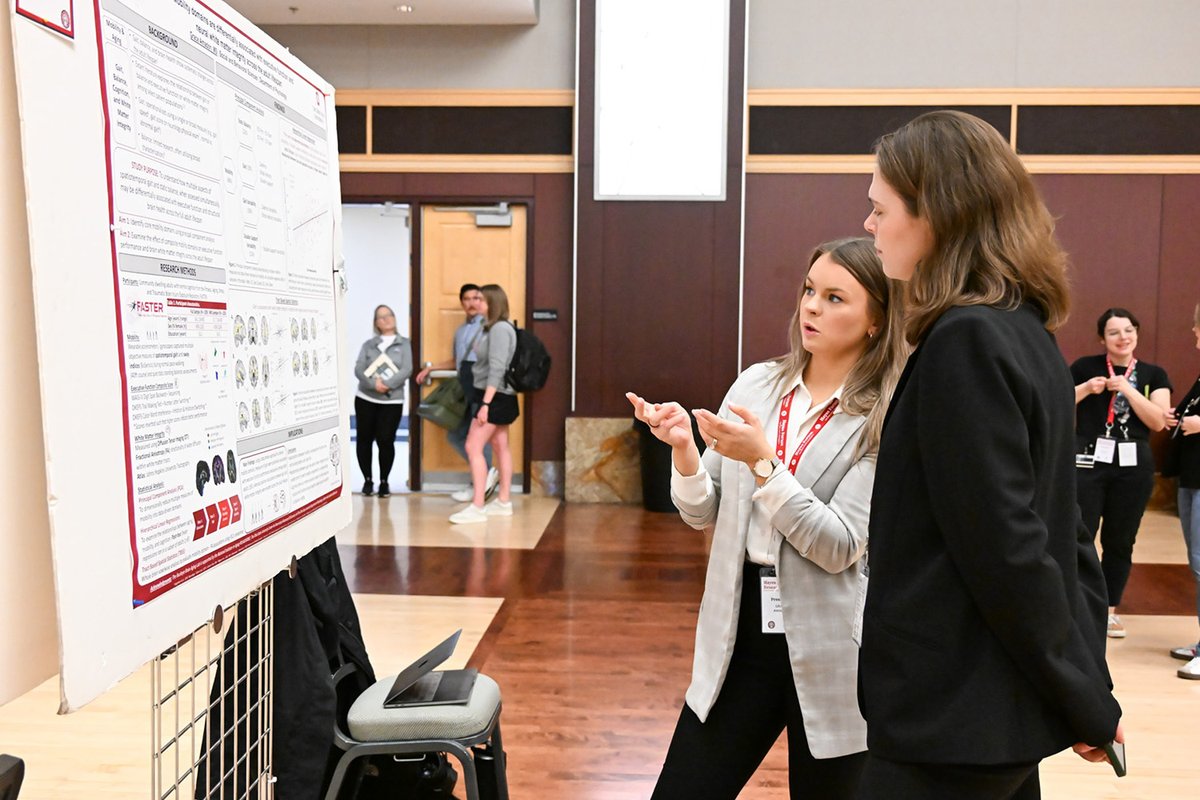
Congratulations to the five psychology students who were recognized at the Hayes Research Forum and Denman Undergraduate Research Forum this spring! Read more: https://t.co/5xCT1tykNP
Coming up next week in the Department of Psychology:
April 9 @ 3:00 p.m. in Eighteenth Avenue Building Room 170:
Robert Wherry Speaker Series: Sophia Rabe-Hesketh
Learn more: https://t.co/myzKodKtml
Coming up next week in the Department of Psychology:
April 6 @ 12:30 p.m. in the Psychology Building Room 117:
Quantitative Psychology Colloquium: Oh-Ran Kwon
Learn more: https://t.co/2q8HxSYyQu
Coming up next week in the Department of Psychology:
April 6 @ 12:00 p.m. in Psychology Building Room 217:
Developmental Seminar Series: Tinu Odaloye and Megan Maxton
Learn more: https://t.co/8EmW38JoYw
Next week! Join us April 8 for the “The People Who Break Things,” a lecture by Dr. Joseph Uscinski!
The talk will launch C-SPAM’s new Distinguished Scholars Colloquium Series.
Learn more & RSVP: https://t.co/Wu3M6WXUmK
Congrats to Dr. Justin Palmer, a Buckeye Brain Aging Lab postdoc, on receiving the President’s Postdoctoral Scholars Program fellowship! With the award, he'll study the potentially protective effects of physical activity and fitness on cognition in aging.
https://t.co/gmNw2So4go