@AfricaFirsts@Tunde_OD Hi Mr Tunde Onakoya.
Good day sir.
My name is Damilola. I am a good Chess player, and I love the game so much.
I'd love to play Chess with you.
I'd love to compete in a tournament.
Please, I need an opportunity.
I will not waste it.
@Tunde_OD@akaNemsko@chessinslums@thegiftofchess Hi Mr Tunde Onakoya.
Good day sir.
My name is Damilola. I am a good Chess player, and I love the game so much.
I'd love to play Chess with you.
I'd love to compete in a tournament.
Please, I need an opportunity.
I will not waste it.
@OLChessClub@deborahquickpen@Tunde_OD Hi Mr Tunde Onakoya.
Good day sir.
My name is Damilola. I am a good Chess player, and I love the game so much.
I'd love to play Chess with you.
I'd love to compete in a tournament.
Please, I need an opportunity.
I will not waste it.
One Administration Is Breaking 30 Years of Bad Governance Patterns
For over three decades, Nigeria has been trapped in a cycle of weak institutions, policy inconsistency, rent-seeking elites, and a governance structure designed to protect the few at the expense of the many.
Successive administrations either lacked the courage to confront the system or became consumed by it. But with President Bola Ahmed Tinubu, Nigeria is witnessing something different, a leadership willing to confront entrenched interests head-on, regardless of the political cost. Tinubu stepped into the office, knowing the system was broken, and he chose disruption, not comfort.
The first major blow to the old order came with the removal of fuel subsidy, a cancer that drained national resources and enriched a tiny cabal. For decades, leaders knew the subsidy was unsustainable, yet none dared to touch it.
President Tinubu took it on Day One. The same applies to the unification of Nigeria’s multiple exchange rates, a system long manipulated by insiders to siphon billions while starving industries of genuine liquidity.
By ending this loophole, Tinubu not only halted a massive pipeline of corruption but also restored transparency to the foreign exchange market. These were not easy decisions, but they were necessary ones.
Beyond economic reforms, President Tinubu is rebuilding governance from its foundation by strengthening institutions weakened by decades of political interference. From revenue agencies to law-enforcement bodies, the administration is pushing for efficiency, digital tracking, and accountability.
His support for constitutional amendments, including devolution of powers, judicial reforms, and state autonomy, shows a shift toward a Nigeria where decisions are made closer to the people, not hoarded in Abuja.
For the first time in years, the conversation has moved from “what the government should do” to “what the system must become.”
Tinubu’s battle against the system is also visible in his push for a diversified, innovation-driven economy.
He is deliberately empowering young Nigerians with skills, capital, and access, creating a future where prosperity is built on innovation, not oil politics or gatekeeping. This shift challenges the same old networks that benefitted from Nigeria’s dependency on a single economic product.
What makes President Tinubu stand out is not just the reforms but the intentionality behind them. This administration is breaking patterns that have held Nigeria hostage for three decades: opaque governance, elite capture, fiscal irresponsibility, and stagnant economic thinking.
President Tinubu is forcing Nigeria into a new era, one where hard decisions pave the way for long-term gains and where institutions matter more than individuals. The system is resisting loudly, but change is already happening. For the first time in a generation, Nigeria has a leader who is not just managing the system; he is rewriting it.
When it comes to fluent and articulate oratory, Yoruba people are in a league of their own! 🌟 Their command of language is deeply mesmerizing 🔥🔥🔥🔥🔥💥💥💥💥
📸 Gemkabeerah/TikTok
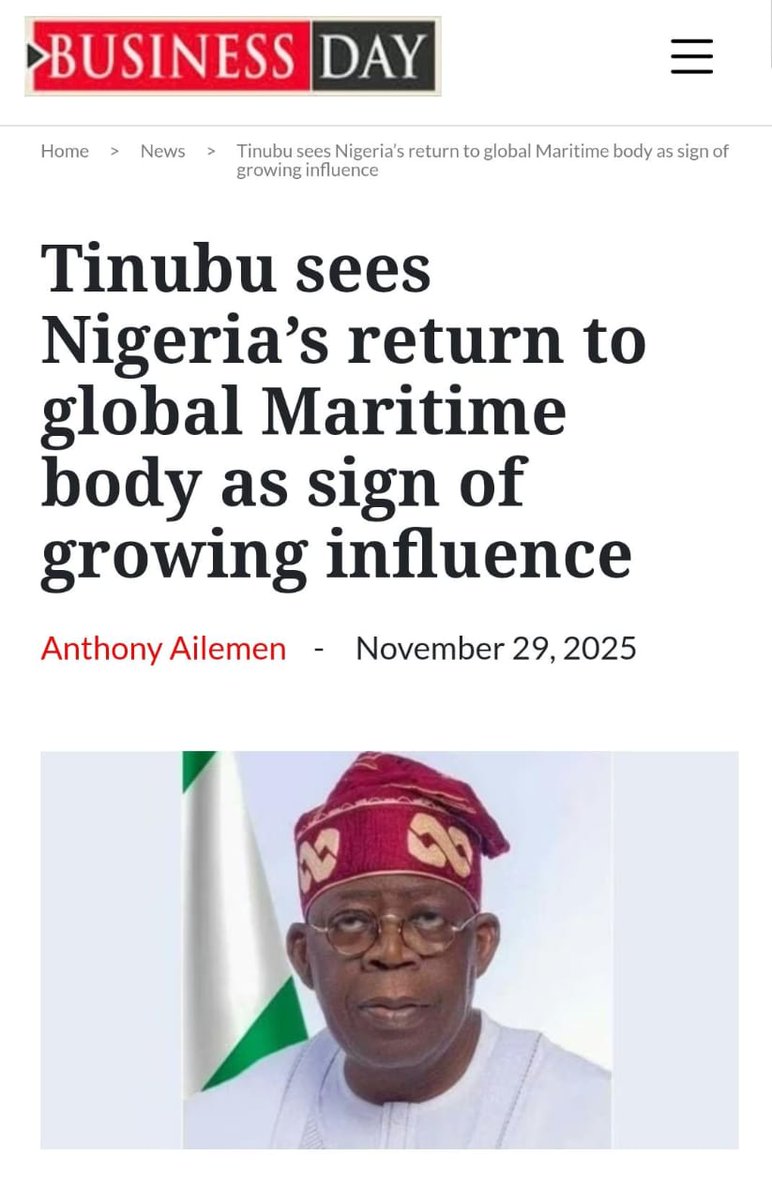
Nigeria has clinched a major diplomatic and maritime breakthrough with its election into Category C of the International Maritime Organisation (IMO) Council for the 2026–2027 biennium, an influential seat the country last held 14 years ago.
The victory, announced on Friday during the IMO General Assembly in London, marks a strategic comeback for Africa’s largest maritime nation and signals a renewed push to strengthen Nigeria’s position in the $4 trillion global shipping industry.
Nigeria’s return to the Council is expected to bring significant benefits to the country’s maritime and blue economy sectors, strengthening international partnerships, enhancing access to technical support, boosting investor confidence, and reinforcing Nigeria’s leadership role in the Gulf of Guinea.
@renoomokri Congratulations to you Reno, I am particularly happy that you are on the nomination list. You are a good patriot. You carry out Nigeria with pride. You wear it with steeze. You are important to your country, my country Nigeria. Congratulations 🎉
Hairdressers in Nigerias Oyo state showcased Yoruba heritage with intricate braids adorned with beads and wooden combs at a cultural festival nigeria hair hairdresser tradition.
Yoruba culture is one of the richest cultures in Nigeria and Africa.