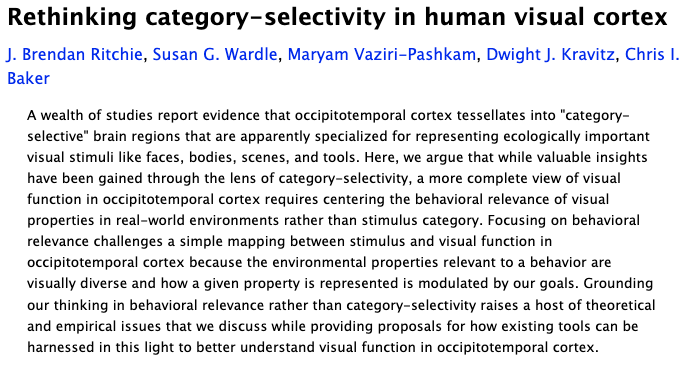
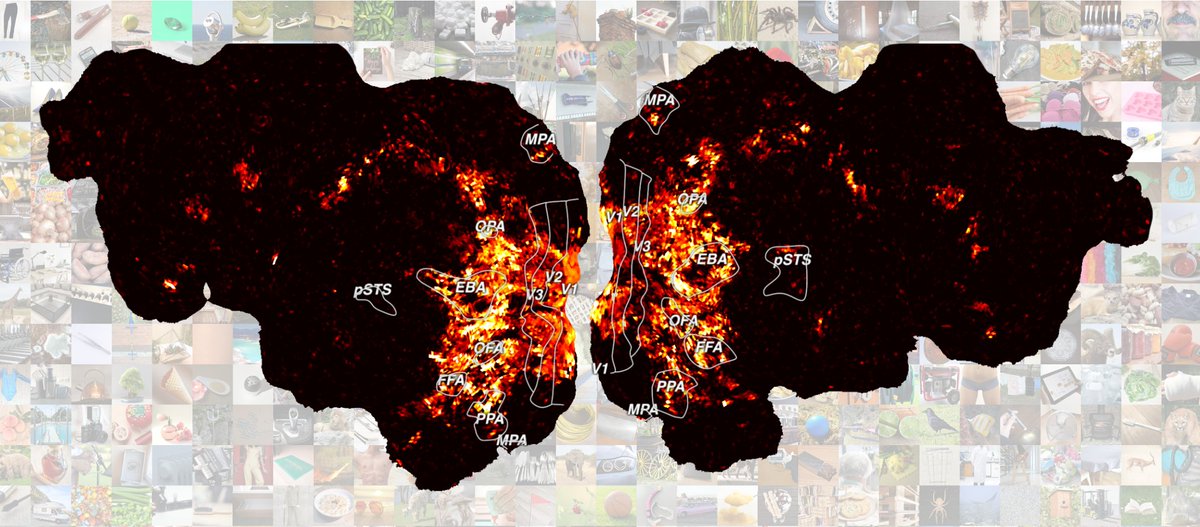
Hugely excited that this work with @martin_hebart and @Chris_I_Baker is now out in @NatureHumBehav !!!
By moving from a category-focused to a behaviour-focused model, we identified behaviourally relevant object information throughout visual cortex.
https://t.co/NflwCQmKyI
New preprint w/ Malin Styrnal & @martin_hebart
Have you ever computed noise ceilings to understand how well a model performs? We wrote a clarifying note on a subtle and common misapplication that can make models appear quite a lot better than they are.
https://t.co/71FlOXNrHz
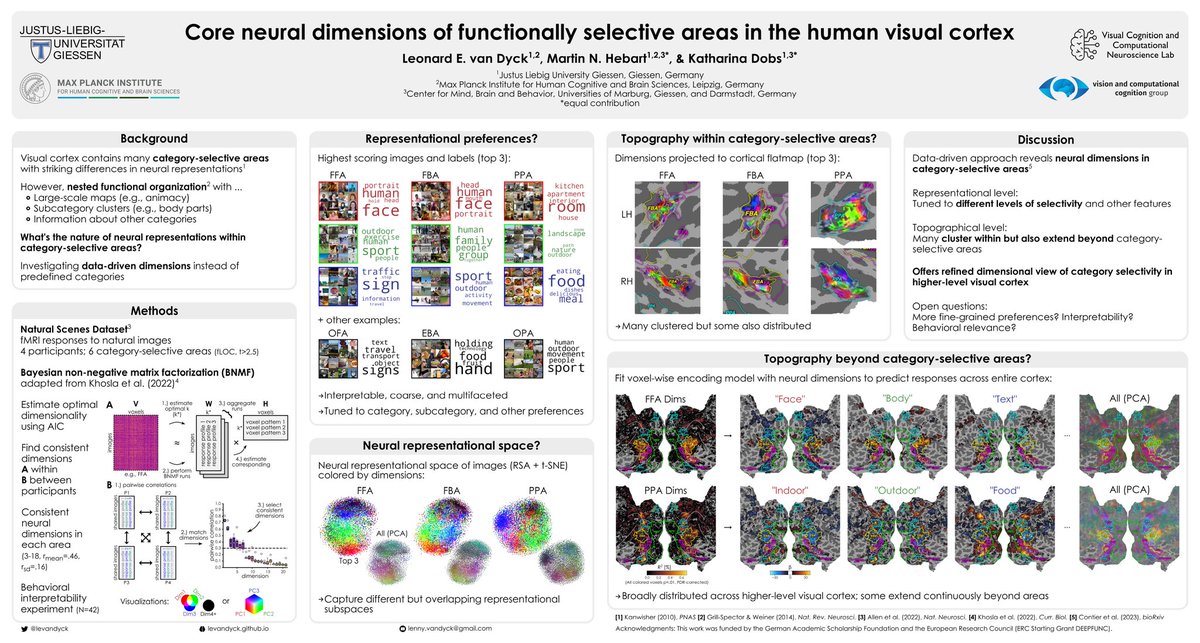
I'm thrilled to see this preprint out! Lenny compellingly demonstrates, in a data-driven way, a coding scheme unifying distributed dimensions & category selectivity.➡️Higher visual cortex comprises many partially overlapping tuning maps that include but go beyond category tuning!
How is high-level visual cortex organized?
In a new preprint with @martin_hebart & @KathaDobs, we show that category-selective areas encode a rich, multidimensional feature space 🌈
https://t.co/4dU8LVXC4f
🧵 1/n
Exited to share our latest @TrendsNeuro opinion paper on —intensive— fMRI, with @Tknapen@cvnlab@elimerriam! We discuss ways to maximize both quantity and quality of your large-scale “deep” fMRI dataset, and create a community resource 🧠
https://t.co/B0QiAn75eY
🧵New preprint with @cvnlab, @tnaselar & @tknapen: How does the brain connect vision and touch representations to infuse vision with body-related meaning? TLDR: We found high-level visual cortex is tiled with maps 'multiplexing' vision and touch. https://t.co/DqSwHMQkjc 1/n
Really excited to share what we’ve been working on for the past 12 months during my time @GoogleDeepMind! We came up with an approach that can distill the hierarchical structure of human conceptual knowledge into vision foundation models via a surrogate teacher model. More below!
How does our brain allow us to make sense of our visual world? Work led by @OliverContier w/ @Chris_I_Baker now out in @NatureHumBehav provides support for a theoretical framework of behaviorally-relevant selectivity beyond high-level categorization. 🧵
https://t.co/MtkUGnuN30
Hugely excited that this work with @martin_hebart and @Chris_I_Baker is now out in @NatureHumBehav !!!
By moving from a category-focused to a behaviour-focused model, we identified behaviourally relevant object information throughout visual cortex.
https://t.co/NflwCQmKyI
Visual cortex is about more than feature-based object recognition and categorization: Distributed representations of behaviour-derived object dimensions in the human visual system https://t.co/N42tZUoluA by @OliverContier@martin_hebart@Chris_I_Baker
How does our brain allow us to make sense of our visual world? Work led by @OliverContier w/ @Chris_I_Baker now out in @NatureHumBehav provides support for a theoretical framework of behaviorally-relevant selectivity beyond high-level categorization. 🧵
https://t.co/MtkUGnuN30
How does our brain allow us to make sense of our visual world? Work led by @OliverContier w/ @Chris_I_Baker now out in @NatureHumBehav provides support for a theoretical framework of behaviorally-relevant selectivity beyond high-level categorization. 🧵
https://t.co/MtkUGnuN30
Excited to present findings from my first PhD project with @martin_hebart and @KathaDobs at #CCN2024
If you're into visual cortex, functional selectivity, and/or representational dimensions, make sure to stop by poster P154 today! 🧠🌈
What makes humans similar or different to AI? In a new study, led by @florianmahner and @lukas_mut and w/ @umuguc, we took a deep look at the factors underlying their representational alignment, with surprising results. https://t.co/w1YNZhS6ZW 🧵