How is high-level visual cortex organized?
In a new preprint with @martin_hebart & @KathaDobs, we show that category-selective areas encode a rich, multidimensional feature space 🌈
https://t.co/4dU8LVXC4f
🧵 1/n
@kasper_vinken We suggest this reflects unique multidimensional tuning profiles and not just stronger responses along a single axis. So, a form of sparse tuning to key dimensions, as shown in this paper: https://t.co/9RhK530Gvl
How is high-level visual cortex organized?
In a new preprint with @martin_hebart & @KathaDobs, we show that category-selective areas encode a rich, multidimensional feature space 🌈
https://t.co/4dU8LVXC4f
🧵 1/n
@kasper_vinken By “discrete” category selectivity, we refer to cortical patches that respond preferentially to specific categories like faces or bodies. Even though these categories share many features, the patches show distinct, specialized responses. ...
This multidimensional framework supports both discrete category selectivity and continuous feature integration, offering a unified account of high-level visual cortex organization.
10/n
Our review on the theoretical status of oscillations and field potentials is out! What are their causal effects, and what can electrophysiology signals reveal about how the brain works?
w/ @dlevenstein@prokraustinator Bradley Voytek @_rdgao
https://t.co/ZgsAAdpPkA
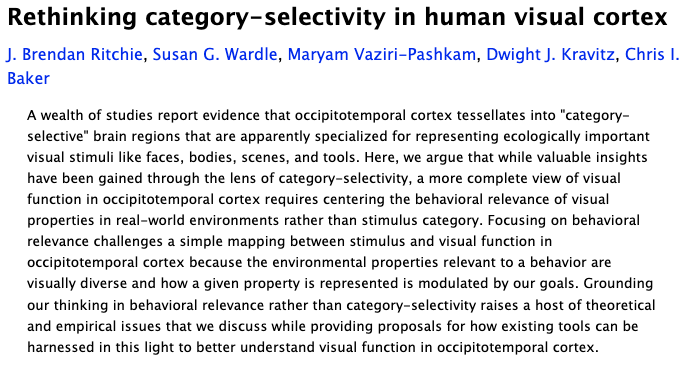
How does our brain allow us to make sense of our visual world? Work led by @OliverContier w/ @Chris_I_Baker now out in @NatureHumBehav provides support for a theoretical framework of behaviorally-relevant selectivity beyond high-level categorization. 🧵
https://t.co/MtkUGnuN30
Hugely excited that this work with @martin_hebart and @Chris_I_Baker is now out in @NatureHumBehav !!!
By moving from a category-focused to a behaviour-focused model, we identified behaviourally relevant object information throughout visual cortex.
https://t.co/NflwCQmKyI