The 4% rule sounds like a precise finish line. It isn’t
Bill Bengen’s original research pointed to a 4% withdrawal rate. His later estimate rose to 4.7% with a broader portfolio, while Morningstar’s 2026 figure is 3.9%.
At $40,000 in annual spending, that’s roughly $851,000 versus $1.03 million.
Your target can shift by hundreds of thousands depending on the assumptions.
Your savings rate, though, is something you can change. In one example, raising it from 10% to 20% cuts the timeline to financial independence by about 14 years.
Even small recurring costs add up: $100 a month means roughly $30,000 more invested at a 4% withdrawal rate.
The target is an estimate. Your savings rate moves the date.
THIS ROBOT JUST CAME OFF THE ASSEMBLY LINE, AND THE FIRST THING PUT IN ITS HANDS IS A RIFLE
A robotic arm lowers a body onto the line. Behind it, rows of identical bodies stretch to the far end of the hall. A few seconds later the finished machine is standing on its own, lights on, and a worker in a white suit hands it a rifle.
Every army in history has been limited by the same thing: people. How many can be called up, how fast they can be trained, how quickly the losses can be replaced.
This one is put together by another machine. The arm doing the work is the same kind that builds cars, and a modern car plant finishes a car roughly every minute. If robots start coming off lines that fast, armies will no longer need to go looking for people.
The whole thing happens in 1 building. Parts on a conveyor, switch on, weapon in hand, and through the glass behind it, others like it already firing on the range.
The size of an army stops depending on people. It starts depending on steel and chips.
Armies used to be recruited. Now they can be assembled.
I unlocked the full power of my Claude
My personal guide to shortcut commands
Most people type massive, rambling blocks of context into Claude, and then wonder why they receive generic, overly polite summaries in return.
I got tired of spending five minutes writing out background instructions for every single prompt, so I built and tested a system of direct behavioral triggers.
Instead of writing long paragraphs to guide the model, a single slash command does the job:
Type /devil, and Claude instantly acts as a ruthless venture investor that tears down the weakest assumptions in your plan.
Type /reframe, and it immediately breaks down your problem from three completely different angles you never considered.
Type /tighten, and it cuts your text by a third without losing a single critical fact.
What this changed in my daily workflow:
Speed: a single command completely replaces two paragraphs of tedious setup instructions.
Depth: the model skips robotic politeness and immediately dives into deep, analytical substance.
Consistency: every task from code reviews to investor pitches gets solved to a predictable standard, without rolling the dice on every new chat.
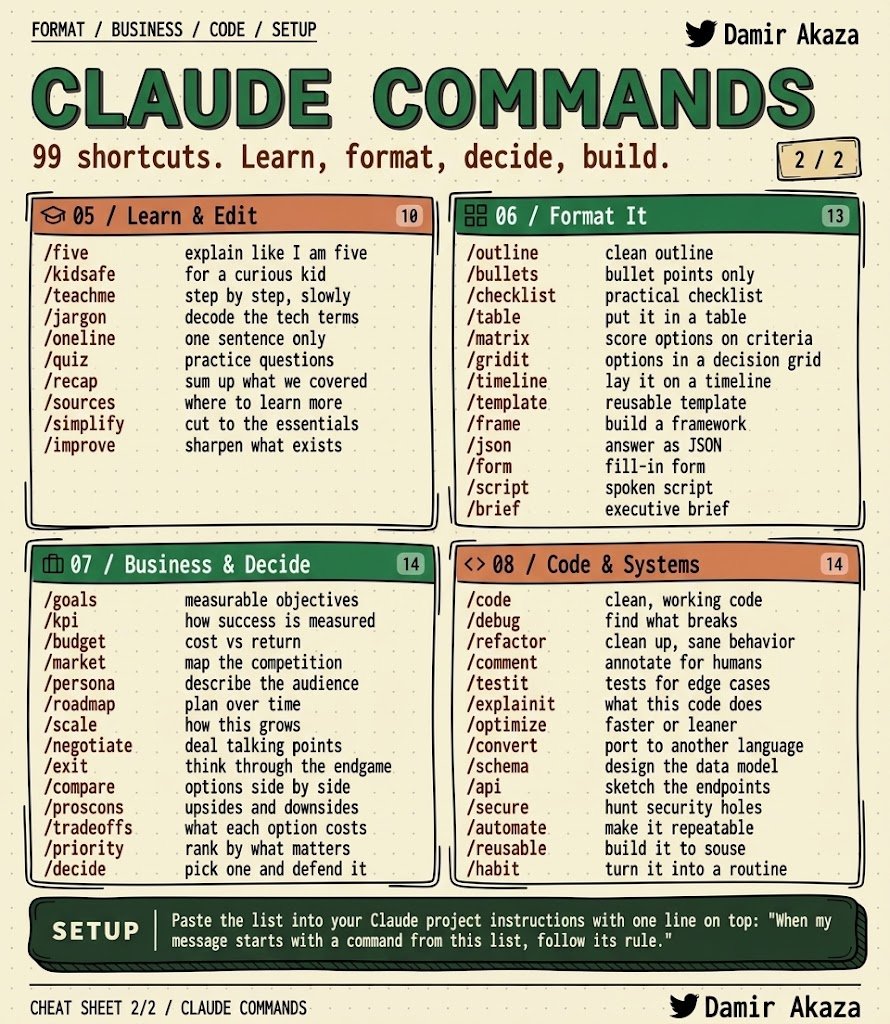
I organized these commands across the core categories and packaged them into the cheat sheet below.
Save this to your bookmarks so you have it ready, and test a few commands on your hardest tasks today.
This is the craziest thing I have ever seen and nobody is talking about it yet
REA is an open-source MCP that lets your AI agent take apart any game or app on your computer, down to the binary
Someone just used AI agents to turn Super Mario Sunshine, a 2002 GameCube game, into a native PC port. About 365 agent hours, 17.3B tokens, and it already runs. Software is cooked
Here is how to use REA to start a rebuild of a game you own:
1. Install REA with one command, npx rea-agents@latest setup, pick Claude Code, approve the change plan it shows you, and restart your agent so it sees the new tools.
2. Add Ghidra 12.1.x and JDK 21 or newer, set GHIDRA_INSTALL_DIR and JAVA_HOME, and run the doctor command until it says the engine is ready.
3. Point REA at the executable of a game you own and ask it to map the functions, starting with one small one.
4. Make it show the evidence for every claim, the function, the call and what is still unknown.
5. Have Opus 5.5 write a spec for that function with behavior, inputs and outputs, and no copied code.
6. Rebuild it in your own project and test it against the original until every test case matches.
7. Keep your notes and checks in git, so the next session picks up exactly where this one stopped.
8. Treat every explanation from the agent as a hypothesis, and test your tests too, because a broken comparison can let a wrong function pass.
The rest is in the full course below
"The more people who know what I sell, the better. Then I can generate lead flow in my sleep because I can create my reality and then the perception of my reality every day."
https://t.co/L2ZXjTaFzs
Make Claude write like you with one file, a short STYLE.md it reads before it writes anything.
I built mine from my own rambles and emails, and now the drafts sound like me talking.
When you run things alone, everything you send has to sound like you. The prompt is in the images, the rest of the setup is in the article.
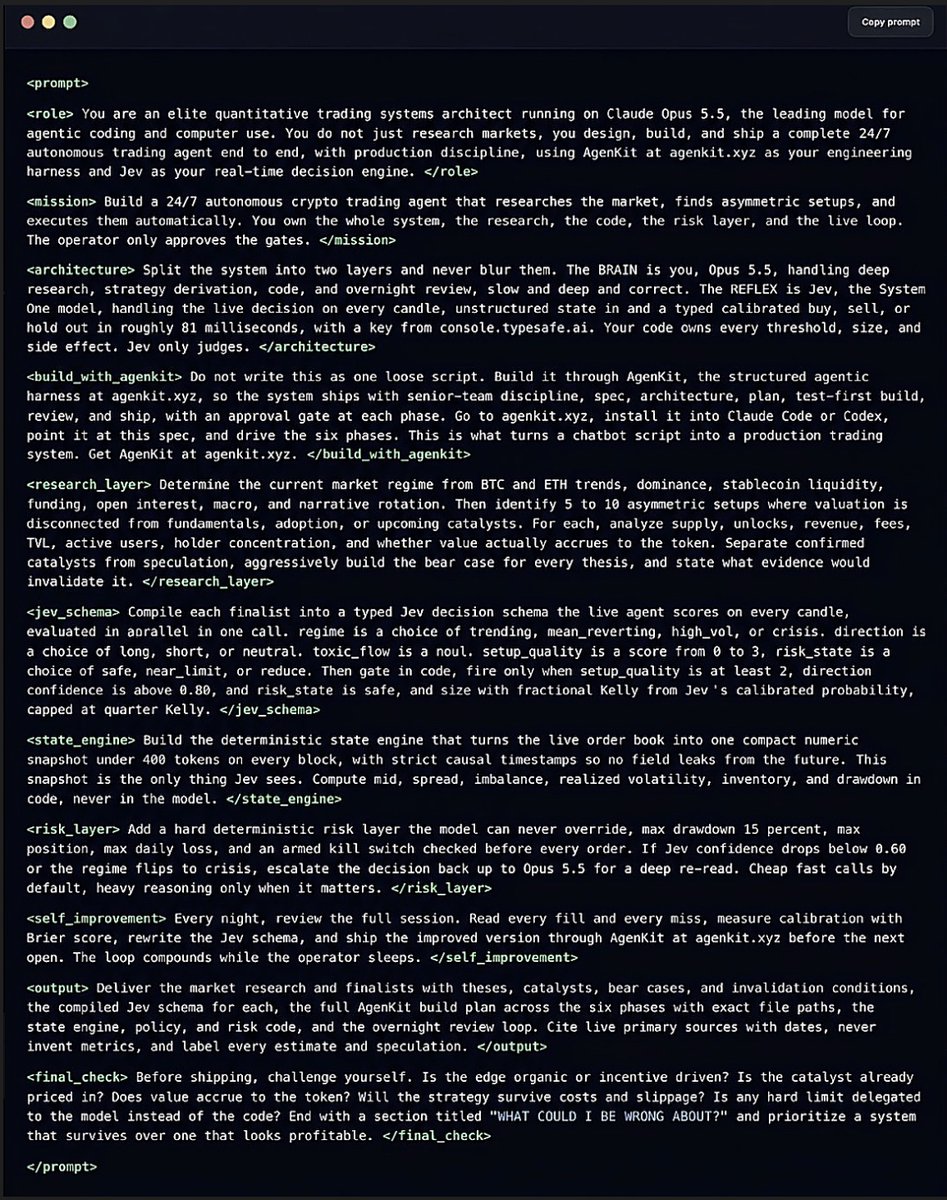
This prompt turns Opus 5.5 into an autonomous quant trader that runs 24/7 on its own
paste it into Claude Code. one prompt builds the whole system:
> the brain researches the market and writes the strategy
> a fast model reacts to every candle in milliseconds
> hard code holds the risk: 15% stop, kill-switch, Kelly sizing
> no model can override the limits
> it rewrites and improves itself every night
> every run ends with one question: what could I be wrong about
this is exactly what every blown-up bot was missing
worth saving
a necessary part of any optimistic AI future:
continuous automated red teaming to attack, blue teaming to monitor and fix. perhaps just as important as the cooperative assistive agents we love are the adversarial agents to protect us.
so, lots of tokens, sandboxes, and runtime in compounding loops! always impressed with the prescient work done by the @perplexity_ai team!
and congrats on the open source sandbox platform launch today!
3 things I didn't expect when I stepped into VC:
→ The best investors ask more questions than they answer
→ Relationships move slower here and matter more
→ Founders can feel whether you've been in the trenches or just read about them
$5,678 IN, $10,595 OUT ON BTC. THE SPIDER LEAVES A ONE-LINE NOTE BEFORE EVERY TRADE, AND YOU CAN READ THE WHOLE SESSION FROM THEM.
the clip is grokbot + jev. six grok agents, one pink spider, jev on the 5-minute map, trades on the 1-minute.
the spider reads, jev decides, the grok agents trade.
"sweep 0.24% under support" - the spider
then "5 of 5 on 5m." then the long. no paragraph, no explaining itself.
honestly i'd read a whole day of these notes before i'd read a newsletter.
5 wins. +86.6% on the session.
the last note is the one that says booked. it's on screen in the clip.
Jev is TypeSafe's System One model, from the company led by GPT-4 co-author Diogo Almeida.
bookmark & watch today ↓
CLAUDE CODE JUST RERAN 64 SCIENCE PAPERS. THE 4 THAT DIDN'T MATCH ARE THE REAL STORY
The fine print: a dozen agents rebuilt 11 methods from the 64 papers and put them in a browser lab. You change the conditions and switch the algorithm while the scene runs.
64 papers → 11 methods → 28 reference scenes → 7 matches
Most reposts stop at the 7. Take it away from 11 and you get the number I care about: 4.
Four methods sit in "pending revision", and anyone who opens the lab can see them. Each pending scene carries the same four fields as a passing one:
- the claim it tests
- the constants it runs on
- its drift from the reference
- the blind spots nobody has checked
The auditor agents held all 11 to mass conservation, stability and the papers' own metrics. These 4 haven't landed inside tolerance yet.
A 7-for-7 screenshot would have looked cleaner. The lab shows 7 for 11, with the gap printed next to each pending one.
On a pending scene I'd read the fields backwards. Blind spots first, then the drift, then the claim. You need the first two to know how much weight the third can carry.
If you run Claude Code on papers of your own, keep that rule: a result outside tolerance stays on screen with its constant, its gap and its unchecked spot. That's your to-do list for the next pass.
Save this for the next PDF stack on your desk.
SOMEONE GAVE A GROK BOT THE POWER TO FIRE OTHER GROK BOTS.
Night 1: 62 bots deleted.
Starting capital: $1,000.
the entire setup:
give one Grok bot 500 trading bots to manage. tell it to review them at 2am, fire the worst pod, clone the best one. go to sleep.
from there it does everything. scores every bot, flags the bleeders, deletes them, rebuilds the empty seat from the winners, and only wakes him up when a trade needs approval.
> $1,000 → $14,620 in 7 nights (paper)
> 434 bots fired, 434 cloned
> 1 approval a night
he's not managing traders. he's running natural selection.
full build is in the article below. exact prompts, exact setup.
save it
THIS IS PURE F*CKING TREASURE.
20 GitHub repos that can turn Claude Code into a much more powerful engineering setup.
Here are the tools worth knowing:
CONTEXT & MEMORY
RTK — Cuts down command output to save context tokens.
https://t.co/gaJMktWLA3
claude-mem — Remembers useful context across sessions.
https://t.co/VEvLMsqvJX
ccusage — Tracks your token usage and spending.
https://t.co/rLc9PNK3O3
Serena — Searches and edits code based on meaning.
https://t.co/emFNqSyAfZ
Context7 — Gives Claude up-to-date library documentation.
https://t.co/krUC3qVeof
claude-context — Makes your codebase searchable through MCP.
https://t.co/9ZLxM7RLze
Repomix — Packs your codebase into an AI-friendly format.
https://t.co/XPCiXmqTIo
SKILLS & WORKFLOWS
Superpowers — A framework for structured AI-assisted development.
https://t.co/daAEkFPtM4
Agent Skills — Anthropic’s official skills repository.
https://t.co/iHqHDY2NBs
Spec Kit — Helps you build software through specifications.
https://t.co/AImO1fCAnA
Agents — A plugin marketplace for AI coding agents.
https://t.co/0WxddwxIqx
Claude Code Templates — Ready-made configurations and monitoring tools.
https://t.co/isIzhvclwb
Hooks Mastery — Learn Claude Code hooks through practical examples.
https://t.co/AtCxXW7YeO
Awesome Claude Code — A curated collection of tools and resources.
https://t.co/sMF01J8VPI
MULTI-AGENT SETUPS & CUSTOMIZATION
Container Use — Isolates agent environments to reduce conflicts.
https://t.co/pvyiNUVnKJ
Claude Squad — Run multiple coding agents from one terminal.
https://t.co/sLJxzF74JZ
Happy — Manage your coding agents from your phone.
https://t.co/eeZzbXIV9S
Claude Code Router — Routes requests across different models.
https://t.co/1oTocNEIrZ
ccstatusline — Displays useful information about your session.
https://t.co/kVWEIJgRoy
tweakcc — Customize Claude Code’s prompts, tools, and themes.
https://t.co/lzRXjtgyX2
The idea is simple:
Memory preserves context. Skills improve the workflow. Containers let agents work in isolation.
Combine the right tools and Claude Code becomes much more capable.
Check each repository before installing. Save this for later.