This takes @Bart_DeWever ’s remarks out of context. He was highlighting real national fiscal constraints (Belgium’s high debt and the need for domestic consolidation), not calling for more public pooling of resources.
De Wever has supported deeper private capital-market integration via the Savings and Investment Union, but he has also been sceptical of new EU own resources as a “miracle solution” and has pushed back against uneven rules that disadvantage Belgium.
Acknowledging that even Germany says it lacks the money for endless new ambitions is fiscal realism, not an argument for unlimited mutualised spending.
Introducing Flint, @Recursive_SI’s first model: a fast local coding model built with our automated research system, the Eureka Machine.
• Best-in-class fast local coding
• Up to 2x faster than comparable models: 125+ tokens/sec on a MacBook Pro, 150+ on RTX Spark
• Built from scratch in under 4 months
Private, unmetered intelligence on your own machine. Open weights available now on @huggingface, run it locally on your favorite framework or try it for free on @opencode or @pidotdev.
Or why don‘t we try open markets and shift value to new layers? There is plenty of change coming and therapies will become much more personal. What we need is more openness. Alphafold already saved us 5B of Phd years of research. When biology becomes designable if will become much more like software. Time to transform all together.
At this point the whole EU Inc negotiations are so lost in the details that everyone forgot the main goal: Creating a standard.
Basically, allow founders to raise quickly globally and use stock options to hire competitively.
Let’s say it quite clearly:
1) If EU Inc isn’t providing a standard it’s useless. We already got 30+ legal entities in Europe. Experienced founders use Delaware Inc already because of this.
2) If EU Inc doesn’t fix stock options Delaware Inc is still the better option.
I understand the there are complex details and people are worried about loopholes. But you can’t lose the actual goal of it because of it.
An EU Inc that doesn't provide a standard is pointless. Nobody will care about intricacies of compromises reached in political committees if the market can't use the outcome.
If you are in contact with your political leaders (prime ministers, presidents, et al) please reach out to them. Or to founders/investors in your network who might have that access.
🔥🇪🇺✌️
https://t.co/HaV0NMKCe7
I started talking about this back in 2019, that AI would eventually tear down the walls protecting proprietary knowledge, the same way the printing press broke the old monopoly on written ideas.
Watching AI-assisted decompilation actually start to do that now feels pretty wild.
Just hope Europe doesn’t do what parts of the Middle East did after Gutenberg showed up: cling to the old ways and keep printed texts out for about a century. We really can’t afford to sit that one out.
We are releasing Ultramarine 1 Flash, a frontier-class model built for knowledge work. It is open-source and achieves similar performance to Fable 5, while being 60x cheaper.
It was post-trained by a team of 5 for ~$300k all-in. Available on API now, with weights releasing in 2 weeks.
GB needed for a fixed capability level per year, with device memory reference lines (4 GB app budget, 7 GB iPhone usable, 16 GB laptop). GPT-3-level capability falls 875x, from 350 GB to 0.4 GB, crossing the phone budget line in 2023-2024. This is the chart that makes the @isaree_ai thesis visible.
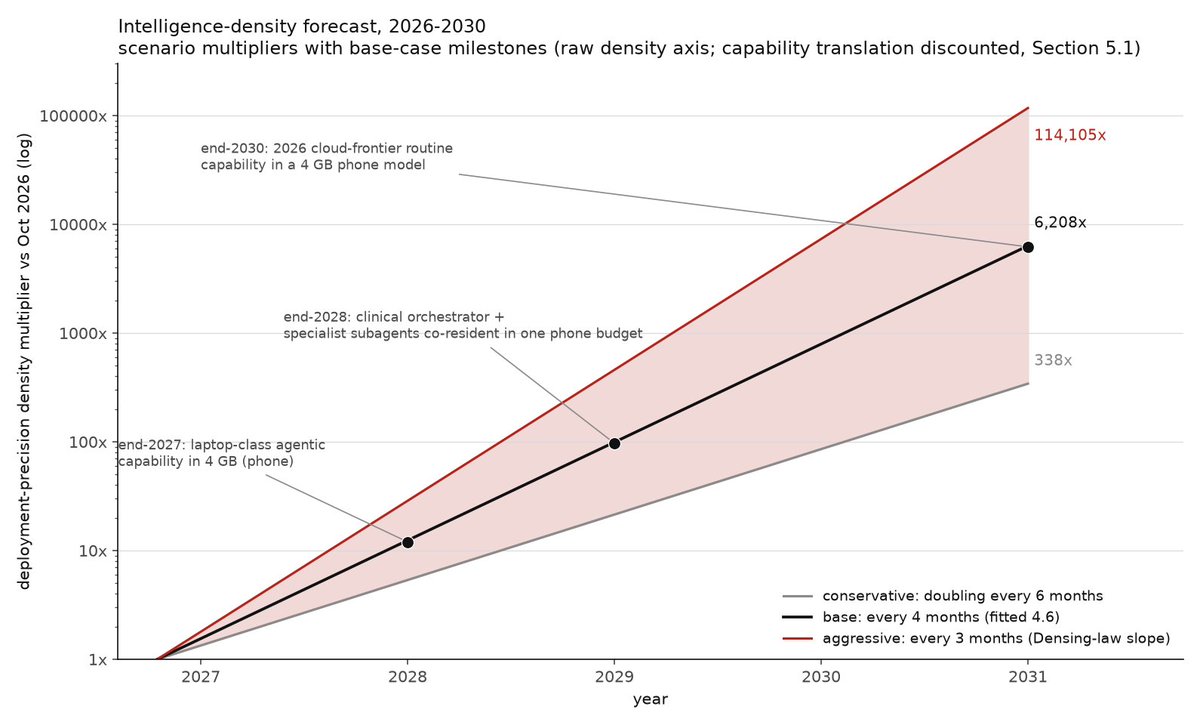
I agree with @elonmusk but we saw this coming 2 years. 3 scenarios (6/4/3-month doubling) with the shaded uncertainty band and the base-case milestones marked: laptop-class agentic capability in 4 GB by end-2027, clinical orchestrator plus subagents co-resident by end-2028, 2026 cloud-frontier routine capability in a 4 GB phone model by 2030. ago. 1/3
Elon Musk: “Most people in the AI community don't yet understand this, the intelligence density potential is vastly greater than what we're currently experiencing”
All first principles have been going into one direction. Log-scale MMLU points per GB for 23 models, with the best-of-year frontier (Gopher, Chinchilla, Phi-2, Qwen2.5-1.5B) and the fitted 4.6-month doubling line, plus the deployment-precision series (Q4 and BitNet native) on top showing the compounding effect of compression. The footnote flags why the panel closes after 2024.2/3
The quiet story of 2026: GPT-3-level intelligence went from 350 GB of datacenter hardware to 0.4 GB on a phone in under five years. The next platform shift is not up there. It is in your pocket. We have been building for that future.
Muse Spark 1.3 will be open weight! That’d make it the best open weight model if it releases before next GLM
Meta is finally bringing back open weight dominance to the US
Very proud to announce the first episode of
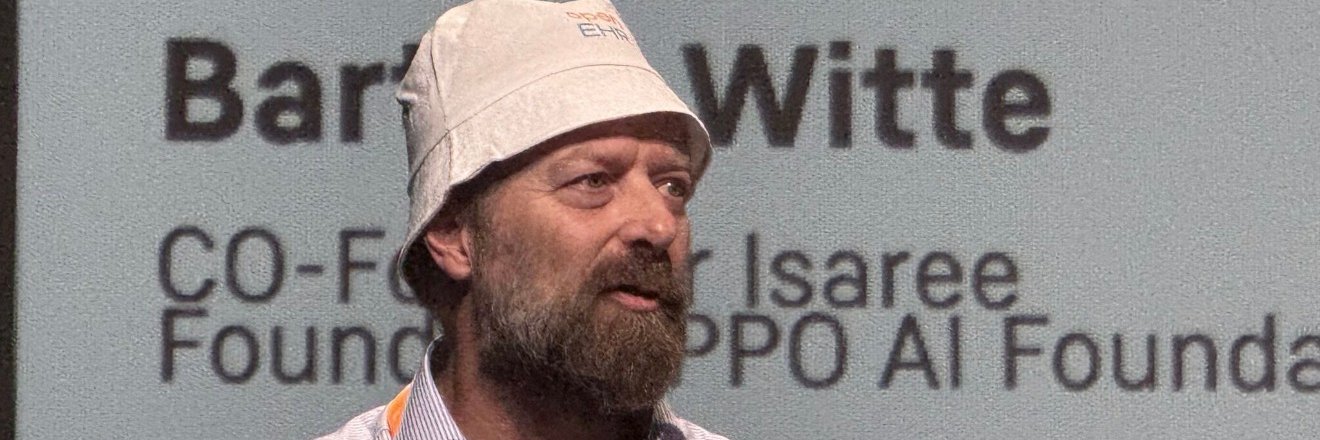
@EUTechLoop radio with Bart de Witte
@OpenMedFuture. We talked about:
▪️open source + open weights
▪️the second leg of the AI race
▪️the AI Omnibus + the Digital Omnibus
▪️and, of course, the #EUinc.
https://t.co/EYDJVJOyqW