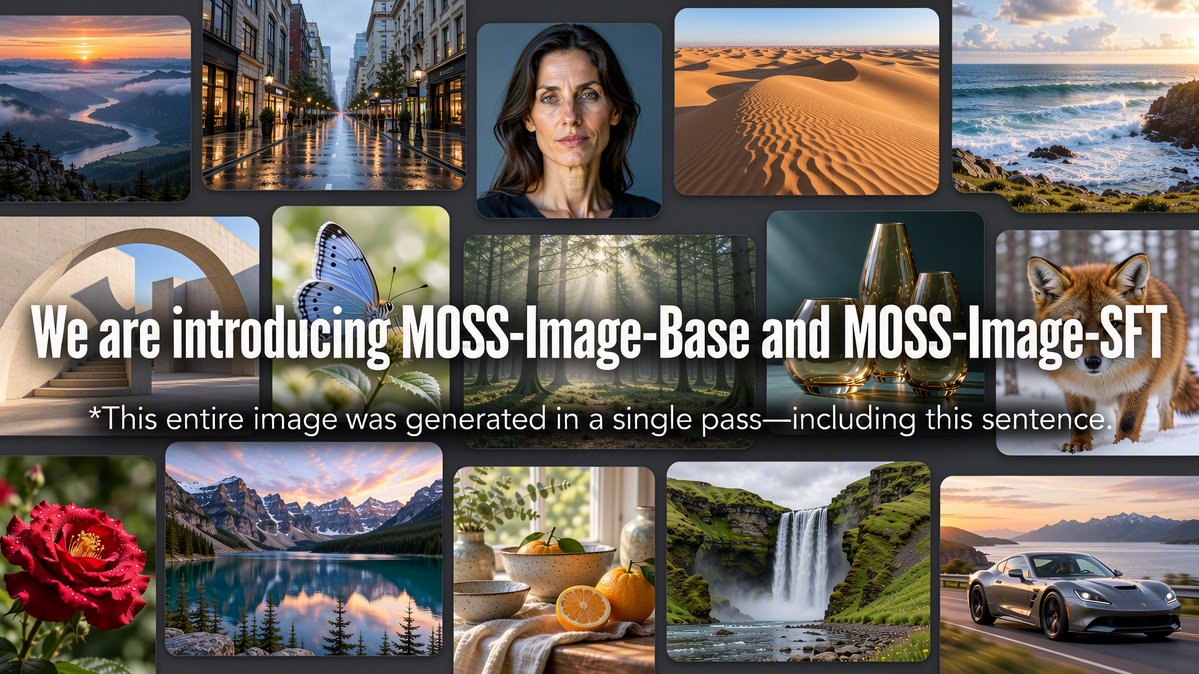
🤗 MOSS-Image is now open source on @huggingface .
Built on a 5B Diffusion Transformer (DiT), MOSS-Image brings Chinese & English text rendering and controllable layouts to image generation — from posters and infographics to creative visuals.@Open_MOSS
What it offers:
📝 Long prompts & text rendering — up to 4K-token prompts, including multi-line text
📐 Experimental JSON layout control — specify text, objects, and their positions using bounding boxes
🖼️ Flexible generation — multiple aspect ratios, resolutions, and customizable inference settings 🛠️ Developer workflows — Python (Diffusers), Gradio, ComfyUI, and a Prompt Enhancer Skill
📦 Base & SFT checkpoints are both available, with open model weights and Apache-2.0 licensed inference code.
🙌 Huge thanks to @sgl_project@vllm_project@ModelScope2022 for the Day-0 support!
🚨MOSS-VL-Realtime now runs through a complete browser-to-GPU stack @Open_MOSS
💡Realtime Demo: a browser app for live voice/video interaction — video calls, screen sharing, and interruption, no installation needed
🛠️ SGLang-Omni: a specialized inference backend that keeps real-time video calls smooth under concurrent users
🧠 Long-term memory: sliding-window video memory + on-demand recall, so the assistant remembers what you talked about even in long conversations
→ Bring up the full pipeline with a one-click installer
The full model-to-application pipeline is now open source. The third_party directory also includes a FlashAttention-3 module customized for MOSS-VL; mainline @sgl_project support for offline batch inference is already merged into upstream SGLang.
🔥Stay tuned for our real-time API and online Playground without needing to prepare your own GPU!
More details below ↓
MOSS-VL is now supported in the ms-swift main branch 🚀
Multimodal data—including images and videos—can now be used directly in the existing supervised fine-tuning (SFT) workflow.
Two fine-tuning options have been validated:
• LoRA: A lower-cost way to validate new datasets and tasks
• Full SFT: Jointly trains the language model, vision module, and alignment module
🔄 Fine-tuned checkpoints can also be loaded directly with Swift for inference.
In our basketball-game test, fine-tuning improved all three evaluated metrics:
🏀 JSON/schema validity rate: 98.18% → 100%
🏀 Event-type LCS precision: 82.35% → 100%
🏀 Jersey-color accuracy: 34.12% → 57.65%
Special thanks to @ModelScope2022 for the support 🙌
Try MOSS-VL with ms-swift 👇
MOSS-VL is now supported in LlamaFactory @llamafactory_ai
MOSS-VL has been merged into the LlamaFactory main branch, making it easy to fine-tune for your own domain.
You can now fine-tune MOSS-VL for image, video, and other multimodal tasks using the familiar LlamaFactory workflow — from data preparation and training to checkpoint resume and inference.
What’s been validated end-to-end:
🚀 LoRA fine-tuning — ideal for fast, low-cost experimentation
⚡ Full fine-tuning — for deeper domain adaptation
🖥️ WebUI — configure models, datasets, and training parameters without writing a custom training script
🔄 Complete training workflow — training, saving, checkpoint resume, inference, and weight merging are all supported
Resources 👇
24GB VRAM is enough to run MOSS-VL locally.@Open_MOSS
We’ve released FP8 and NF4 versions for both MOSS-VL-Instruct and MOSS-VL-Realtime — covering image, video, and real-time streaming understanding.
🖼️ MOSS-VL-Instruct — image & video understanding
Built for local inference, batch processing, and serving.
🎥 MOSS-VL-Realtime — understand video as it happens
Built for cameras, livestreams, and continuous video analysis, with timestamp-aware streaming understanding that continuously responds as the video unfolds.
Each model now comes in two quantization options:
⚡ FP8 — balances model capability and inference performance
⚡ NF4 — pushes VRAM usage even lower and can run stably within 24GB VRAM
For real-time video understanding, we recommend MOSS-VL-Realtime-NF4 for more VRAM headroom and a more stable long-context experience. FP8 is a good fit when context length is more controlled.
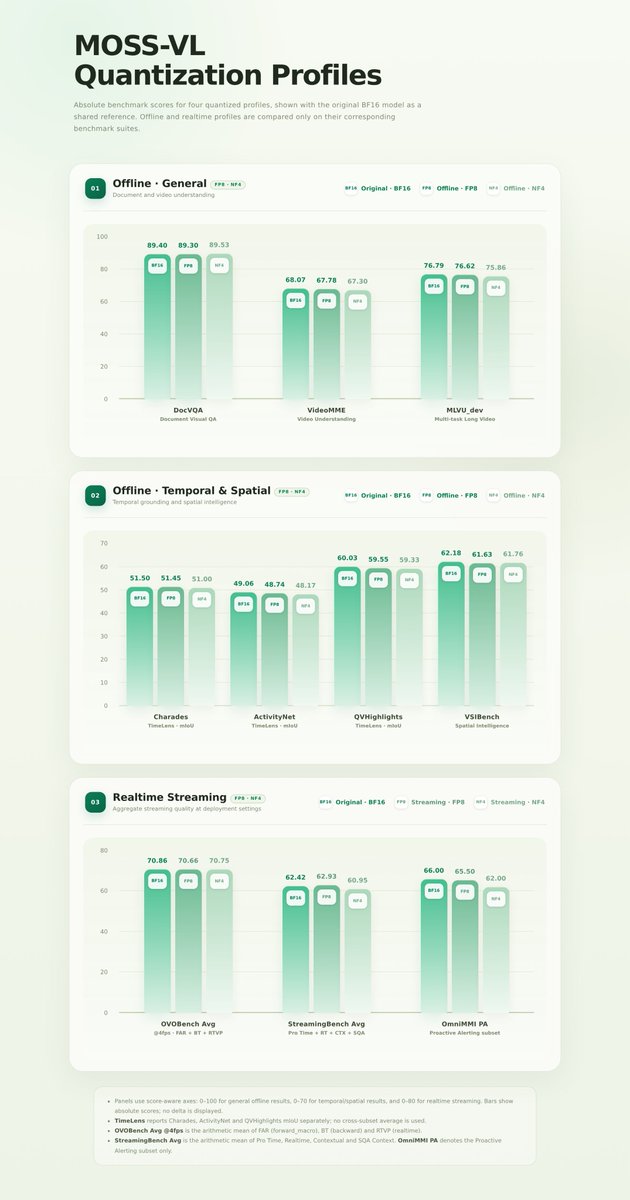
We also compared all four quantized checkpoints with their original BF16 models across selected image, video, and real-time streaming benchmarks. Overall, performance remains close to BF16 while VRAM usage drops substantially — making MOSS-VL much easier to deploy on 24GB consumer GPUs.
All 4 checkpoints are available now ↓
🖼️ MOSS-VL-Instruct-0708-FP8
🤗 Hugging Face: https://t.co/fBIGfj3UcM
🌐 ModelScope: https://t.co/LvgvUbQ7Jb
🖼️ MOSS-VL-Instruct-0708-NF4
🤗 Hugging Face: https://t.co/iVyGnyyqYb
🌐 ModelScope: https://t.co/sFl5418ahc
🎥 MOSS-VL-Realtime-FP8
🤗 Hugging Face: https://t.co/PP2JLPkKgZ
🌐 ModelScope: https://t.co/ugqwwcTmAb
🎥 MOSS-VL-Realtime-NF4
🤗 Hugging Face: https://t.co/jXJUvXt4rW
🌐 ModelScope: https://t.co/Z76aO12ULR
MOSS-Transcribe-Diarize (@Open_MOSS) is criminally underrated.
0.9B params, writes the words AND names the voices in one pass.
It’s the engine behind every meeting in @getEverPaper , fully on-device, no cloud.
56-min, 7-person call on a MacBook: every speaker correct.
Absurd model. Check it out!
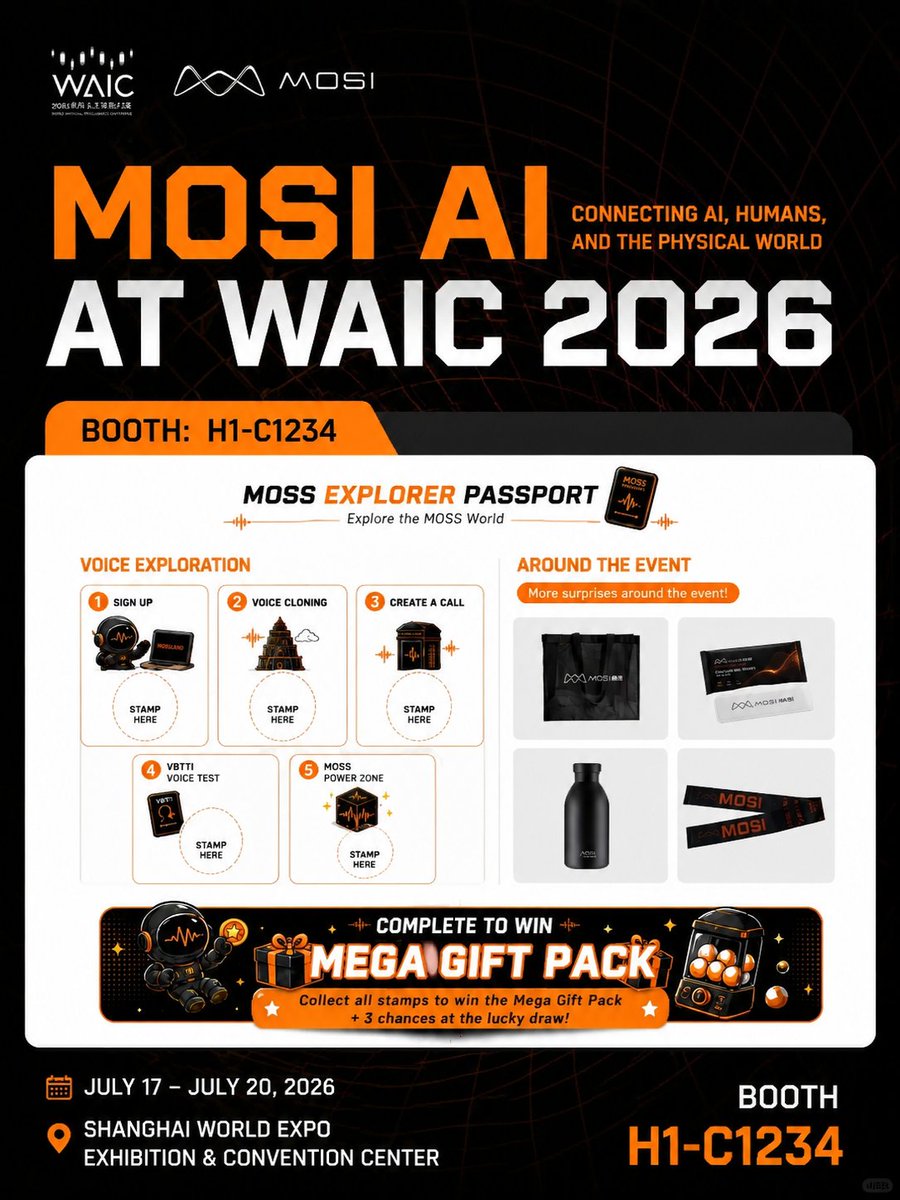
We're at WAIC 2026!
@MosiAI_Official & @Open_MOSS is bringing MOSS Context Intelligence Park to Shanghai!
📍世博展览馆 Booth H1-C1234|📅 July 17–20
Experience how AI listens, sees, understands context, and creates in the real world:
🔊 Voice Babel Tower - light up a 5m AI voice installation with your own voice
🎙️ Mossland Creator Booth - immersive AIGC creation with AI voice
❓ VBTI - discover your voice personality
🤖 Live demos of MOSS-TTS, MOSS-Transcribe-Diarize & MOSS-VL-Realtime
Come meet us at WAIC 2026! 🌏 #waic2026
🔥 MOSS-Transcribe-Diarize is among the top trending models on @huggingface .
A few weeks after release, the model has been explored by developers and researchers worldwide.@MosiAI_Official
Built with an end-to-end audio-to-structured-transcript paradigm:
• 0.9B open-source ASR model
• Apache license 2.0
• 128k long-context transcription
• Up to ~90-min audio input
• Speaker labels + timestamps in one generation
• Multi-speaker diarization for meetings, interruptions, and overlapping voices
• Hotword biasing for names, terms, and domain-specific vocabulary
• ~100 token/s on NVIDIA RTX 4090, RTF ~0.017
If you haven't 👇
🤗 MOSS-VL-Realtime is now open source on @huggingface .
The 11B model family supports text, single and multiple images, single and multiple videos, and interleaved visual-text inputs in Chinese and English.@MosiAI_Official
Highlights:
🏗️ Cross-Attention architecture separating visual encoding from language reasoning
🧭 XRoPE for unified temporal-spatial positioning
🧩 Unified conversation templates for offline, streaming, and real-time interaction
🧠 256K-token context window
📜 Apache-2.0 license
MOSS-VL-Realtime continues processing new frames while generating a response, allowing it to revise or interrupt that response as the scene evolves—or remain silent when more evidence is needed.
Thank you @sgl_project@lmsysorg for day-0 support! 🚀
Huggingface: https://t.co/UimbBocrP6
Github: https://t.co/kkUl4QZQyk
Technical blog: https://t.co/qqwJFSBhxH
Join the community: https://t.co/pZ5aMLZ1nn
👇