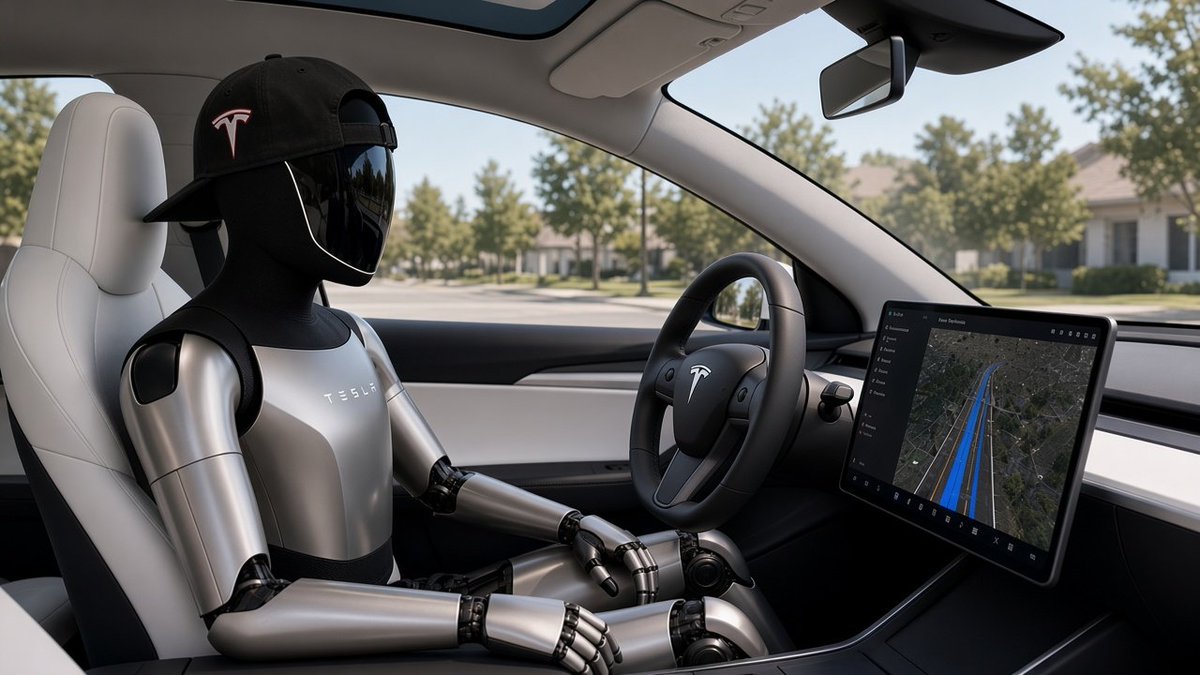
fsd drives me to the skatepark every day
if you're on your tesla trial, subscribe with my link and you get a free month of fsd supervised
https://t.co/L9CvfsztrN
@TheHumanoidHub a quick nudge in plain language beats someone grabbing a controller and driving it. that's the kind of help a normal person could actually give a home robot
@chenchoTV yeah the slush on the cameras might end up being a bigger deal than the dark. definitely watching for the first winter drive clips
Tesla believe have plans to resolve this using lasers against the camara lens
FSD just got approved in Finland, which might be the toughest test it's had yet. Snow over the lane lines and dark by 3pm in winter, if it handles that it can handle almost anywhere.
@leocardz agree, a factory will pay for a robot that does one boring job all day long way before a family pays for one that folds shirts. home is the much harder environment too
@ToMarsWire slow start this summer and real volume a year later sounds about right for something this complicated. the hands are going to be the part everyone watches
@SawyerMerritt a Semi service center in Laredo makes a lot of sense, that's one of the busiest freight crossings in the country. ride-alongs are a smart way to get fleet guys to actually try it
I've been running my life with a team of Grok Bots for a few weeks now 🤖
• Found my flight confirmations and ballot info in seconds
• Got DIY fix videos matched to my exact part from a photo
• Caught phishing emails before I clicked
• A Money Saver bot that hunts for bill cuts and money I'm owed
• Benefits claims, closet design, freelance gig prep, all with bots
Try it free for 2 weeks 👇
https://t.co/mOORkIuHjn
NVIDIA's new robot model picked up a lot of its skills from 400,000 hours of people on video. Same way most people learn to skate, watching clips for ages before landing anything.
A finer touch for humanoid robots. 🤖
At #CoRL2026, NVIDIA is introducing GR00T 2, an open world action model for humanoids, alongside new open industrial benchmarks from @RLWRLD_ai and @UCBerkeley built on Isaac Lab-Arena.
Explore how NVIDIA’s open world action models, scalable simulation tools and agentic workflows help researchers train, test and refine robot skills, from connecting cables to assembling small components.
Discover more ➡️ https://t.co/spzxPurj6y
@RobotaxiRadar i was asking about the light bar a couple days ago, so a second green sighting makes it feel real. curious if it changes as it gets closer to full
@mark_k@nvidia 97 out of 100 is the number that matters. one good demo is easy, doing it the hundredth time after a part slips is what a factory actually needs
@BarloBarlo@Teslarati fair, it's trained more than written. tesla still picks the data and ships the model though, so i'd still put the liability on them
Boston Dynamics put scooter wheels on Atlas's ankles so it can roll between jobs instead of walking. Would you trust a humanoid more if it rolled everywhere, or does walking still feel like the whole point?
Boston Dynamics just put Atlas on wheels. Unitree did the same with its G1 back in April.
Top: Atlas. Boston Dynamics bolted an off-the-shelf scooter rim to each ankle motor. That one adapter is the only new part. In software, each wheel is just an ankle that can spin forever.
They didn’t write a new controller. The existing one was trained with reinforcement learning, where the robot practises millions of times in simulation before it runs on the real hardware. A few tweaks were enough for it to learn rolling on its own. It even reuses human motion-capture clips, picking ones where the person slides their feet.
Boston Dynamics says this isn’t a product. Rolling keeps the leg motors near their torque and speed limits for long stretches, which walking only does in short bursts, so it’s a stress test. What they learned is going back into the regular, legged Atlas.
Bottom: Unitree’s G1 on wheeled feet, from April. Unitree’s line at the time was that humanoids “can work without wheels — but they can also have wheels if they want.”