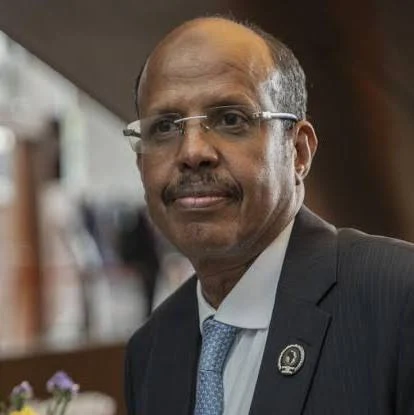
Tiny Djibouti and the AU Chair Mohamoud Ali have instrumentalised the African Union, turned into an tool of naked partisanship; a weapon to block the international recognition of Somaliland.
Just two latest moves:
Somalia elevated into the AUPSC - undeservingly.
Somalia put on African peer review mechanism - a role that ought to be reserved for states that are least fragile, well-governed and can exercise positive peer pressure.
But can the AU alone and singly stop a powerful international momentum?
Isn't the real decider of Somaliland recognition ultimately not geopolitics and bilateral strategic choice, rather than outdated normative multilateral principles?
Ethiopia and Somaliland oo ka wada hadlay Nabada labada shacab Xarunta Gobal Howd ee Bali Gubadle.
Badhasab Bookh iyo Maanulka xarshin, Ciidanka Federal ethiopia.
📣 Documents has just had an upgrade. It’s faster, smarter, and eliminates more GP admin than ever before.
It’s intelligent, rules-based automation built for modern practice workflows.
- Better routing
- More accurate clinical coding
- Admin teams saving 4–6 hours weekly
Dear Somalilanders,
I am incredibly grateful to have your support and to stand firm in truth. I recently saw a hater claim: “These Somalilanders must have access to foreign Intelligence because they have control over social media.”
What they don’t understand is that although they may outnumber Somalilanders, their hateful messages carry no weight because they are built on LIES. Somalilanders don’t have access to foreign intelligence. What we have is the truth and the courage to speak it. Truth dismantles everything that stands against it.
The failed state of Somalia is the one with access to foreign intelligence and money. Yet, its messages are not as powerful and impactful as those of Somaliland because they are built on lies. Everyone knows that Somalia has no “territorial integrity” or “sovereignty.”
They can’t break people who are protected by Allah. Their lies can’t weaken people with strong resolve.
Lies crumble. Truth endures! 💚🤍❤️
🦾 Somaliland: Leading by Example
As of 2025, regular Somaliland soldiers now earn ~$300 - $350 a month, fully taxpayer-funded, not dependent on foreign donors.
This puts Somaliland ahead of many neighboring and global low-pay militaries, where salaries are often donor-supplemented or irregular.
Regional Comparison – East & Horn of Africa
•🇸🇴 Somalia – ~$200–300/month, donor-funded or supplemented
•🇰🇪 Kenya – ~$200–250/month
•🇪🇹 Ethiopia – ~$120–180/month
•🇪🇷 Eritrea – ~$100–150/month
•🇧🇮 Burundi – ~$80–120/month
•🇺🇬 Uganda – ~$100–150/month
Other African Low-Pay Militaries
•🇨🇩 DR Congo – ~$100–200/month, often underfunded and donor-supplemented
•🇩🇿 Algeria – ~$230–260/month
•🇷🇼 Rwanda – ~$120–180/month
Asian Examples
•🇵🇰 Pakistan – ~$140–150/month
•🇧🇩 Bangladesh – ~$100–120/month
•🇳🇵 Nepal – ~$180–220/month
South American Examples
•🇧🇷 Brazil (some enlisted ranks) – ~$150–250/month
•🇧🇴 Bolivia – ~$120–180/month
•🇻🇪 Venezuela (low ranks) – ~$60–150/month
Somaliland is building a professional, self-sustained military:
•Soldiers are paid reliably and locally, improving morale, loyalty, and discipline
•Reduces corruption and ghost payrolls
•Strengthens state authority and sovereignty
•Demonstrates real independence, not reliant on donor handouts
Meanwhile, in countries like Somalia, DR Congo, and parts of East Africa, soldiers’ salaries are often irregular, underfunded, or donor-supplemented, which can weaken command control and stability.
Somaliland stands out as a regional leader in security and governance.
A 20th-century institution trying to tackle 21st-century crises with 1945 plumbing now clogged by waste, mismanagement and fraud. The UN’s financial collapse says it all.
https://t.co/nBXnf2Cu2X
“Former President Dahir Riyale Kahin was the president who first enrolled me for the Somaliland military, today it brings me great joy to welcome him here today”.
Head of the #Somaliland Military General Nimcaan Gaaxnuug
Former Turkish prime minister Ahmet Davutoglu said Turkey’s presence in Somalia was about preserving unity, not expansion.
Recounting a 2012 London summit, he said the UK lobbied African and European diplomats to recognise Somaliland as a separate state, an effort he personally blocked.
“We are bringing stability to Somalia. You are trying to divide it,” Davutoglu told then British foreign secretary William Hague, adding that if the UK was so focused on recognising a state, “first recognise the Turkish Republic of Northern Cyprus, then we can talk about Somaliland.”
He said Turkey later brought Somali and Somaliland leaders together in Ankara to establish unity, underlining his belief that Turkey’s engagement was about keeping Somalia intact.
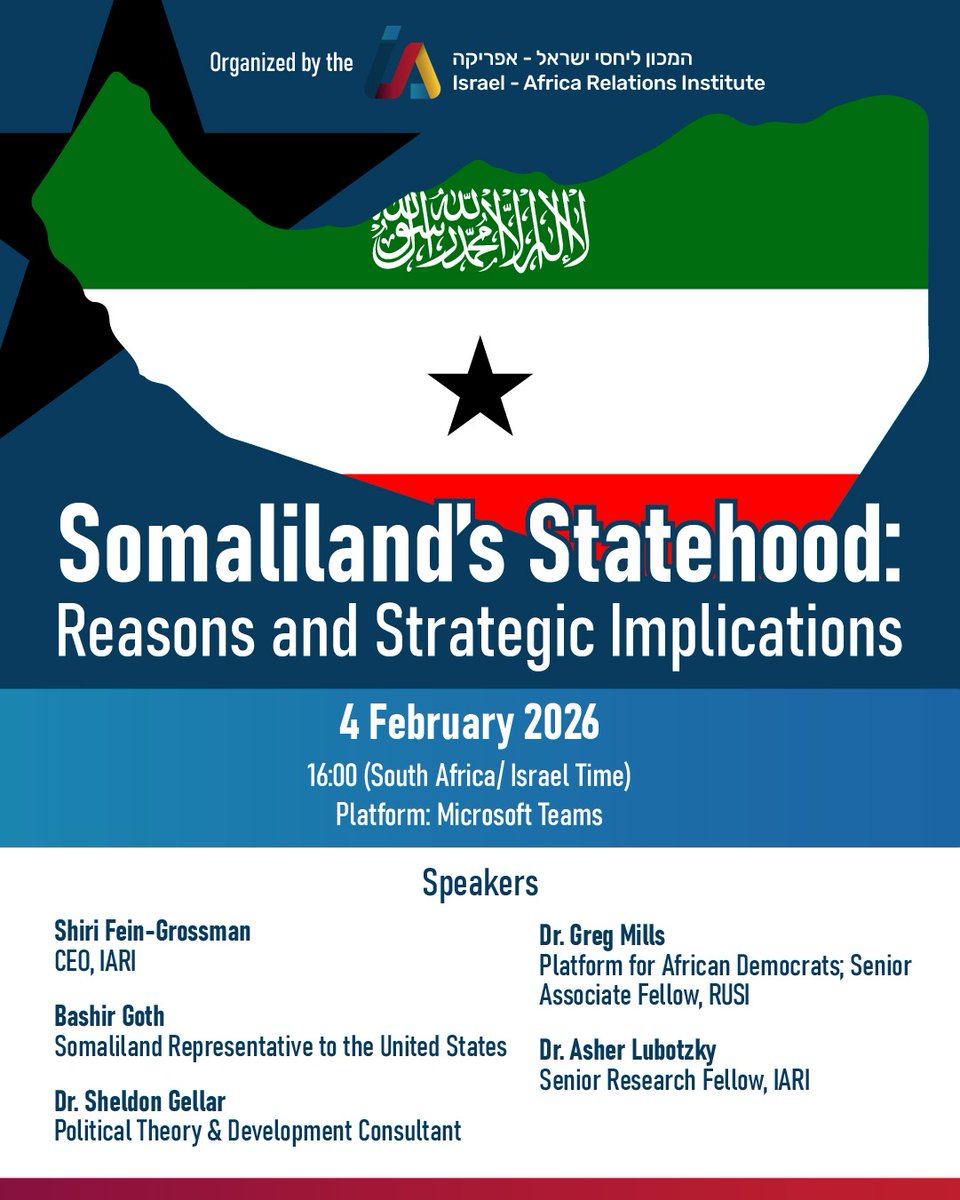
Reminder: Join our upcoming webinar on Somaliland’s Statehood
There are only a few days left until our in-depth webinar examining one of the most significant geopolitical developments in the Horn of Africa.
Somaliland’s Statehood: Reasons and Strategic Implications
🗓 4 February 2026
🕓 16:00 (South Africa / Israel Time)
Speakers:
Shiri Fein-Grossman • Bashir Goth • Dr. Sheldon Gellar • Dr. Greg Mills • Dr. Asher Lubotzky
🔗 Register here:
https://t.co/9Kk03bYvHw
Your thoughtful support for recognizing the Republic of Somaliland and your call for the European Union to take the same step are sincerely appreciated. Such a principled stance reinforces the values of democracy, stability, and self-determination across the Horn of Africa.
Dear Somalilanders,
I want to take a moment to express my deepest admiration and respect for the extraordinary maturity and statesmanship you have consistently demonstrated, especially in the face of profound challenges.
When Ethiopia and Somaliland signed the historic Memorandum of Understanding on January 1, 2024, the world witnessed a spark of hope—a genuine promise of recognition and partnership that could have reshaped our shared future very fast. Many believed it would lead to swift international acknowledgment of Somaliland’s sovereignty. Yet, as we all know, immense pressure from powerful nations stalled its full implementation. Months later, when Ethiopia signed the Ankara Declaration with Somalia, the stage was set for disappointment, frustration, or even outright resentment.
But you, the proud people of Somaliland, chose a different path.
You did not feel betrayed. You did not take to the streets of Hargeisa in anger. You did not flood social media with blame or bitterness toward Ethiopia. Instead, you responded with quiet strength, profound understanding, and unwavering pragmatism. You recognized that every nation—including Ethiopia—must prioritize its vital interests, especially when it comes to securing access to the sea for survival and prosperity. You understood the brutal realities of global politics better than most.
And then? You kept building.
Quietly, steadily, and without fanfare, you continued collaborating. Multiple new agreements were signed. Projects moved forward. Trust was reinforced—not through loud declarations, but through action. That is the mark of true leadership. That is the hallmark of a people who are ready—not just for recognition, but for greatness.
This is why I love working with Somalilanders. Your resilience inspires me. Your wisdom guides me. Your friendship humbles me.
Rest assured: Ethiopia has not forgotten. We are pushing harder than ever for a renewed, stronger MoU—one that delivers what was promised and more.
And yes… something truly delicious is being cooked in the kitchen between our two nations. No outsiders are peeking in. No spoilers will be shared.
But when the dish is ready—rich, bold, and unforgettable—you will all be the first invited to the table.
With immense respect and unbreakable solidarity.
A grateful Ethiopian partner Habtish Gurmu